
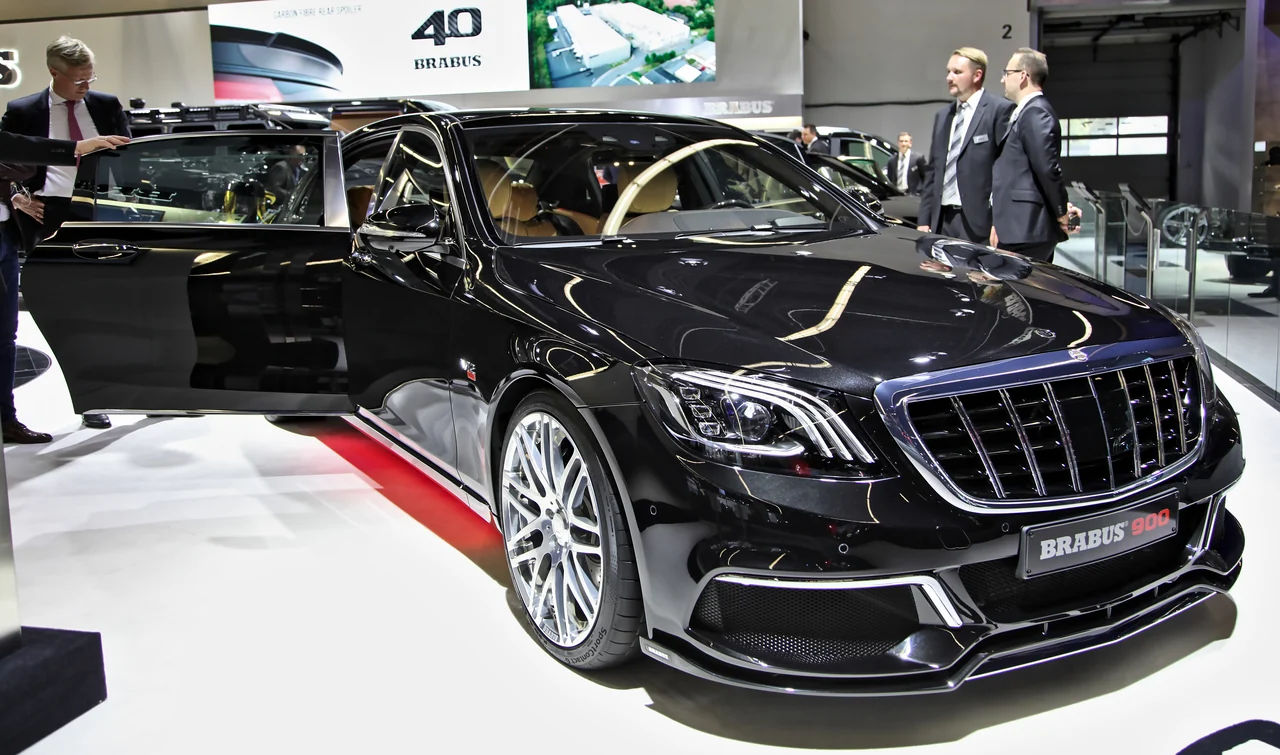

The Brabus story
Bodo Buschmann and Klaus Brackmann established Brabus in 1977. The name combines the opening letters of their surnames. The early ambition was to make Mercedes-Benz cars more individual, and the company grew around increasingly extensive performance and luxury conversions. Bottrop became the centre of an identity that eventually expanded beyond Mercedes donors into other premium manufacturers and specialist products.
The historical interest lies in that expansion of the brief. A powerful saloon, a heavily reworked G-Class and a Porsche-based performance car can all carry a recognisable Brabus treatment while answering different needs. Earlier E V12 and Rocket programmes helped establish the idea of exceptional performance in a body that retained a connection with a familiar production car.
Current lineup & programmes
The following groups describe Brabus’s published complete-car and conversion portfolio. Colour editions are grouped with their parent programme. Catalogue presence does not establish an open allocation, and donor model and generation remain part of the specification.
Bodo / Bodo Cabriolet
Published complete-car programmes
Rocket GTS / Rocket GTC
Published programmes, including colour editions
Brabus 1000: AMG GT / S-Class; Rocket 1000
Published performance conversions
Brabus 930: AMG GT / S-Class
Published performance conversions
Brabus 900 Rocket R / Mean Green
Porsche 911 Turbo S-based programme
Brabus 900: Urus SE / Bentley Continental GT and GTC
Published conversion families
Brabus 900 Rocket Edition: G-Class
W463A and W465 donor programmes
XLP / 6x6 / Crawler
Specialist off-road programmes; approval differs by vehicle
Mercedes-Benz, Bentley, Lamborghini, Porsche, Rolls-Royce, Range Rover and Smart tuning
Donor-brand product catalogues
Brabus 900: GLE / GLS / Maybach GLS; 900 Deep Blue / Peetch 911 Cabriolet
Published donor programmes
Brabus 850 Maybach S 680; Brabus 820 911 Turbo S Cabriolet
Published donor programmes
XLP 800 / 6x6 Adventure; XL 800 / Cabrio; 800 G-Class / Cabrio / 4x4²
Published off-road donor families
750 Bodo Buschmann Edition; 700 Cullinan / Ghost; 600 Range Rover
Published performance and luxury conversions
Taycan Turbo S / AMG EQS 53; Invicto
Electric and armoured donor programmes
Past models
Past performance-car families relevant to our 1996–2026 archive. A surviving product page or conversion catalogue does not mean the original donor car remains in production.
E V12 / E V12 One of Ten
Historic Mercedes-Benz conversions
Earlier Rocket generations
Historic performance programmes
Earlier Mercedes-Benz and Smart projects
Heritage conversions
The SuperCarNews view
Brabus is most persuasive when the conversion has a clear intended use. A long-distance saloon can justify a different balance of power, cabin treatment and suspension from a track-oriented Porsche. Applying the same visual intensity everywhere risks obscuring those distinctions. The best programme is the one whose details support the same purpose.
We are interested in the interaction between performance and luxury because it creates real engineering demands. More torque is only one part of the job; the rest of the car still has to manage it, and the occupant still has to live with the result. A lavish cabin cannot explain the chassis, just as a large output figure cannot explain refinement.
The catalogue requires careful reading. A number such as 900 can appear on different donor vehicles and does not establish one common engine or specification. Rocket names also span distinct generations and applications. The donor, complete programme title and actual build documentation matter more than the badge in isolation.
For historical cars, a documented factory Brabus conversion and a later collection of individual branded parts should not be represented as the same thing. Both can be interesting, but they tell different stories. Our preference is for an accurate account of what the car is, followed by a considered judgement about whether its changes make a coherent whole.