

The McLaren story
The McLaren name begins with Bruce McLaren’s racing team, formed in 1963. The later road-car business draws on that competition inheritance, but its production cars have their own history and requirements. The F1 and the series-production models that followed are best read as distinct chapters rather than as direct copies of a racing car.
McLaren’s modern road-car story has two useful starting points: the F1 and the later series-production business that grew around the MP4-12C. The first made its central driving position and three-seat cabin fundamental to its identity. The second established a repeatable carbon-structure approach across a widening range of sports cars and supercars. P1, Senna, Speedtail, Elva and W1 then explored more specialised briefs alongside those core models.
That progression rewards separating a model family from its limited derivatives. The 675LT and 765LT matter because of how they reinterpret their parent cars, while Speedtail’s grand-touring emphasis is a different proposition from Senna’s circuit focus. Our preference is to assess the coherence of each brief, rather than assume that the newest or rarest McLaren is automatically the most compelling.
Current lineup & programmes
Performance and specialist model families are listed below. Programme status describes the manufacturer’s published range or announcement, rather than stock or an available allocation. Open-top and special derivatives are grouped where they share a family; follow the model link for the distinctions.
750S / 750S Spider
Current range
Artura / Artura Spider
Current range
GTS
Current GT range
788HS / Spider
Published programme
W1
Current limited programme
Solus GT / MCL-HY GTR / GT3 / GT4 / Trophy
Track programmes
Past models
Past performance-car families relevant to our 1996–2026 archive. A surviving product page or conversion catalogue does not mean the original donor car remains in production.
F1 / LM / GT
Archive · 1990s
F1 GTR
Track-only archive · 1990s
540C / 570S / 570GT / Spider / 600LT / 620R
Archive · 2010s
650S / Spider / 625C / 675LT / 688HS
Archive · 2010s
720S / 765LT / Spider
Archive · 2010s
Elva
Archive · 2010s
MP4-12C / 12C / Spider
Archive · 2010s
P1
Archive · 2010s
P1 GTR
Track-only archive · 2010s
Senna / Sabre
Archive · 2010s
Senna GTR
Track-only archive · 2010s
Speedtail
Archive · 2010s
Concepts & prototypes
These projects are kept separate from confirmed production cars.
McL 6GT
Concept · 2020s
The SuperCarNews view
The F1 was realised in 1992 and remained part of the supercar story as this archive opens in 1996. Its central driving position and three-seat cabin gave the road car a distinctive architecture. LM, GT and GTR names identify different parts of the family and its competition history. McLaren’s often-quoted total of 106 includes more than ordinary road cars, so it should not be described as 106 identical customer road examples.
We think the F1’s continuing value as a reference lies in the clarity of its thinking rather than a requirement that every successor repeat its layout. A later McLaren can be excellent while choosing a different seating arrangement or powertrain. The useful inheritance is the willingness to make decisions for a reason, even when they are unusual. Turning the F1 into a rule that forbids change would miss that point.
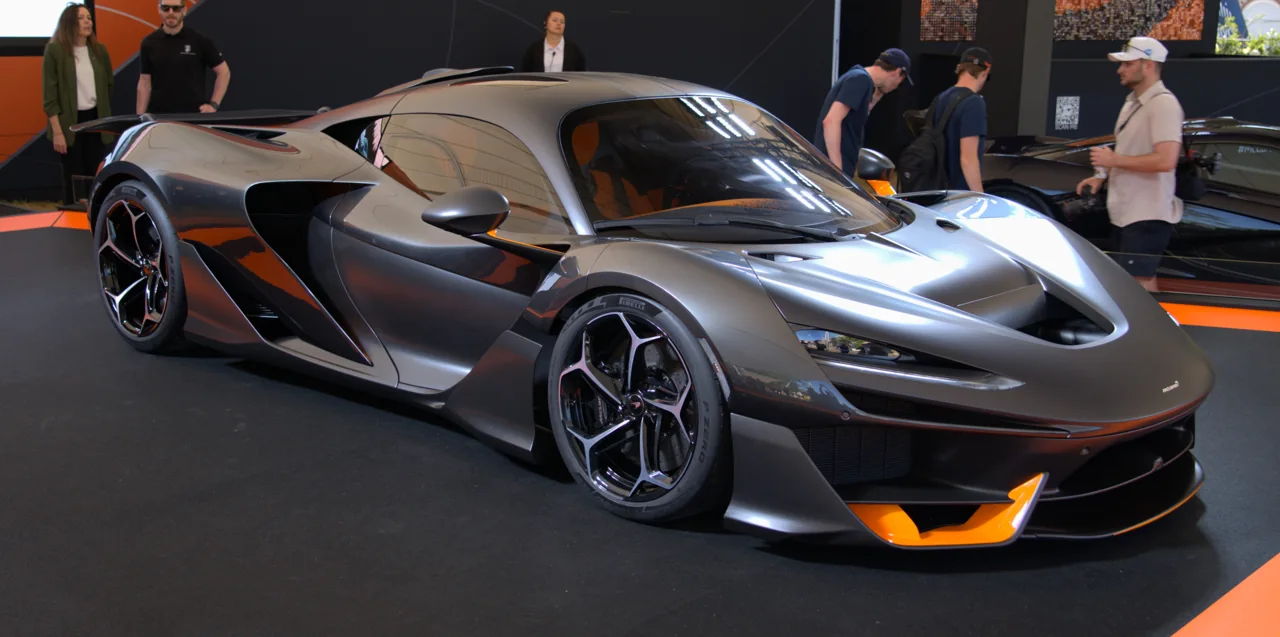
McLaren explicitly describes the McL 6GT as a concept. Its official page identifies V8 combustion power, rear-wheel drive, hydraulic steering and a manual transmission, with design references to Bruce McLaren’s M6GT. It belongs in the catalogue as a concept, not as a confirmed customer production model with invented delivery dates.
We think the concept raises an excellent question about the future of expensive performance cars. If outright capability is abundant, a deliberately tactile interaction can become a more distinctive ambition. The manual gearbox is interesting for the relationship it proposes, not because every modern McLaren should abandon its existing transmission. A concept is allowed to explore an alternative without invalidating the current range.