

The Bugatti story
Ettore Bugatti established his company in Molsheim in 1909. Its history has since included separate periods of revival, with different custodians interpreting the relationship between design and engineering. That discontinuity matters: the modern Veyron and Tourbillon programmes inherit a name and an ambition, rather than an unchanged mechanical tradition.
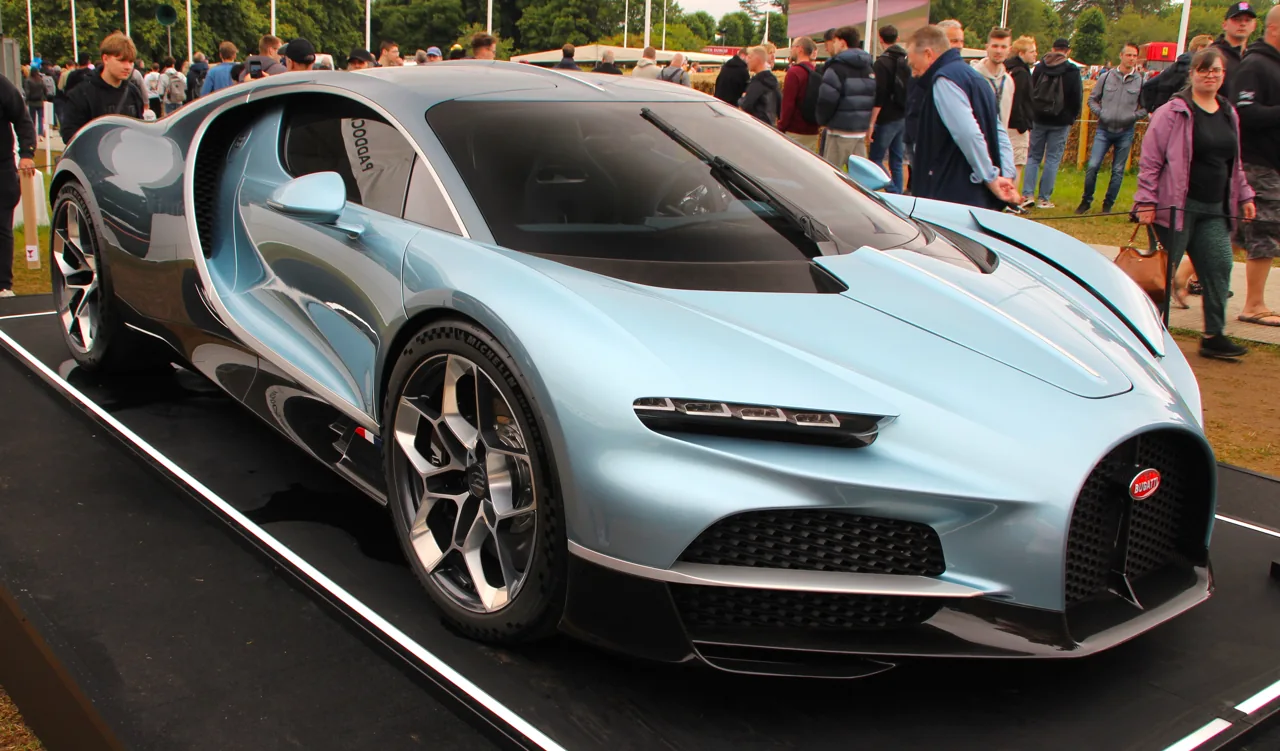
Bugatti’s modern identity was reshaped by Veyron, whose engineering made extreme performance coexist with a deliberately luxurious road-car brief. Chiron developed that W16 foundation, while Divo, Centodieci, La Voiture Noire and Mistral demonstrated very different approaches to limited production and coachbuilt appearance. Bolide took the mechanical inheritance towards the circuit. Tourbillon begins the next powertrain chapter with a V16 hybrid layout.
The interesting history is as much about restraint and presentation as outright speed. Instruments, materials and a recognisable body language give a Bugatti its identity when the car is stationary. The transition to Tourbillon therefore asks a larger question than how to replace one engine: how much of the experience belongs to the mechanical architecture, and how much belongs to the way the car is conceived around it?
Current lineup & programmes
Performance and specialist model families are listed below. Programme status describes the manufacturer’s published range or announcement, rather than stock or an available allocation. Open-top and special derivatives are grouped where they share a family; follow the model link for the distinctions.
Brouillard / F.K.P. Hommage / Destrier
Bespoke programme · 2020s
Tourbillon
Development programme · 2020s
Past models
Past performance-car families relevant to our 1996–2026 archive. A surviving product page or conversion catalogue does not mean the original donor car remains in production.
Veyron 16.4 / Grand Sport / Super Sport / Vitesse
Archive · 2000s
Centodieci
Archive · 2010s
Chiron / Sport / Pur Sport / Super Sport / 300+ / Profilée
Archive · 2010s
Divo
Archive · 2010s
La Voiture Noire
Archive · 2010s
Bolide
Track-only archive · 2020s
W16 Mistral
Archive · 2020s
The SuperCarNews view
We think the Veyron remains most interesting as a whole-system achievement. Enormous power creates demands on cooling, tyres, transmission, aerodynamic stability and braking. The engine is the part everyone remembers, but it cannot fulfil its purpose alone. A serious appraisal should explain that coordination rather than treat the cylinder count as a sufficient description of the car.
Visually, the Veyron’s rounded, concentrated form gives it a different character from the angular supercars around it. We find that distinction valuable. It looks like an object organised around substantial machinery and a particular kind of luxury, rather than a racing silhouette adapted to road use. Its place in history does not require it to resemble its rivals.
Programme Solitaire began with Brouillard in 2025. F.K.P. Hommage followed in January 2026, with a design that explicitly honours the Veyron and Ferdinand Piëch. Destrier, presented in August 2026, is the programme’s third individual creation and takes the Bolide as its starting point. These are bespoke commissions, not three ordinary new trim levels in a dealer range.
The Destrier’s origin is a reason to be particularly careful about road-use assumptions. A new body and a public reveal do not, by themselves, establish a change in homologation status. We record the commission as part of Solitaire without inventing a general road-car approval claim.
Our view is that bespoke programmes become most interesting when they allow design ambitions that a larger series could not support. The danger is that coverage becomes a recital of owner exclusivity and material extravagance. We would rather examine what each commission changes in the visual and mechanical conversation. That gives readers something worthwhile even when ownership is entirely remote from their circumstances.