
In this article
- The problem with judging every Bugatti by top speed
- Veyron: the engineering becomes the identity
- Chiron: developing the W16 idea
- Divo: another use for familiar machinery
- Centodieci: remembering an earlier Bugatti
- La Voiture Noire: the individual commission
- W16 Mistral: the road-going farewell
- Bolide: a different environment entirely
- Tourbillon: the next engine is not another W16
- Programme Solitaire: three individual statements
- The SuperCarNews view
The problem with judging every Bugatti by top speed
Bugatti’s modern reputation is inseparable from extraordinary speed, but speed alone is an inadequate explanation of the cars. A record can be overtaken. The engineering, proportion, materials and rituals of ownership have to retain their appeal after that happens. The most interesting part of the marque’s recent history is how it has gradually made that broader proposition more explicit.
This guide follows the major modern families within the 1996–2026 archive, with the earlier EB110 appearing as historical context rather than being relabelled a new model of the period. Road cars, track cars and bespoke commissions are distinguished. The opinions are SuperCarNews analysis of documented programmes; we have not driven these cars or independently measured their performance.
Veyron: the engineering becomes the identity
The Veyron’s W16 programme established the central idea of the revived Bugatti: exceptional performance combined with a luxury brief. The family developed through the 16.4, Grand Sport, Super Sport and Grand Sport Vitesse. Bugatti announced the sale of the 450th and final Veyron in 2015, a total spanning the programme rather than 450 examples of one identical version.
We think the Veyron remains most interesting as a whole-system achievement. Enormous power creates demands on cooling, tyres, transmission, aerodynamic stability and braking. The engine is the part everyone remembers, but it cannot fulfil its purpose alone. A serious appraisal should explain that coordination rather than treat the cylinder count as a sufficient description of the car.
Visually, the Veyron’s rounded, concentrated form gives it a different character from the angular supercars around it. We find that distinction valuable. It looks like an object organised around substantial machinery and a particular kind of luxury, rather than a racing silhouette adapted to road use. Its place in history does not require it to resemble its rivals.
Chiron: developing the W16 idea
The Chiron followed in 2016, with a family that included Sport, Pur Sport, Super Sport, Super Sport 300+ and the one-off Profilée. Bugatti’s final Chiron announcement in 2024 identifies the 500th example as the end of the core programme. That establishes a historical boundary even though related W16 projects continued afterwards.
The derivatives are most useful when read as different priorities. A car discussed around circuit response and a car discussed around very high speed do not necessarily need the same aerodynamic or gearing choices. We would not rank the entire family by one headline number and assume the result captures what each version is for.
The Chiron also raises an interesting design question: how do you make a second car feel important after the first has become famous for changing expectations? Our view is that a successor earns its place by refining and clarifying the proposition, not only by making it more extreme. The Chiron’s more emphatic visual architecture gives it its own presence while retaining a recognisable relationship with the Veyron.
Divo: another use for familiar machinery
The Divo belongs to Bugatti’s coachbuilt W16 branch rather than representing an entirely unrelated engine family. That connection is important, but it should not end the discussion. A different body and intended emphasis can create a distinct proposition from an established technical base.
We think the interesting question is whether the changes form a coherent car. Rarity can explain why a project attracts collectors; it cannot establish that the design is successful. The Divo deserves to be considered through its proportions, aerodynamic intentions and relationship to the core Chiron idea. That is a more durable form of criticism than asking only whether the production total makes it exclusive enough.
Centodieci: remembering an earlier Bugatti
The Centodieci places a contemporary W16 project in conversation with the EB110. Its historical reference points back beyond the core period of this archive, showing that Bugatti’s recent identity is not limited to the Veyron and Chiron. It is a deliberate interpretation of another chapter in the marque’s story.
Our response to such projects depends on how well the new design stands independently. Recognisable references can make a car immediately engaging, but a collection of familiar details is not automatically a convincing whole. We prefer to discuss the Centodieci as a modern design with a historical subject, rather than pretend that it is a continuation of the original EB110 programme.
La Voiture Noire: the individual commission
La Voiture Noire sits at the most individual end of the W16 coachbuilding story. Its purpose differs from a normal series model: it gives a single commission a distinctive design identity. That does not make it unsuitable for serious editorial coverage, but it changes the questions worth asking.
We would focus on the relationship between form, materials and the commission’s intended character. A price headline or a claim of uniqueness can attract attention without telling the reader much about the object. The most useful criticism asks whether the design remains compelling when those external signals are removed. An extraordinary commission should reward looking and thinking, not merely knowing that nobody else has one.
W16 Mistral: the road-going farewell
Bugatti confirmed the end of W16 Mistral production in July 2026. The manufacturer frames it as the closing chapter of the W16’s road-going story. That makes the Mistral an archive programme at the date of this guide, even if individual examples remain prominent in current events or retail conversation.
The open-top format gives the final road-going chapter a particular logic. It changes the relationship between occupants, surroundings and the mechanical occasion. We find that a more meaningful way to conclude an engine story than simply adding another fixed-roof derivative with a slightly larger number.
This does not amount to a claim about sound or refinement that we have experienced. It is an interpretation of the chosen format. The practical quality of an open car still depends on airflow, visibility, access and how its controls work in use. Those details deserve as much attention as the ceremonial significance of being the last W16 road model.
Bolide: a different environment entirely
The Bolide is a track-only programme. Bugatti’s account of 2025 records the final example reaching its owner that year. It therefore belongs in the track archive, with its intended environment kept clear. It should not be inserted into a comparison of road cars as if the absence of road requirements were irrelevant.
We think the Bolide is particularly interesting as a change of brief. The W16 machinery is being asked to serve a different kind of experience, supported by a car organised around circuit use. That can be an exciting conclusion to a technical story without implying that every owner would prefer it to a Chiron or Mistral.
The distinction also changes how performance claims should be read. A track car can rely on equipment, preparation and support that do not describe ordinary road use. Explaining those conditions makes its capability more intelligible. It does not diminish the achievement.
Tourbillon: the next engine is not another W16
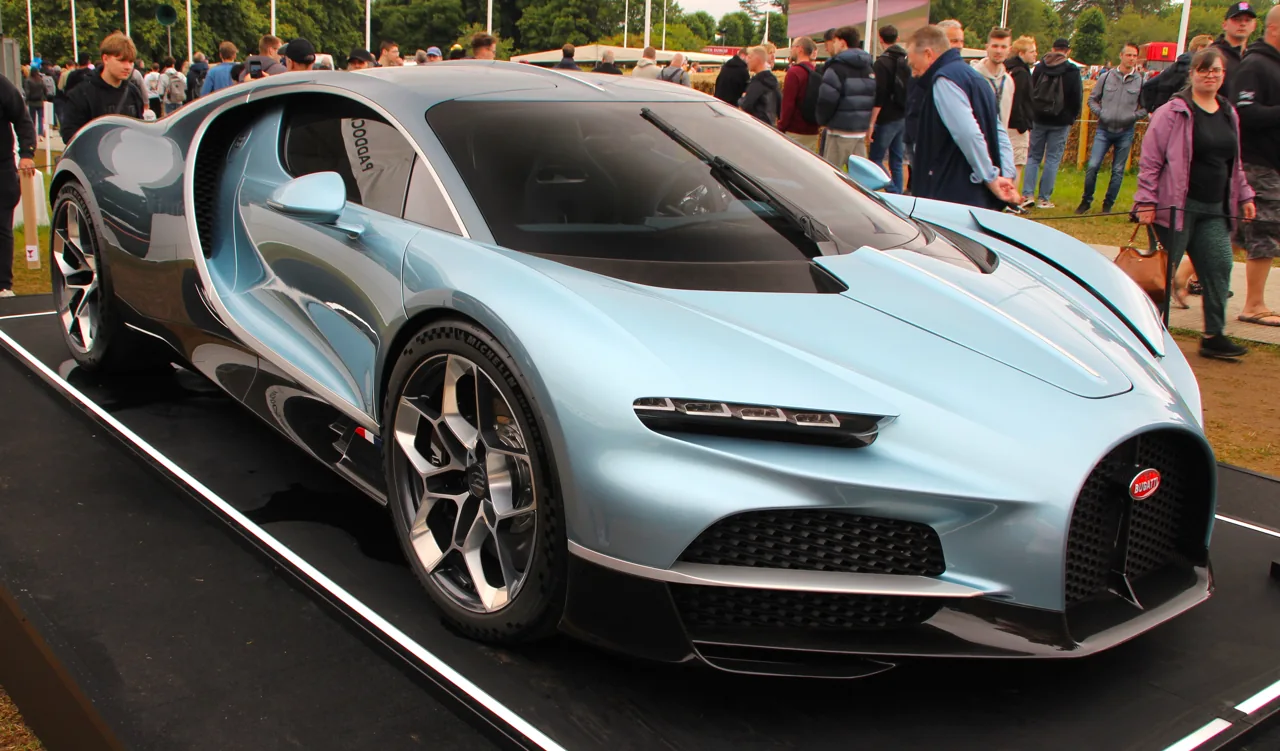
The Tourbillon introduces a naturally aspirated V16 hybrid architecture rather than extending the W16 programme. Our dedicated model guide examines the engine, electrical system and mechanical instrument concept. The September 2026 sound-development report adds a specific milestone, without establishing that every part of vehicle approval or customer delivery has been completed.
For us, the most persuasive part of the new direction is the attempt to give Bugatti a lasting attraction beyond an escalating speed contest. The instruments and the engine both invite attention as machinery. That is a meaningful response to a market in which extraordinary output is becoming more widely available.
The unresolved question is how the complexity is made natural to use. A car can be fascinating to understand without requiring its owner to manage every system consciously. The Tourbillon’s eventual standing will depend on that integration as well as the beauty of its individual components.
Programme Solitaire: three individual statements
Programme Solitaire began with Brouillard in 2025. F.K.P. Hommage followed in January 2026, with a design that explicitly honours the Veyron and Ferdinand Piëch. Destrier, presented in August 2026, is the programme’s third individual creation and takes the Bolide as its starting point. These are bespoke commissions, not three ordinary new trim levels in a dealer range.
The Destrier’s origin is a reason to be particularly careful about road-use assumptions. A new body and a public reveal do not, by themselves, establish a change in homologation status. We record the commission as part of Solitaire without inventing a general road-car approval claim.
Our view is that bespoke programmes become most interesting when they allow design ambitions that a larger series could not support. The danger is that coverage becomes a recital of owner exclusivity and material extravagance. We would rather examine what each commission changes in the visual and mechanical conversation. That gives readers something worthwhile even when ownership is entirely remote from their circumstances.
The SuperCarNews view
Bugatti’s strongest modern story is the gradual broadening of what extraordinary performance can mean. The Veyron made the scale of the engineering impossible to ignore; the Chiron family explored different priorities; Mistral and Bolide gave the W16 contrasting conclusions; and Tourbillon asks how mechanical fascination can carry the next chapter.
We prefer that history to an endless ranking by maximum speed. The cars are more distinctive, and more worth discussing, when their purposes remain visible. Manufacturer announcements establish programme facts, while our opinions concern the reasoning and design those facts reveal. Neither needs to be inflated into a driving experience we have not had.
Sources & further reading
Reporting is based on the manufacturer material below. Photographs are credited separately.
- Bugatti: the last Veyron
- Bugatti: the final Chiron
- Bugatti: the W16 engine
- Bugatti: W16 Mistral production ends, July 2026
- Bugatti: 2025 programme milestones and final Bolide
- Bugatti Programme Solitaire and Brouillard
- Bugatti F.K.P. Hommage
- Bugatti Destrier
Explore the manufacturer directory for company history and model lineups.