
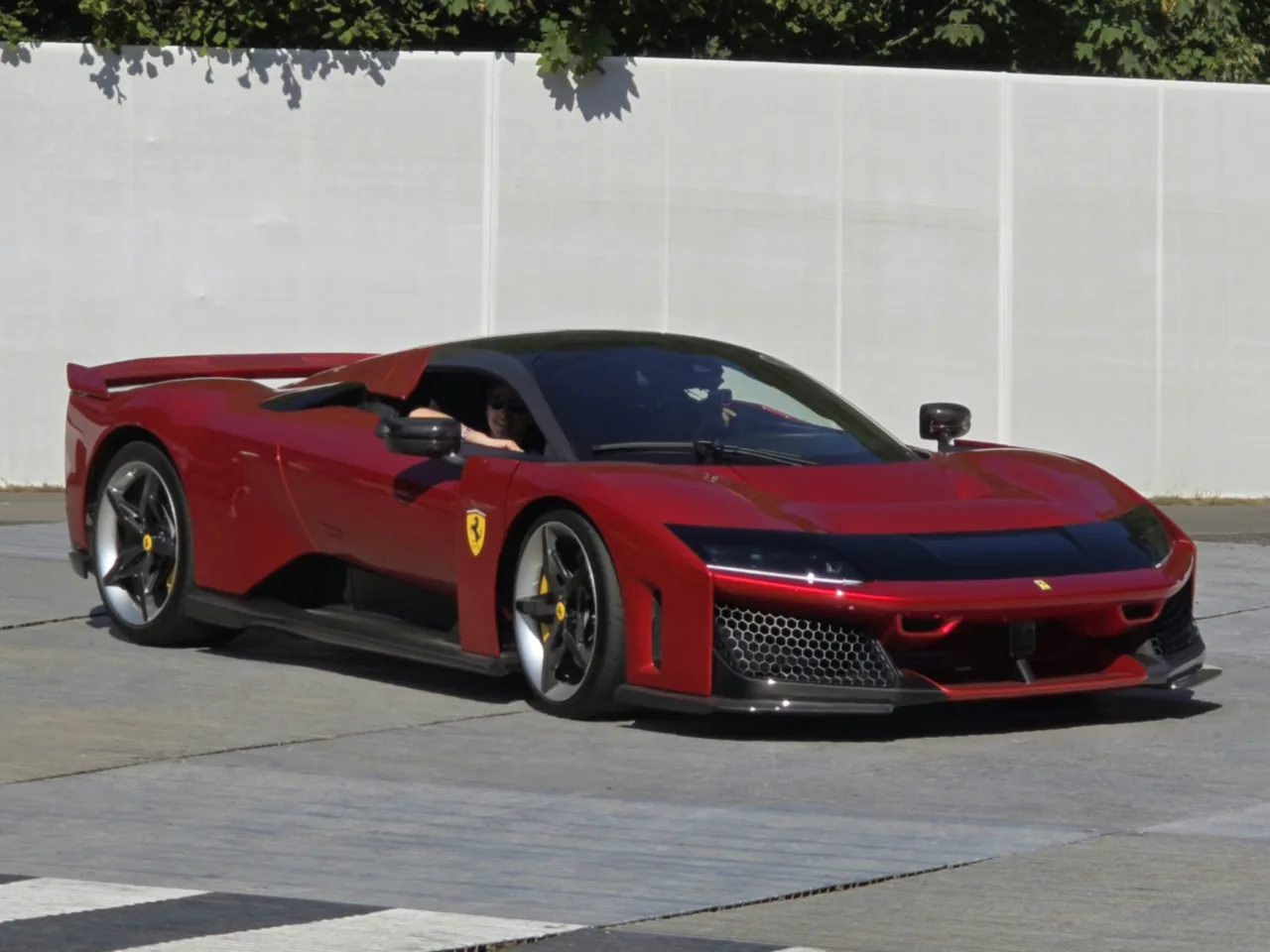

The Ferrari story
Enzo Ferrari’s 125 S was the first car to bear his name in 1947. Its twelve-cylinder engine and competition debut established a link between the road-car marque and racing that remains central to how the company presents its engineering. That origin gives the modern range context, but it does not require every new Ferrari to follow the same mechanical formula.
Ferrari’s road-car history contains several distinct traditions: the front-engined grand tourer, the mid-engined sports car and the limited flagship. During the opening years of this archive, the F355, F50 and 550 expressed those traditions in very different ways. The following decades brought aluminium construction, increasingly capable electronic controls, turbocharged range cars and hybrid assistance. The current lineup makes more sense when those parallel histories remain visible.
The Ferrari we find most interesting is the one with a clear reason to exist. A twelve-cylinder grand tourer does not need to justify itself against a hybrid flagship on acceleration alone. Maranello’s strength is the ability to give those different briefs their own proportions, mechanical layout and sense of occasion. Its challenge is preserving that distinction as the range expands.
Current lineup & programmes
Performance and specialist model families are listed below. Programme status describes the manufacturer’s published range or announcement, rather than stock or an available allocation. Open-top and special derivatives are grouped where they share a family; follow the model link for the distinctions.
SF90 Stradale / Spider / XX
Range transition · 2010s
12Cilindri / Spider
Current range · 2020s
296 GTB / GTS / Speciale / Speciale A
Range transition · 2020s
849 Testarossa / Spider
Current programme · 2020s
F80
Current programme · 2020s
Ferrari Luce
Announced programme · 2020s
Roma / Spider / Amalfi
Range transition · 2020s
Purosangue
Current four-door range
Past models
Past performance-car families relevant to our 1996–2026 archive. A surviving product page or conversion catalogue does not mean the original donor car remains in production.
360 Modena / Spider / Challenge Stradale
Archive · 1990s
456 / 612 / FF / GTC4Lusso
Archive · 1990s
550 / 575M / Barchetta / Superamerica
Archive · 1990s
F355
Archive · 1990s
F50
Archive · 1990s
458 Italia / Spider / Speciale / Speciale A
Archive · 2000s
599 GTB / GTO / SA Aperta
Archive · 2000s
599XX / Evo
Track-only archive · 2000s
California / T / Portofino / M
Archive · 2000s
Enzo Ferrari
Archive · 2000s
F430 / Spider / 430 Scuderia / 16M
Archive · 2000s
FXX / Evoluzione
Track-only archive · 2000s
488 GTB / Spider / Pista
Archive · 2010s
812 Superfast / GTS / Competizione
Archive · 2010s
F12berlinetta / F12tdf
Archive · 2010s
F8 Tributo / Spider
Archive · 2010s
FXX K / Evo
Track-only archive · 2010s
LaFerrari / Aperta
Archive · 2010s
Monza SP1 / SP2
Archive · 2010s
Daytona SP3
Archive · 2020s
The SuperCarNews view
The F355 arrived in 1994 and remains essential to understanding the start of this archive. Its five-valve-per-cylinder V8 and the later introduction of the F1-style automated manual gearbox put it at a meeting point between familiar mechanical rituals and electronic intervention. Berlinetta, GTS and Spider bodies offered different ways into the same family; the Challenge car belongs to the competition story.
We think its significance goes beyond the appeal of a manual gear gate. The F355 shows that the analogue Ferrari people now romanticise was already a technologically ambitious product. That makes it a useful antidote to the idea that innovation only began to dilute character recently. The more interesting question is how successfully each innovation serves the car.
Ferrari’s February 2026 investor presentation identifies Ferrari Luce within its programme. That document establishes the name and planned changeover context; it does not, on its own, justify a detailed specification or an assertion about local customer deliveries. We therefore record it as an announced programme here, pending a fuller model-specific assessment.
The archive concentrates on road-going supercars, hypercars and closely related grand tourers. It does not attempt to turn every one-off commission, racing chassis or SUV into a separate model page. Significant variants are grouped where they help explain the parent family. This keeps the structure useful while preserving the distinctions that a reader needs to understand what each car actually is.
Sources & further reading
- Company origins and heritage
- Ferrari historical garage and model chronology
- Ferrari: the F355 at thirty
- Ferrari: F430 technological masterclass
- Ferrari FY2025 results: 2026 model changeover
- Ferrari annual report 2024: range, special series, Icona and supercars
- Ferrari: Daytona SP3 and sports-prototype design
- Ferrari: anniversary chronology
- Ferrari 849 Testarossa technical release (Italian)