
In this article
- How to read thirty years of Ferrari
- F355: the opening chapter
- F50: the uncompromising flagship
- 360: a more open design vocabulary
- F430: electronics become part of the character
- 458: the naturally aspirated benchmark
- 488: the turbocharged argument
- F8: the concentrated V8 conclusion
- 296: six cylinders and a new hierarchy
- SF90: the hybrid becomes a range model
- 849 Testarossa: a name with a different job
- Enzo: the flagship as a technical statement
- LaFerrari: electrification enters the flagship
- F80: a flagship that invites disagreement
- 550 and 575: the front-engined return
- 599: the GT becomes more assertive
- F12: compact ambition, large engine
- 812: the V12 explores its extremes
- 12Cilindri: the engine in the name
- Monza SP1 and SP2: an experience with conditions
- Daytona SP3: history through a modern lens
- California and Portofino: the broader brief
- Roma and Amalfi: elegance as a priority
- The four-seat GT context
- Ferrari Luce and the boundary of this guide
- The SuperCarNews view
How to read thirty years of Ferrari
Ferrari’s recent history is easier to understand as several parallel stories. There is the mid-engined line, the front-engined V12 grand tourer, the limited flagship and the increasingly varied world of special projects. Treating every expensive Ferrari as one interchangeable kind of supercar hides the decisions that make individual models interesting. A 550 and an F50 belong to the same era, but they express very different ideas about what a road car should provide.
This guide follows models relevant to the 1996–2026 period, including cars introduced earlier but still part of the opening years. Related open-top and specialist variants sit with their parent family. Road cars, customer track cars and announced programmes are distinguished in the catalogue. The interpretations below are SuperCarNews editorial opinions based on documented design and history; they are not accounts of driving these cars.
F355: the opening chapter
The F355 arrived in 1994 and remains essential to understanding the start of this archive. Its five-valve-per-cylinder V8 and the later introduction of the F1-style automated manual gearbox put it at a meeting point between familiar mechanical rituals and electronic intervention. Berlinetta, GTS and Spider bodies offered different ways into the same family; the Challenge car belongs to the competition story.
We think its significance goes beyond the appeal of a manual gear gate. The F355 shows that the analogue Ferrari people now romanticise was already a technologically ambitious product. That makes it a useful antidote to the idea that innovation only began to dilute character recently. The more interesting question is how successfully each innovation serves the car.
F50: the uncompromising flagship
The F50’s 1995 arrival places it at the archive’s threshold. It followed the F40 as Ferrari’s limited flagship and took a very different mechanical direction. The F50 GT belongs alongside it as a competition project, rather than as a normal road-car trim. The distinction matters when spectacular track photographs circulate without context.
Our attraction to the F50 is conceptual: it makes very little effort to disguise that its identity revolves around serious machinery. That does not automatically make it the best Ferrari to live with, or the best answer for every collector. It does make it an unusually clear statement about what a flagship can choose to prioritise. It is worth understanding on those terms before ranking its styling against more universally celebrated relatives.
360: a more open design vocabulary
The 360 Modena arrived in 1999, followed by the Spider and the more focused Challenge Stradale. Ferrari’s historical chronology separates the road-going Stradale from the 360 Challenge and other competition derivatives. The names sound related because they are, but their intended uses are not identical.
Visually, we see the 360 as a decisive move towards broader, more fluid surfaces after the F355. The Challenge Stradale then gives that shape a more concentrated purpose. Our preference is to understand both as valid interpretations rather than assuming that the rarer, more demanding version makes the standard car irrelevant. A model family becomes more interesting when its different briefs are allowed to coexist.
F430: electronics become part of the character
The F430 made the relationship between driver controls and electronic systems more explicit. Ferrari’s retrospective highlights its new V8 and the steering-wheel manettino, while the 430 Scuderia and Scuderia Spider 16M took the family towards a more specialised role. The F430 Challenge remains a separate racing derivative.
This is one of the most useful generations for discussing what enthusiasts mean by purity. Its appeal cannot be reduced to the absence of electronics, because electronic control is part of its technical identity. We find the more productive question is whether those systems help the driver understand and use the car. That question connects the F430 to current hybrids more closely than a simple old-versus-new argument suggests.
458: the naturally aspirated benchmark
The 458 Italia, Spider, Speciale and Speciale A form a particularly easy family for enthusiasts to follow: a core road car, an open version and more focused derivatives. Ferrari’s chronology also identifies the separate Challenge competition programme. Keeping those branches clear prevents the road-going Speciale from being described as if it were merely a race car with number plates.
Our view is that the 458’s long-term appeal comes partly from the clarity of its visual and mechanical proposition. It offers an understandable reference point before the turbocharged and hybrid generations that follow. That does not prove that it is universally preferable. It explains why it has become such a convenient reference in debates about what people want a modern Ferrari to preserve.
488: the turbocharged argument
The 488 GTB and Spider moved the mid-engined family into a turbocharged era, with the Pista and Pista Spider giving the architecture a more focused expression. The relevant editorial question is not simply whether a turbocharger is desirable. It is what a different way of producing power allows Ferrari to change elsewhere in the car’s character and priorities.
We resist treating the 488 as an interruption between more emotionally acceptable models. That approach reduces a substantial engineering programme to one disliked component. The Pista in particular makes sense as an attempt to give the turbocharged formula a sharper identity. Its success as an ownership choice must still be judged against how someone intends to use it, rather than its position in an enthusiast hierarchy.
F8: the concentrated V8 conclusion
The F8 Tributo and F8 Spider appear in Ferrari’s 2019 chronology. Their place between the 488 family and the later hybrid range gives them a distinctive historical role. They belong to the mature turbocharged V8 story, rather than representing the beginning of Ferrari’s electrical transition.
That positioning is attractive in its own right. There is value in a car that refines an established idea while the manufacturer develops a different future elsewhere. We do not think every desirable model has to introduce a new architecture. For some readers, the F8’s interest will be exactly that it offers a concentrated expression of a familiar formula, without requiring the historical significance of a flagship to justify itself.
296: six cylinders and a new hierarchy
The 296 GTB and GTS give the mid-engined range a V6 hybrid identity. Ferrari’s 2026 changeover presentation places those versions in phase-out while the 296 Speciale and Speciale A enter the programme. That is a range transition, not a reason to label every 296 as discontinued or every newly named derivative as already delivered everywhere.
The family is important because it challenges an old shortcut: more cylinders no longer provide a reliable guide to where a Ferrari sits in technical ambition. We find the 296 an especially useful subject for comparing the packaging and control opportunities of hybridisation with its additional complexity. The Speciale name raises expectations about focus, but those expectations should be explored through the actual specification rather than inherited automatically from earlier cars carrying the badge.
SF90: the hybrid becomes a range model
The SF90 Stradale and Spider brought plug-in hybrid technology into a different part of Ferrari’s range from the limited LaFerrari. The later SF90 XX Stradale and XX Spider are road-legal models, an important distinction from earlier customer track programmes carrying XX branding. Ferrari’s reporting places the XX versions in the 2026 phase-out schedule.
Our view is that the SF90 matters because it makes hybridisation part of the normal product conversation rather than reserving it for a distant halo car. That change also makes clarity more important: a buyer should understand the role of the electrical system, not merely the combined output. The XX naming is exciting, but it is not a substitute for explaining what kind of car the owner is actually receiving.
849 Testarossa: a name with a different job
Ferrari’s 2026 programme includes the 849 Testarossa and Spider. The official technical release describes a turbocharged V8 hybrid with 1,050 CV combined. The revived Testarossa name connects a contemporary engineering programme to an exceptionally recognisable part of Ferrari’s past, but it should not lead readers to assume that the new car repeats the older model’s mechanical layout.
We have mixed feelings about that kind of naming. A familiar name gives a new car an immediate cultural presence, but it also creates expectations that may have little to do with the actual design. The most convincing outcome would be for the 849 to establish its own meaning over time. Its technical identity deserves to be discussed before nostalgia decides whether the badge is appropriate.
Enzo: the flagship as a technical statement
The Enzo arrived in 2002, occupying the limited flagship position after the F50. Ferrari’s history places the FXX customer track programme in the following chapter. They are related parts of the story, but the road car and the track programme should remain distinct when discussing ownership, intended use and historical significance.
We see the Enzo as a particularly forceful example of a flagship whose appearance announces an engineering agenda. It is not a design that needs everyone to find it conventionally pretty. That confidence is part of its appeal. A halo car can be memorable because it crystallises a moment in a company’s thinking, even when later generations offer greater capability or a different kind of beauty.
LaFerrari: electrification enters the flagship
LaFerrari and the later Aperta brought hybrid power into Ferrari’s flagship sequence. The FXX K and its evolution belong to the associated customer track story. Ferrari’s anniversary material identifies LaFerrari as a pivotal first hybrid in its history, which gives the model a technical significance beyond its place in a famous group of contemporary rivals.
Our interest is in the way a new technology can be introduced without making the entire car’s identity about novelty. A flagship has to be compelling after its once-unusual hardware becomes familiar. LaFerrari’s place in this archive is therefore both an engineering milestone and a reminder that the best historical narratives do not end at the launch announcement. The later influence of a car can matter as much as its initial impact.
F80: a flagship that invites disagreement
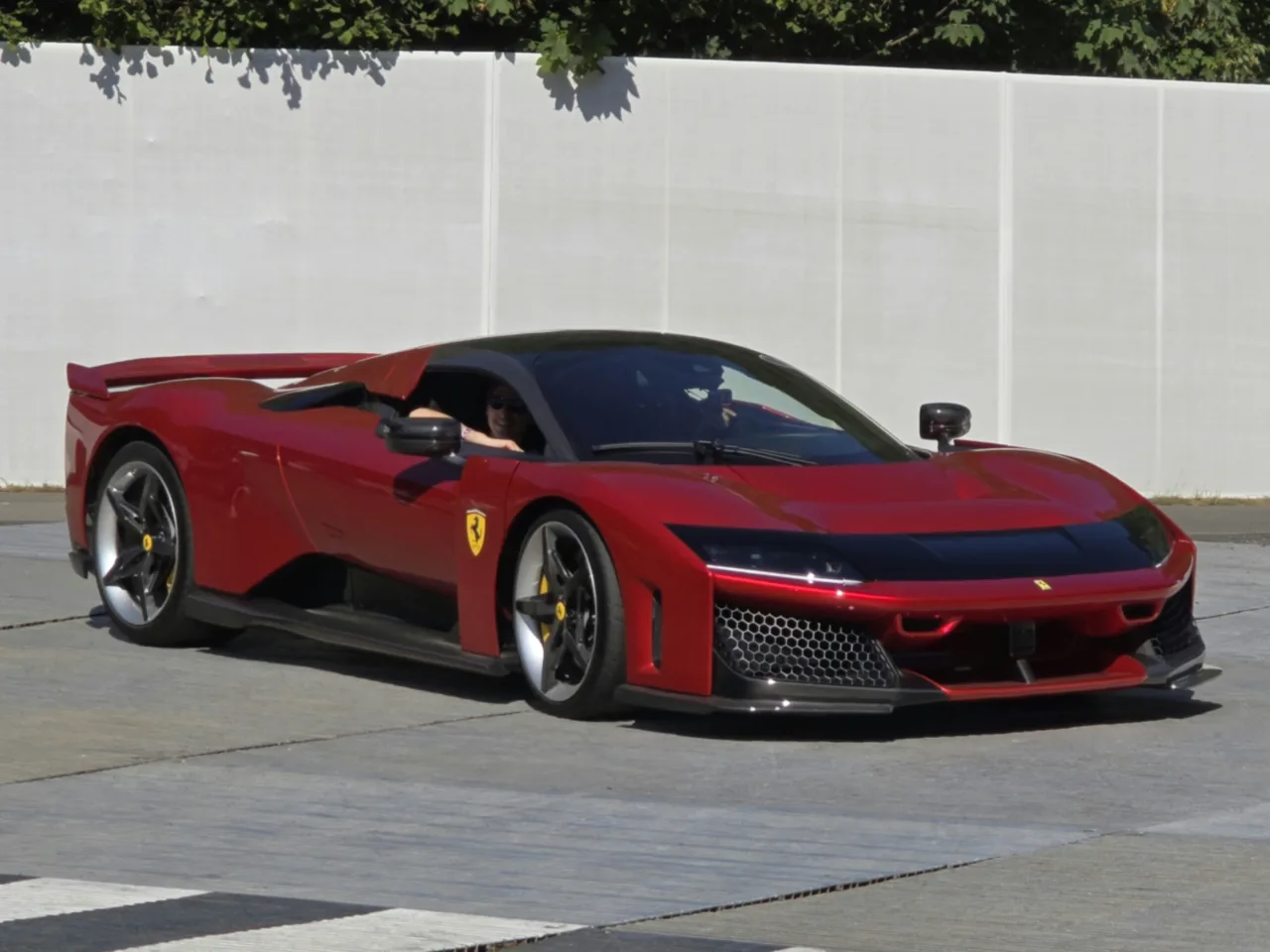
The F80 shifts the flagship discussion towards a V6 hybrid, active aerodynamic management and a different relationship with contemporary competition technology. Our dedicated guide examines that choice in detail. It is a useful contrast with the F50, Enzo and LaFerrari because the family resemblance lies in ambition rather than a fixed engine recipe.
We welcome that willingness to change the answer. A flagship programme becomes less interesting if its only permitted development is to repeat the emotional cues of the previous one. At the same time, enthusiasts are entitled to prefer a different kind of spectacle. The F80 should earn its appeal through the clarity and quality of its own decisions, not through an insistence that technical progress settles every question of taste.
550 and 575: the front-engined return
The 550 Maranello arrived in 1996, followed in the family chronology by the 550 Barchetta, 575M and Superamerica. This is the start of a separate thread from the mid-engined flagships: the powerful front-engined Ferrari as a serious grand touring proposition. Our existing 550 retrospective explores that setting further.
We think this branch is essential to a credible supercar publication because it asks a different question of performance. A car can be extraordinary through the breadth and confidence of its purpose, not only through visual extremity. The 550 family’s enduring interest lies partly in that restraint. It provides a useful counterweight to the assumption that the most dramatic-looking Ferrari must be the most rewarding one to understand or own.
599: the GT becomes more assertive
The 599 GTB Fiorano, GTO and SA Aperta show how far Ferrari could stretch the front-engined brief. The 599XX belongs to the track programme and should not be conflated with the road-going GTO. Similar names and shared visual references do not erase that practical distinction.
For us, the 599 family illustrates a recurring Ferrari tension: how to preserve the appeal of a grand tourer while moving towards increasingly specialised performance. The standard car and its more focused relatives need not be judged against identical expectations. A reader interested in long journeys should be allowed to value a different balance from a reader drawn to the concentrated identity of a limited derivative.
F12: compact ambition, large engine
The F12berlinetta and F12tdf continue the front-engined V12 line with a more concentrated visual stance. Ferrari’s historical chronology places the berlinetta in 2012 and the tdf in 2015. The suffix identifies a distinct version; it is not a reason to treat every F12 as if it shared the same brief.
We find the F12 family compelling as a reminder that a front-engined car can still look tightly organised around its machinery. The long bonnet is not merely a styling gesture; it communicates the car’s layout. Our editorial preference is to appreciate that architecture on its own terms rather than treating it as a less exotic alternative to a mid-engined Ferrari.
812: the V12 explores its extremes
The 812 Superfast, GTS, Competizione and Competizione A take the V12 branch through both open-air and more specialised interpretations. Ferrari’s 2026 reporting places the Competizione A’s phase-out in 2025. A car can remain prominent in showrooms, collections and editorial discussion after the factory programme has moved on.
The family’s appeal is the opportunity to see one central idea developed in several directions. We would not automatically choose the most limited derivative as the definitive expression for every reader. Open-air use, touring priorities and the attraction of a focused specification are different reasons to care about a car. A good archive should explain those reasons, rather than merely arrange the badges by rarity.
12Cilindri: the engine in the name
Ferrari lists the 12Cilindri and 12Cilindri Spider in global distribution for 2026. The name makes the central attraction unusually explicit. Alongside the company’s hybrid programmes, the continuation of this V12 branch demonstrates that Ferrari’s current range cannot be reduced to one technical direction.
We like the confidence of that coexistence. A manufacturer can pursue a compact hybrid flagship and a very different front-engined grand tourer without either being an embarrassment. Their purposes are not identical. The 12Cilindri’s editorial interest is the way it gives a familiar engine-led idea a contemporary design context, allowing the reader to compare priorities rather than simply count technological additions.
Monza SP1 and SP2: an experience with conditions
The Monza SP1 and SP2 introduced Ferrari’s Icona programme, drawing on historical barchetta ideas in single-seat and two-seat forms. They belong to the archive rather than the current production range in Ferrari’s reporting. Their format makes intended use unusually important to any discussion of their appeal.
Our view is that these cars are most convincing when their limitations are treated as part of the brief. They are not required to imitate the versatility of a conventional grand tourer. Equally, rarity should not excuse an unwillingness to ask how often and where the owner can enjoy them. A specialised experience can be wonderful, but it becomes more meaningful when the conditions it needs are acknowledged clearly.
Daytona SP3: history through a modern lens
The Daytona SP3 continues the Icona idea with references to Ferrari’s sports prototypes and a mid-rear-mounted V12. Ferrari’s design account discusses the influence of its closed-wheel competition cars, while its 2026 changeover report places the SP3’s phase-out in 2025. Historical inspiration and current production status are separate subjects.
We think the SP3 is most interesting as an interpretation rather than a replica. Its design can recall an era without pretending that a modern road car operates under the same constraints as an old racing prototype. That is a healthier use of heritage than copying individual details without a coherent whole. The result invites discussion about proportion and atmosphere as much as output.
California and Portofino: the broader brief
The California, California T, Portofino and Portofino M occupy a more accessible grand touring branch of the Ferrari story. They are included here as context, rather than being forced into the same narrow category as an F80. Ferrari’s chronology records the progression of these names alongside its more specialised programmes.
We do not think a broader brief makes a Ferrari less worthy of serious writing. Designing a car for a wider range of journeys introduces its own demands. The useful question is whether the compromises form a convincing whole. Dismissing these models because they are not the most extreme cars in the range tells a reader very little about why someone might choose one.
Roma and Amalfi: elegance as a priority
The Roma and Roma Spider place greater visual emphasis on a clean, flowing grand touring shape. Ferrari’s 2026 schedule introduces the Amalfi while phasing out the Roma Spider. Those overlapping programme dates are a reason to use precise status labels instead of presenting the entire range as if it changed on one day.
Our preference for this branch is rooted in design restraint. A powerful car does not need every surface to advertise urgency. There is room in Ferrari’s portfolio for something whose appeal begins with proportion and the prospect of a journey. That is an editorial judgement about the concept, not a claim that we have evaluated the ride, refinement or long-distance comfort of these models.
The four-seat GT context
The 456, 612 Scaglietti, FF and GTC4Lusso families sit around the boundary of a strict supercar catalogue. We include them as grand touring context because leaving them out would distort Ferrari’s actual history. They represent the idea that exceptional performance can coexist with a more accommodating cabin and a different ownership brief.
That breadth is worth defending. A publication can have a clear supercar focus without pretending that every significant vehicle fits one rigid definition. These models help explain how Ferrari served different customers and experimented with different formats. They belong in the conversation, with their role identified honestly rather than upgraded to “hypercar” for the sake of a headline.
Ferrari Luce and the boundary of this guide
Ferrari’s February 2026 investor presentation identifies Ferrari Luce within its programme. That document establishes the name and planned changeover context; it does not, on its own, justify a detailed specification or an assertion about local customer deliveries. We therefore record it as an announced programme here, pending a fuller model-specific assessment.
The archive concentrates on road-going supercars, hypercars and closely related grand tourers. It does not attempt to turn every one-off commission, racing chassis or SUV into a separate model page. Significant variants are grouped where they help explain the parent family. This keeps the structure useful while preserving the distinctions that a reader needs to understand what each car actually is.
The SuperCarNews view
Ferrari’s strongest quality across these thirty years is not adherence to one recipe. It is the ability to sustain several persuasive recipes at once. The compact mid-engined car, the front-engined V12 and the limited technical flagship give enthusiasts different ways to care about the marque. The special series then test how far each idea can be pushed.
Our reservation is that names, rarity and performance numbers can overwhelm the underlying story. A serious archive should make the cars easier to distinguish, not harder. We would rather explain why a particular generation matters than declare every derivative the ultimate Ferrari. The disagreements between these cars are the substance of the history, and the reason there is still so much worth writing about.
Sources & further reading
Reporting is based on the manufacturer material below. Photographs are credited separately.
- Ferrari historical garage and model chronology
- Ferrari: the F355 at thirty
- Ferrari: F430 technological masterclass
- Ferrari FY2025 results: 2026 model changeover
- Ferrari annual report 2024: range, special series, Icona and supercars
- Ferrari: Daytona SP3 and sports-prototype design
- Ferrari: anniversary chronology
- Ferrari 849 Testarossa technical release (Italian)
Explore the manufacturer directory for company history and model lineups.