
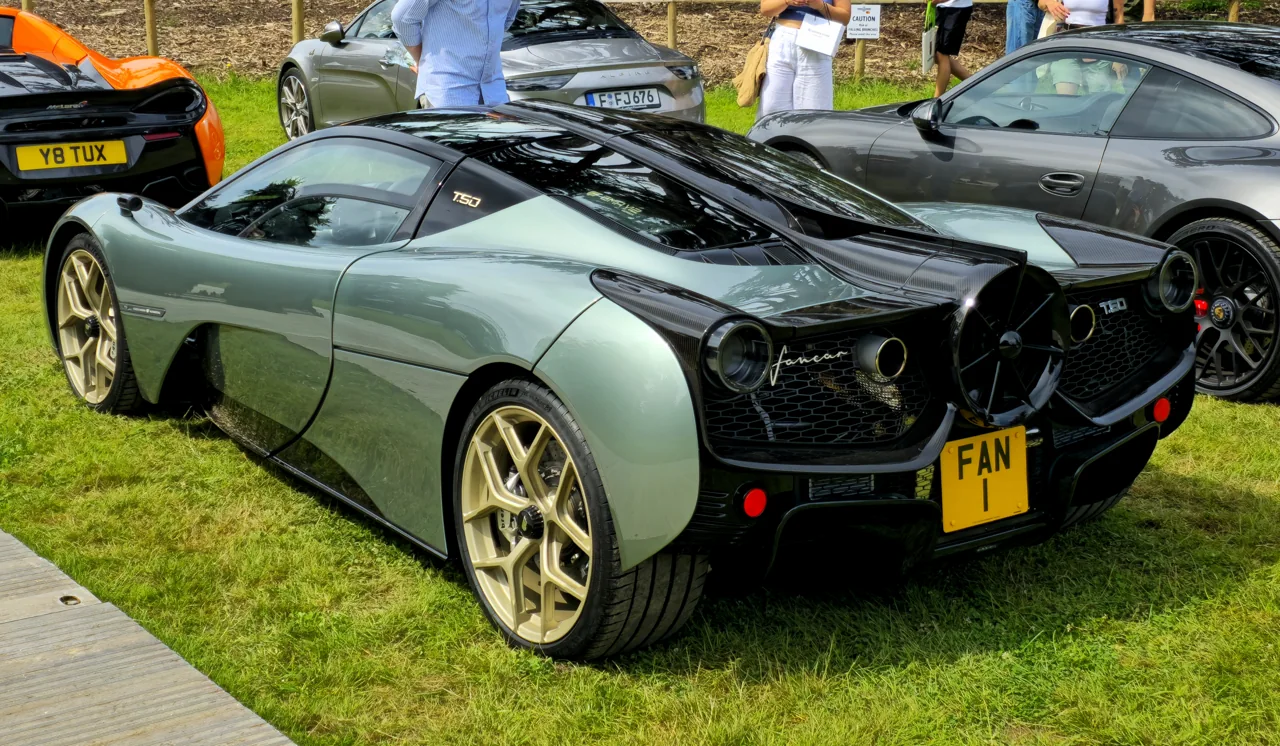

The Gordon Murray Automotive story
Gordon Murray’s road-car work gives unusual importance to packaging, mass and the driver’s position. T.50 established the modern company’s central-seat, naturally aspirated V12 proposition, with T.50s Niki Lauda taking that foundation towards the circuit. T.33 and T.33 Spider widen the road-car brief. The wider group’s Special Vehicles projects, including S1 LM and Le Mans GTR, belong alongside the main range but need their separate programme context.
The attraction is the clarity of the priorities. A compact footprint, a deliberate control layout and a demanding mass target are choices that shape the whole car. They also make the usual comparison by peak power particularly unhelpful. We would rather understand what the design preserves for the driver and what it gives up to do so.
Current lineup & programmes
Performance and specialist model families are listed below. Programme status describes the manufacturer’s published range or announcement, rather than stock or an available allocation. Open-top and special derivatives are grouped where they share a family; follow the model link for the distinctions.
Le Mans GTR
Bespoke programme · 2020s
S1 / S1 LM
Current programme · 2020s
T.33 / T.33 Spider
Current programme · 2020s
T.50
Current programme · 2020s
T.50s Niki Lauda
Track-only programme · 2020s
Past models
Past performance-car families relevant to our 1996–2026 archive. A surviving product page or conversion catalogue does not mean the original donor car remains in production.
This is a young programme without a separate completed road-model generation in our thirty-year archive. The current family and its development history are the starting point.
The SuperCarNews view
We think the seating arrangement is as important as the engine. A central position changes how the driver is placed within the car’s width and how the cabin is organised around that person. It is an expensive and demanding choice to make for a road car, which is why it communicates the programme’s priorities so clearly.
The fan deserves similarly careful explanation. It is part of an aerodynamic system, rather than a decorative reference to racing history. Its significance lies in how it allows the engineers to manage airflow and the relationship between the body and the road. We would not reduce that to a single downforce claim without the associated mode and operating conditions.
Our enthusiasm is for the coherence of the concept. The car asks what can be improved by treating mass, visibility and control interaction as central requirements. Whether every detail fulfils that promise remains a matter for direct evidence, but the published brief is specific enough to support a meaningful editorial opinion.
Le Mans GTR appears in the current Special Vehicles collection, with the manufacturer describing a road-oriented interpretation of its heritage. It belongs in that bespoke context. The name alone does not establish that it is a competition car, just as a road-related description does not establish an Australian registration outcome.
Our editorial interest is in how special programmes can reinterpret an established idea. They can create room for a more individual design position than a larger series would support. The strongest coverage will explain that position rather than treating a familiar racing reference as sufficient evidence of significance.