
In this article
- A contemporary argument for physical involvement
- T.50: the central driving position returns
- T.50s Niki Lauda: a different brief
- T.33 and Spider: a quieter visual statement
- S1 and S1 LM: the special-vehicle branch
- Le Mans GTR: the name needs context
- Reading the current specifications carefully
- The SuperCarNews view
A contemporary argument for physical involvement
Gordon Murray’s current cars are often described with the word analogue. That is useful only if it leads to an explanation. These are modern, highly engineered machines that choose to preserve particular physical interactions. Their appeal is not an absence of technology; it is the direction in which the engineering effort is spent.
Our view is that this makes them an important counterpoint within the current supercar range. A publication should be able to discuss a highly automated hybrid and a manual V12 with equal seriousness, because each can pursue a coherent purpose. This guide examines the published programmes and our interpretation of their priorities. SuperCarNews has not driven them, and no assessment of steering feel, engine response or comfort is implied.
T.50: the central driving position returns
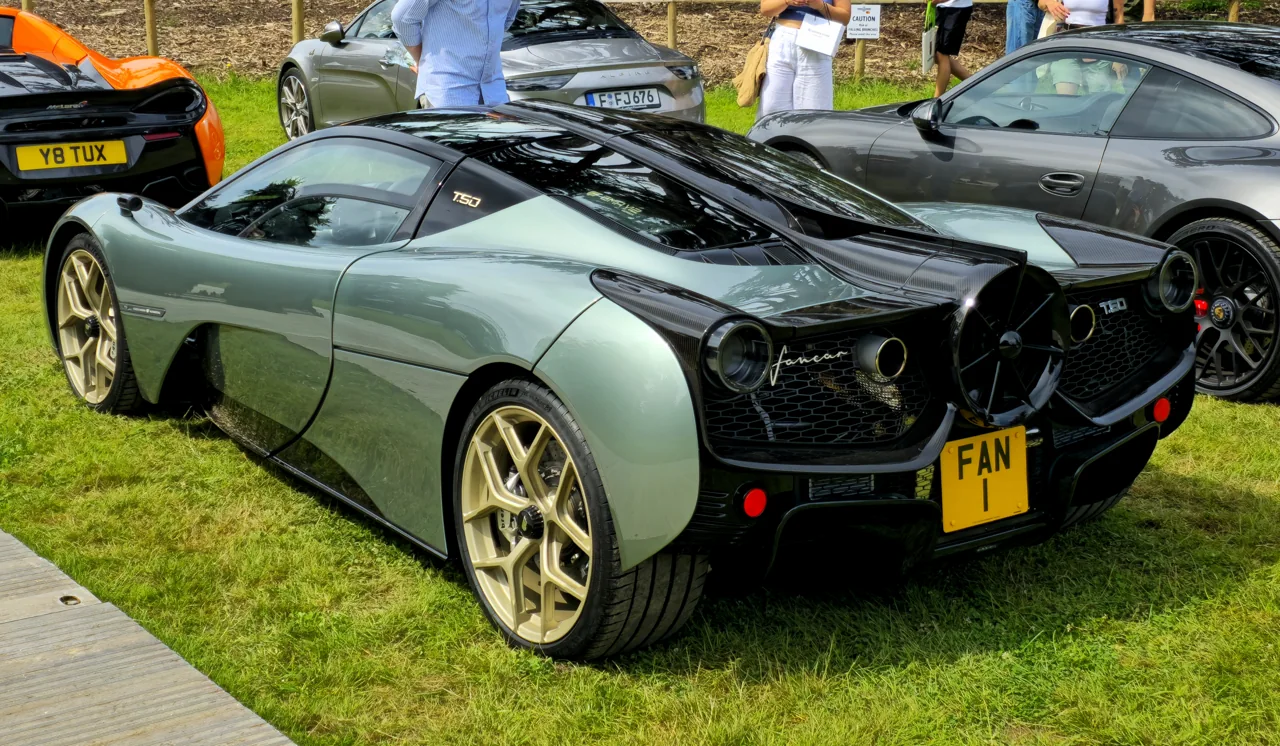
The T.50 combines a central driving position with a naturally aspirated Cosworth V12 and a rear-mounted aerodynamic fan. The official description identifies a 400 mm fan working with the rear aerodynamic system. This is a distinctive architecture, not simply a conventional supercar with an unusual detail attached to its tail.
We think the seating arrangement is as important as the engine. A central position changes how the driver is placed within the car’s width and how the cabin is organised around that person. It is an expensive and demanding choice to make for a road car, which is why it communicates the programme’s priorities so clearly.
The fan deserves similarly careful explanation. It is part of an aerodynamic system, rather than a decorative reference to racing history. Its significance lies in how it allows the engineers to manage airflow and the relationship between the body and the road. We would not reduce that to a single downforce claim without the associated mode and operating conditions.
Our enthusiasm is for the coherence of the concept. The car asks what can be improved by treating mass, visibility and control interaction as central requirements. Whether every detail fulfils that promise remains a matter for direct evidence, but the published brief is specific enough to support a meaningful editorial opinion.
T.50s Niki Lauda: a different brief
The T.50s Niki Lauda is the track-only branch. The manufacturer lists 25 examples and describes extensive changes from the road-going T.50, including a dedicated aerodynamic package and a more specialised version of the V12. It is therefore not appropriate to treat it as a road-car trim whose only difference is a larger wing.
We find the contrast useful because it shows the limits of a single definition of purity. A road car designed around an engaging manual interaction and a track car designed around a narrower performance environment can both be deliberate products. Their equipment and operating demands need not match.
The T.50s should be appreciated within that specialist setting. A circuit car can rely on preparation and support that do not describe ordinary road use. Explaining those requirements makes the engineering clearer rather than diminishing the excitement.
T.33 and Spider: a quieter visual statement
The T.33 and T.33 Spider retain a naturally aspirated Cosworth V12 while choosing a different body and cabin arrangement from the T.50. The official T.33 account describes a six-speed manual transmission and an aerodynamic approach using underbody ducting and a discreet active rear spoiler rather than the T.50’s fan.
We are particularly drawn to the restraint of the design in the published photographs. A clean upper surface gives the proportions room to communicate the car’s purpose. It is a useful reminder that a contemporary supercar can look technically serious without placing every aerodynamic element on conspicuous display.
The Spider develops another part of the experience. An open cabin changes how the occupants relate to the surroundings and how the interior is seen. That is a substantive design subject, not merely a weight comparison with the coupé. We would want any future assessment to explain the practical quality of that open-air arrangement alongside the mechanical specification.
The distinction between T.33 and T.50 is also healthy for the range. A less visually unusual architecture does not have to be a lesser idea. It can make a different balance of priorities available while preserving the emphasis on a clear relationship between person and machine.
S1 and S1 LM: the special-vehicle branch
The S1 was announced in August 2026. Its official page describes a touring-focused development of the S1 LM, with a 4.2-litre V12, a central driving position and a three-seat cabin. The announced programme is 64 cars. Those facts establish the intended product, not the delivery status of an individual example.
We find the touring emphasis an interesting development. It asks how a highly concentrated supercar philosophy can make room for longer journeys, more insulation and a more accommodating cabin without losing its central purpose. That is a difficult design balance, and a worthwhile one.
The S1 LM remains a separately identified special-vehicle project. The family relationship is useful context, but specifications should not be moved between the two without checking the source. A programme developed around a different intended use can retain familiar architecture while changing what matters to the owner.
Le Mans GTR: the name needs context
Le Mans GTR appears in the current Special Vehicles collection, with the manufacturer describing a road-oriented interpretation of its heritage. It belongs in that bespoke context. The name alone does not establish that it is a competition car, just as a road-related description does not establish an Australian registration outcome.
Our editorial interest is in how special programmes can reinterpret an established idea. They can create room for a more individual design position than a larger series would support. The strongest coverage will explain that position rather than treating a familiar racing reference as sufficient evidence of significance.
Reading the current specifications carefully
The source pages checked for this guide contain some inconsistent figures between their descriptive copy and technical tables. We have therefore avoided publishing a definitive cross-model output or weight ranking from those pages. The architecture and programme descriptions provide enough material for this feature without selecting whichever conflicting number makes the strongest headline.
The manufacturer also states that current allocations are reserved. That is different from saying every programme has ended production. Our catalogue uses programme labels to preserve that distinction. Availability, delivery timing and local approval are separate facts that need their own evidence.
The SuperCarNews view
The most persuasive part of Gordon Murray’s current work is the insistence that the driver’s interaction can be the primary engineering goal. Weight control, a physical gearshift, a clear view and understandable instruments can justify substantial development effort. That is a meaningful alternative to judging every new car by the largest possible output.
Our reservation is that a persuasive philosophy still needs to be fulfilled in the actual car. Attractive explanations of purity should not exempt any product from practical scrutiny. These programmes are worth following because their priorities are clear enough to be assessed, not because their stated intentions make criticism unnecessary.
Sources & further reading
Reporting is based on the manufacturer material below. Photographs are credited separately.
- Gordon Murray current vehicle programmes
- Gordon Murray T.50
- Gordon Murray T.50s Niki Lauda
- Gordon Murray T.33
- Gordon Murray S1
- Gordon Murray S1 LM
- Gordon Murray Le Mans GTR
Explore the manufacturer directory for company history and model lineups.