
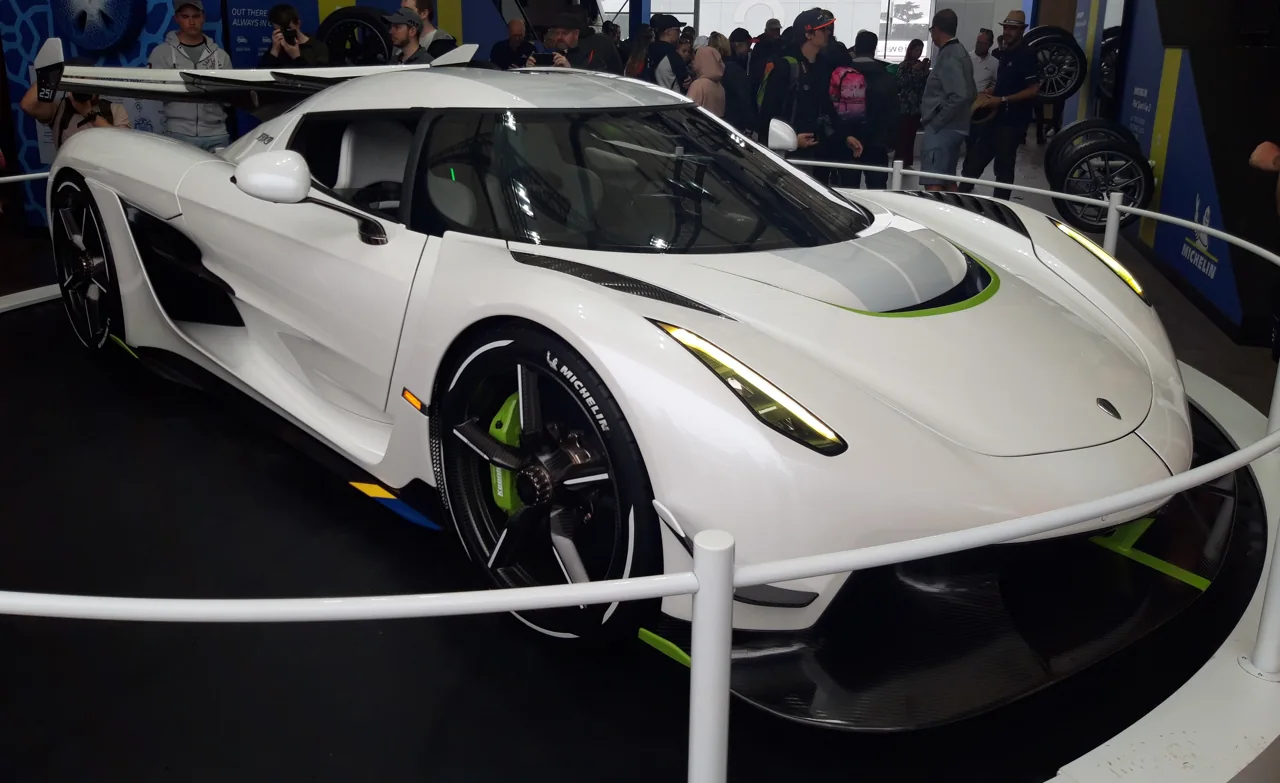

The Koenigsegg story
Koenigsegg’s road-car progression runs from CC8S and CCR through CCX, Agera and Regera to the present Jesko, CC850 and Gemera programmes. The company has repeatedly made the transmission and powertrain architecture part of the car’s identity. It is a history of mechanical problem-solving as much as steadily increasing performance figures. The four-seat Gemera also widens the brief beyond the two-seat hypercar shape most associated with the marque.
The archive makes more sense when those ideas are followed individually. Regera’s approach to transmitting power differs fundamentally from the thinking behind CC850’s driver interface. Jesko Attack and Absolut represent different aerodynamic priorities. Understanding the distinction is more useful than arranging all of them in a single horsepower table.
Current lineup & programmes
Performance and specialist model families are listed below. Programme status describes the manufacturer’s published range or announcement, rather than stock or an available allocation. Open-top and special derivatives are grouped where they share a family; follow the model link for the distinctions.
Jesko Attack / Absolut
Current programme · 2010s
CC850
Current programme · 2020s
Gemera
Current programme · 2020s
Sadair’s Spear
Current programme · 2020s
Past models
Past performance-car families relevant to our 1996–2026 archive. A surviving product page or conversion catalogue does not mean the original donor car remains in production.
CC8S / CCR
Archive · 2000s
CCGT
Track-only archive · 2000s
CCX / CCXR / Edition / Trevita
Archive · 2000s
Agera / R / S / RS / Final
Archive · 2010s
One:1
Archive · 2010s
Regera
Archive · 2010s
The SuperCarNews view
We think the early cars are particularly interesting for their relative visual simplicity. Their low, concentrated shape makes the architecture clear, while the unusual roof and door arrangements provide memorable detail. It is tempting to discuss them only as preliminary steps towards later records, but they deserve attention as the first coherent expression of a new manufacturer’s ideas.
That first expression also establishes an important standard for the rest of the archive. A small company can make ambitious claims; turning a set of ideas into supported customer cars is a different achievement. The production history matters because it distinguishes the realised programme from the attractive possibility of a show car.
The current Gemera page describes a four-seat car with a hot-V8 hybrid arrangement, a Dark Matter electric motor and a nine-speed Light Speed Tourbillon Transmission. Koenigsegg quotes 2,300 hp combined and a 300-car programme. Earlier descriptions of the project should not be mixed into a current specification without identifying the development stage they described.
The seating arrangement is the more consequential fact for this archive. The Gemera asks whether a hypercar’s central experience can be shared with more than one passenger without abandoning a recognisable mid-engined identity. That is a substantial packaging and design challenge, not merely an extra row of seats added to a familiar shape.
We think the idea is worthwhile because it changes the purpose of the car. A machine that can include family or friends may be used for different journeys and remembered for different reasons. The published claims about space and comfort remain manufacturer claims, but the ambition to broaden participation is a distinctive contribution to a category often organised around exclusivity.