
In this article
- Why the mechanisms deserve the headline
- CC8S and CCR: establishing the engineering habit
- CCX and CCXR: fuel becomes part of the specification
- CCGT: a separate competition project
- Agera: a family with important differences
- One:1: the number is the name
- Regera: questioning the conventional gearbox
- Jesko Attack and Absolut: choose the problem
- Sadair’s Spear: a more focused branch
- CC850: complexity in the service of tactility
- Gemera: four seats change the question
- The SuperCarNews view
Why the mechanisms deserve the headline
Koenigsegg is easy to describe through enormous output figures and record attempts. It is more rewarding to describe through its willingness to question familiar mechanisms. The transmission, the relationship between combustion and electric power, the choice of fuel and even the number of seats become subjects for reinvention. That gives the marque an identity beyond being an ambitious entrant in a speed contest.
Our view is that the best way to understand these cars is to ask what problem each unusual solution is trying to solve. Novelty alone is not proof of superiority, but a clear engineering argument is worth serious attention. This guide follows the road-car families relevant to the 1996–2026 period, with the CCGT competition project separately identified. It is research and editorial analysis; SuperCarNews has not driven these cars.
CC8S and CCR: establishing the engineering habit
Koenigsegg identifies the CC8S as its first production model, with six examples built in 2002 and 2003 after an earlier public debut. Its carbon structure and removable roof established features that continued to matter in later cars. The CCR followed as an evolution, with the manufacturer recording 14 examples produced between 2004 and 2006.
We think the early cars are particularly interesting for their relative visual simplicity. Their low, concentrated shape makes the architecture clear, while the unusual roof and door arrangements provide memorable detail. It is tempting to discuss them only as preliminary steps towards later records, but they deserve attention as the first coherent expression of a new manufacturer’s ideas.
That first expression also establishes an important standard for the rest of the archive. A small company can make ambitious claims; turning a set of ideas into supported customer cars is a different achievement. The production history matters because it distinguishes the realised programme from the attractive possibility of a show car.
CCX and CCXR: fuel becomes part of the specification
The CCX and CCXR continued the early family, with Edition and other limited interpretations adding further distinctions. Koenigsegg’s CCXR account makes flex-fuel capability central to the model’s identity and quotes its higher output on E85. That qualification is essential to a useful specification.
We would not publish the largest available power figure without naming the fuel condition. A car can produce different outputs under different circumstances, and a reader deserves to know which one is being described. This is especially important when comparing a Koenigsegg with a rival whose figure assumes ordinary pump fuel.
The broader engineering lesson is more interesting than a larger number. Fuel characteristics can become a deliberate part of a performance strategy. Whether a particular owner can readily obtain the relevant fuel is a separate practical question. Technical possibility and everyday convenience are not the same thing, even when both deserve discussion.
CCGT: a separate competition project
The CCGT appears in Koenigsegg’s legacy collection, but belongs to the competition branch rather than the ordinary road-car sequence. Its inclusion helps explain the company’s wider ambitions without suggesting that it was simply another showroom specification of a CCX.
We think that distinction is important to any credible archive. A racing project can be historically significant even when it does not develop into a large customer programme. The intended regulations and environment shape the machine. Treating it as a road car with fewer comforts would obscure the actual purpose of the work.
Agera: a family with important differences
The Agera family includes the original model, R, S, RS and concluding special interpretations. Koenigsegg’s technical account identifies a twin-turbo direction and a seven-speed transmission, while the individual versions differ in specification and fuel-related output. They should be discussed as a related family without being assigned one universal power figure.
Our interest is in the way the Agera develops an established identity while changing significant parts of the mechanical arrangement. The recognisable silhouette can make that evolution appear smaller than it is. A useful article should therefore look beneath the family resemblance and explain which engineering decisions actually changed.
The RS also illustrates why record coverage needs careful conditions. A result belongs to a particular car, configuration and test. It does not automatically transfer to every related example. Readers can appreciate an achievement more clearly when the measurement context remains attached, rather than being reduced to a permanent superlative that later events may make inaccurate.
One:1: the number is the name
Koenigsegg describes the One:1 around a claimed one-horsepower-per-kilogram relationship, with seven examples built during 2014–2015. Its published material quotes 1,360 hp and a 1,360 kg curb-weight condition. The precise definition of that weight and the fuel used are part of the claim, not inconvenient footnotes.
We find the idea compelling as a way of making mass as prominent as output. A car’s power figure receives attention very easily; the effort required to control weight can be less visible. The One:1’s name forces those subjects into the same sentence. That is useful, provided the comparison is not then simplified so aggressively that different measurement conventions disappear.
Our reservation is that a memorable ratio can become a substitute for discussing the rest of the car. Aerodynamics, control response and intended use still matter. The number gives the programme a strong introduction, but it should lead into the engineering story rather than conclude it.
Regera: questioning the conventional gearbox
The Regera combines combustion and electrical power with Koenigsegg Direct Drive. The manufacturer explains that this replaces a conventional multi-ratio transmission arrangement with a different connection between the engine and rear axle. It is one of the clearest examples of the company challenging a mechanism that most manufacturers would simply select and refine.
We think the interesting point is the willingness to define a broader performance brief. The Regera is not merely an Agera with another source of power. Its arrangement asks how exceptional acceleration and a more accommodating grand touring character might be combined through a different system.
That ambition also makes integration central to any eventual appraisal. The owner operates one car, while several sources of torque and several control strategies work underneath. The quality of the result lies in making those interactions coherent. We can explain why the architecture is unusual without claiming to know how it feels from the driver’s seat.
Jesko Attack and Absolut: choose the problem
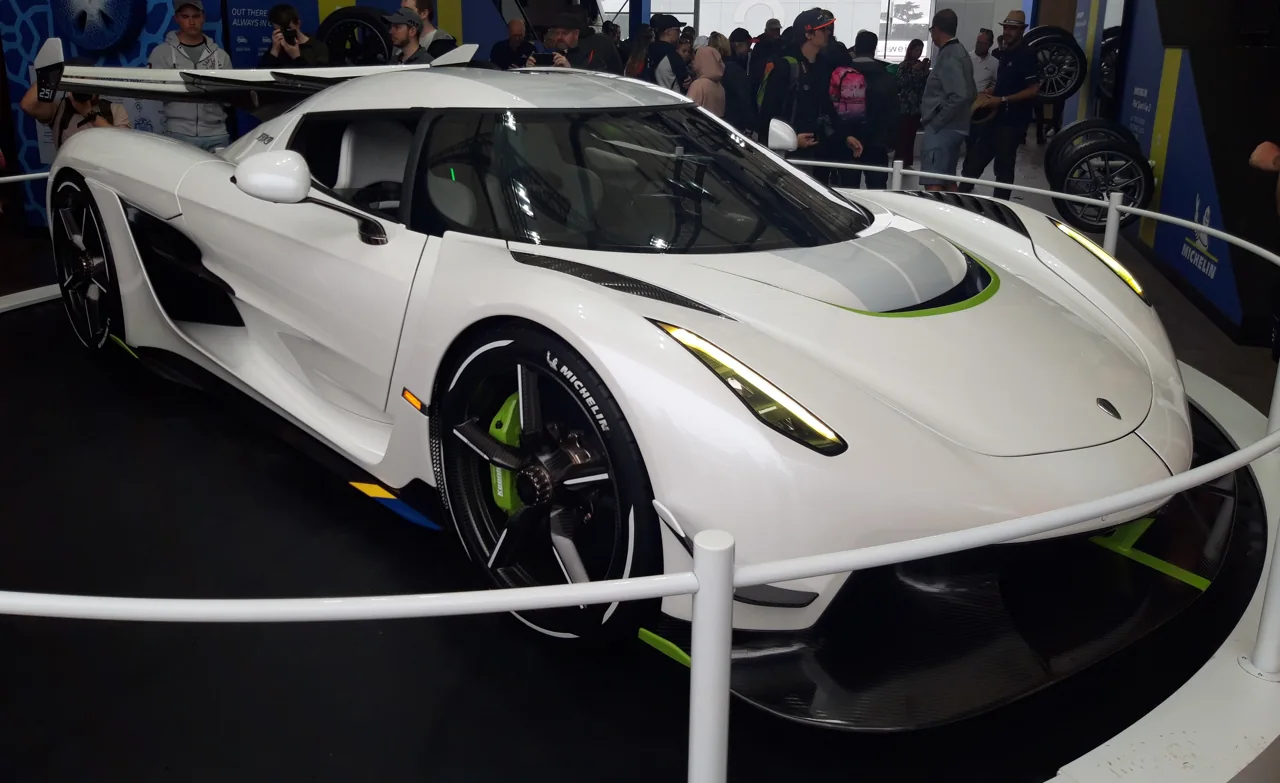
Koenigsegg lists Jesko Attack and Jesko Absolut within its current programme. Their separate names make the distinction between aerodynamic priorities visible in the range itself. The company’s engine account quotes 1,280 hp, or 1,600 hp on E85, for the Jesko V8, again making fuel context indispensable.
We like the clarity of offering distinct answers rather than implying that one aerodynamic configuration is ideal for every task. A car organised around substantial circuit load and a car organised around minimising drag have different demands. The existence of two approaches helps readers understand that performance is a collection of trade-offs rather than one steadily increasing quantity.
The Absolut also requires discipline around speed claims. A theoretical capability, simulation or manufacturer ambition is not a measured record. This guide does not convert one into the other. The engineering can be fascinating before a particular test result exists, and it remains worth explaining without an invented achievement attached.
Sadair’s Spear: a more focused branch
Sadair’s Spear was introduced in 2025 as a limited programme of 30 cars. Koenigsegg explicitly presents it as road legal while emphasising a track-focused purpose. That places it differently from the CCGT and prevents the phrase “track focused” from being mistaken for “track only.”
Our editorial question is how convincingly the focused brief distinguishes it within an already exceptional range. A derivative should have a reason beyond adding another scarce name. The most persuasive case will come from the relationship between its intended use and its changes to the underlying package. We would examine that relationship before deciding whether its exclusivity makes it the most desirable Koenigsegg for a particular reader.
CC850: complexity in the service of tactility
The CC850 looks back towards the CC8S while introducing the Engage Shift System. Koenigsegg describes one transmission providing a gated six-speed manual interaction and a nine-speed automatic mode. The programme is listed at 70 vehicles. This is a more unusual proposition than simply offering two conventional gearboxes as alternatives.
We find it one of the most interesting ideas in the current hypercar conversation. Sophisticated control and mechanical design are being used to create a particular human interaction, rather than only to remove work from the driver. That challenges the assumption that analogue appeal and technical complexity are opposites.
It also deserves careful language. The existence of a clutch pedal and gear gate does not mean the system is identical to an older conventional manual. Understanding what makes it different is part of appreciating the achievement. Whether the resulting interaction is convincing requires experience and evidence beyond the official explanation.
Gemera: four seats change the question
The current Gemera page describes a four-seat car with a hot-V8 hybrid arrangement, a Dark Matter electric motor and a nine-speed Light Speed Tourbillon Transmission. Koenigsegg quotes 2,300 hp combined and a 300-car programme. Earlier descriptions of the project should not be mixed into a current specification without identifying the development stage they described.
The seating arrangement is the more consequential fact for this archive. The Gemera asks whether a hypercar’s central experience can be shared with more than one passenger without abandoning a recognisable mid-engined identity. That is a substantial packaging and design challenge, not merely an extra row of seats added to a familiar shape.
We think the idea is worthwhile because it changes the purpose of the car. A machine that can include family or friends may be used for different journeys and remembered for different reasons. The published claims about space and comfort remain manufacturer claims, but the ambition to broaden participation is a distinctive contribution to a category often organised around exclusivity.
The SuperCarNews view
Koenigsegg’s strongest quality is the habit of making the mechanism itself worth discussing. CCXR, Regera, CC850 and Gemera each create a different argument about how a high-performance car should work. That is more valuable to an editorial archive than a list of changing records alone.
Our reservation is that the ingenuity can be hidden by the scale of the headline claims. Precise units, fuel conditions, programme status and measurement definitions make the story better, not less exciting. The cars are sufficiently ambitious that they do not need those distinctions blurred. Understanding the choices is the foundation for a considered opinion.
Sources & further reading
Reporting is based on the manufacturer material below. Photographs are credited separately.
- Koenigsegg current and legacy model list
- Koenigsegg CC8S history
- Koenigsegg CCR history
- Koenigsegg CCXR
- Koenigsegg Agera
- Koenigsegg One:1
- Koenigsegg Regera and Direct Drive
- Koenigsegg engine development
- Koenigsegg CC850 and Engage Shift System
- Koenigsegg Gemera current specification
- Koenigsegg Sadair’s Spear
Explore the manufacturer directory for company history and model lineups.