

The Maserati story
The Maserati brothers began their business in Bologna in 1914. The Tipo 26 became the first car to wear the trident in competition in 1926. That racing origin precedes the modern supercars by many decades, but it provides useful context for a marque whose road-car identity has repeatedly balanced sporting ambition with grand touring.
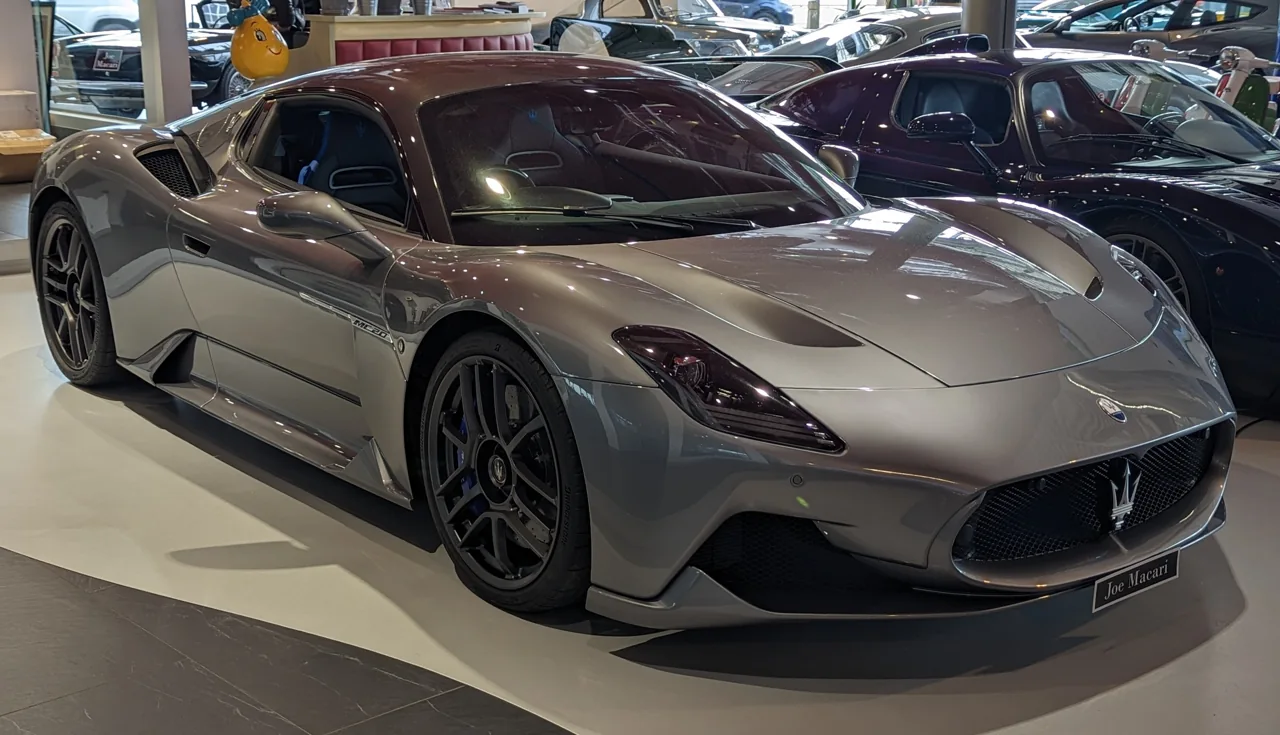
Maserati’s supercar history over the past thirty years is punctuated by MC12 and the later MC20 family. MC12 linked a limited road car to a separate competition-era identity, while MC20 brought a carbon-structure, mid-engined road car to a marque also known for grand touring. MCPURA develops that more recent line. GT2 Stradale and MCXtrema introduce different degrees of circuit emphasis, alongside the distinct GranTurismo and GranCabrio families.
The contrast between GT and supercar is the most useful way into the range. Long-distance accommodation and a mid-engined two-seat layout answer different questions. Maserati benefits when the differences are explicit, rather than when every new model is asked to carry the same vague promise of sporting luxury.
Current lineup & programmes
Performance and specialist model families are listed below. Programme status describes the manufacturer’s published range or announcement, rather than stock or an available allocation. Open-top and special derivatives are grouped where they share a family; follow the model link for the distinctions.
GranTurismo / GranCabrio / Trofeo / Folgore second generation
Current range · 2020s
GT2 Stradale
Current range · 2020s
MC20 / Cielo / Icona / Leggenda
Range transition · 2020s
MCPURA / Cielo
Current range · 2020s
MCXtrema
Track-only programme · 2020s
Past models
Past performance-car families relevant to our 1996–2026 archive. A surviving product page or conversion catalogue does not mean the original donor car remains in production.
GranTurismo / GranCabrio first generation
Archive · 2000s
MC12 Stradale
Archive · 2000s
MC12 Versione Corse
Track-only archive · 2000s
The SuperCarNews view
The MC12 Stradale belongs to 2004–2005. Maserati records 50 road cars, a six-litre V12 and a relationship to Ferrari's Enzo, with substantial changes for Maserati's racing objectives. That origin is the important point. This was not simply a grand tourer given more power or a differently styled Ferrari intended to occupy the same place in the showroom.
Its unusually extended body makes the racing brief visible. In photographs, the cabin seems contained within an aerodynamic object of a much larger scale. We find that more compelling than a styling exercise whose aggression has no obvious engineering purpose. Equally, a shape dictated by competition does not automatically make a better road companion. Width, visibility and the ability to place the car on ordinary roads would be central questions in any proper evaluation.
The MC12's significance is therefore not dependent on declaring it superior to the Enzo. The comparison is useful precisely because shared ancestry produced different priorities. Maserati used a limited road-car programme to support a return to international GT competition. That is a clear editorial identity, and a stronger reason to remember the car than production scarcity alone.
The earlier GranTurismo and GranCabrio belong to Maserati's front-engined grand-touring story. Their successors broaden that idea through combustion and electric Folgore versions. Maserati's 2026 range update also revises the Trofeo offering, so older launch specifications should not automatically be applied to a current car.
These models earn space here because the contrast improves our understanding of the mid-engined range. Seating, luggage and the ability to share a long journey are substantive design objectives. A car does not become less worthy of serious writing because its brief includes them. Equally, strong acceleration does not turn a four-seat grand tourer into an MC12 substitute.