
In this article
- A marque with two distinct ambitions
- MC12: the road car with a racing obligation
- Versione Corse: beyond the road-car brief
- MC20: rebuilding the centre of gravity
- MCPURA: development rather than reinvention
- GT2 Stradale: the road-going specialist
- MCXtrema: a separate track proposition
- GranTurismo: useful context, a different mission
- The SuperCarNews view
A marque with two distinct ambitions
Maserati makes more sense when we resist forcing all of its cars into the same category. The long-distance elegance of a GranTurismo and the competition-led proportions of an MC12 are different answers to different questions. Both belong in this archive, but calling them interchangeable supercars would obscure the decisions that make each interesting. Our focus is the specialist mid-engined line, with the grand tourers providing context for the marque around it.
That distinction matters especially now. A new badge, a track derivative and a replacement model can all appear in the same news cycle. Readers need to know whether the underlying proposition has changed, whether the car can be registered, and whether a specification applies to the actual version being discussed. The following is a researched assessment of those propositions. It contains no claim that SuperCarNews has driven these cars.
MC12: the road car with a racing obligation
The MC12 Stradale belongs to 2004–2005. Maserati records 50 road cars, a six-litre V12 and a relationship to Ferrari's Enzo, with substantial changes for Maserati's racing objectives. That origin is the important point. This was not simply a grand tourer given more power or a differently styled Ferrari intended to occupy the same place in the showroom.
Its unusually extended body makes the racing brief visible. In photographs, the cabin seems contained within an aerodynamic object of a much larger scale. We find that more compelling than a styling exercise whose aggression has no obvious engineering purpose. Equally, a shape dictated by competition does not automatically make a better road companion. Width, visibility and the ability to place the car on ordinary roads would be central questions in any proper evaluation.
The MC12's significance is therefore not dependent on declaring it superior to the Enzo. The comparison is useful precisely because shared ancestry produced different priorities. Maserati used a limited road-car programme to support a return to international GT competition. That is a clear editorial identity, and a stronger reason to remember the car than production scarcity alone.
Versione Corse: beyond the road-car brief
The MC12 Versione Corse followed as a track-only, non-competitive customer car derived from the racing programme. Maserati's historical material identifies a 2006 introduction and a much more powerful unrestricted V12 specification. It should not be confused with either the Stradale or a road car carrying a competition-inspired option package.
A car freed from road requirements invites a different judgement. Windscreen visibility in traffic is no longer the primary concern; operating support, circuit access and the demands placed on its driver become more important. Our interest lies in whether a customer can meaningfully experience the engineering, rather than merely own it. A striking number on a specification sheet says little about that relationship.
MC20: rebuilding the centre of gravity
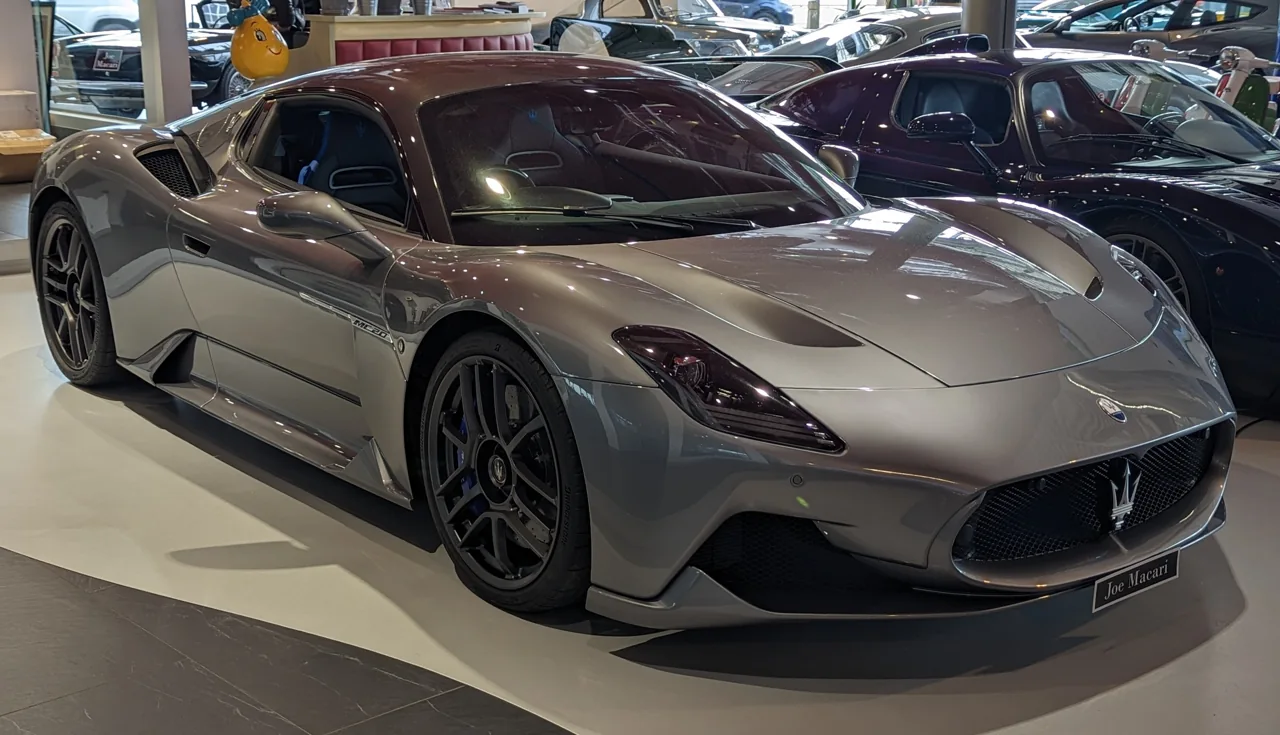
The MC20 brought a modern carbon-structure, mid-engined supercar back to Maserati's centre. The Nettuno twin-turbo V6, butterfly doors and comparatively restrained exterior made a coherent visual statement: technical ambition without a body covered in decorative aggression. The Cielo added an open-roof interpretation, while Icona and Leggenda commemorated the MC12 connection through limited editions.
We think the relatively clean shape is one of the MC20's most persuasive qualities. There is enough distinction in its proportions and door opening to establish its role without relying on an enormous fixed wing. That observation is about design, not a claim about aerodynamic efficiency or how the car feels at speed.
The temptation is to assess every Maserati through Ferrari. That becomes unhelpful once it prevents discussion of the Maserati on its own terms. The relevant questions are whether the controls, cabin and powertrain make a consistent whole, and whether support matches the expectations attached to a specialist carbon-bodied car. Those require inspection and driving evidence that a launch announcement cannot provide.
MCPURA: development rather than reinvention
MCPURA and MCPURA Cielo are the current evolution of this mid-engined family. The official catalogue retains the 630 CV Nettuno V6 proposition. The new name deserves reporting, but it should not erase the relationship to the MC20 or imply an entirely unrelated technical starting point.
Continuity is not a criticism. Developing an existing architecture can produce a more considered result than repeatedly replacing it for a launch headline. Our preference would be for revisions that make the car easier to see out of, operate and maintain, alongside any changes to appearance. Those benefits may matter more to an owner than a marginal increase in peak output.
The Cielo also deserves its own reasoning within the family. Open-roof use changes the experience a buyer seeks, so the discussion should include roof operation, luggage arrangements and exposure to the engine's sound. We would not assume that the coupé's priorities automatically make it the right choice for everyone.
GT2 Stradale: the road-going specialist
GT2 Stradale uses Maserati's competition programme as the basis for a more focused road-legal derivative. It is distinct from the GT2 racing car. Its visual and technical emphasis shifts towards circuit use, with more obvious aerodynamic hardware and a lighter, more purposeful specification than the original MC20 proposition.
For us, this is where a manufacturer must explain trade-offs clearly. More focus can bring genuine rewards on a circuit while making a car less convenient elsewhere. A good editorial assessment should ask which adjustments remain usable by an ordinary owner, what tyre specification underpins the published performance and how consumables behave during repeated sessions. It should not award a blanket victory because a wing is larger.
The Stradale is most interesting as an alternative brief within the family. It gives a reader a meaningful choice between a cleaner road-oriented design, an open car and a more circuit-directed version. That is more useful than presenting all three as positions on a simple good-better-best ladder.
MCXtrema: a separate track proposition
MCXtrema moves beyond that compromise. Maserati describes a 62-car track-only programme with a 740 CV Nettuno-derived engine. Road legality must not be inferred from the presence of familiar mechanical ancestry or from the fact that the customer, rather than a professional team, owns the car.
We would judge a programme like this partly on everything surrounding the machine. Engineering support, coaching, spare parts and access to suitable events determine whether extreme capability becomes a repeatable experience. These are not dull footnotes to a spectacular object; they are what allows that object to fulfil its purpose. The published specification begins the discussion rather than ending it.
GranTurismo: useful context, a different mission
The earlier GranTurismo and GranCabrio belong to Maserati's front-engined grand-touring story. Their successors broaden that idea through combustion and electric Folgore versions. Maserati's 2026 range update also revises the Trofeo offering, so older launch specifications should not automatically be applied to a current car.
These models earn space here because the contrast improves our understanding of the mid-engined range. Seating, luggage and the ability to share a long journey are substantive design objectives. A car does not become less worthy of serious writing because its brief includes them. Equally, strong acceleration does not turn a four-seat grand tourer into an MC12 substitute.
The SuperCarNews view
Maserati's strongest supercar story is the tension between competition ambition and an unusually elegant road-car identity. The MC12 expresses one extreme; the clean-bodied MC20 and MCPURA express another. GT2 Stradale and MCXtrema then let readers follow the decisions involved in moving towards a circuit brief.
Our editorial preference is to keep those distinctions visible. The most powerful or rarest version is not automatically the most convincing. The car worth remembering is the one whose design, engineering and intended use tell the same story. That is the standard these Maseratis deserve to be assessed against when direct experience becomes available.
Sources & further reading
Reporting is based on the manufacturer material below. Photographs are credited separately.
- Maserati MC12 historical specification
- Maserati MC12 Versione Corse
- MC20 Icona and Leggenda
- MCPURA global catalogue
- MCPURA, GT2 Stradale and MCXtrema at Goodwood
- Maserati 2026 GranTurismo and GranCabrio range
- GranTurismo production history
Explore the manufacturer directory for company history and model lineups.