
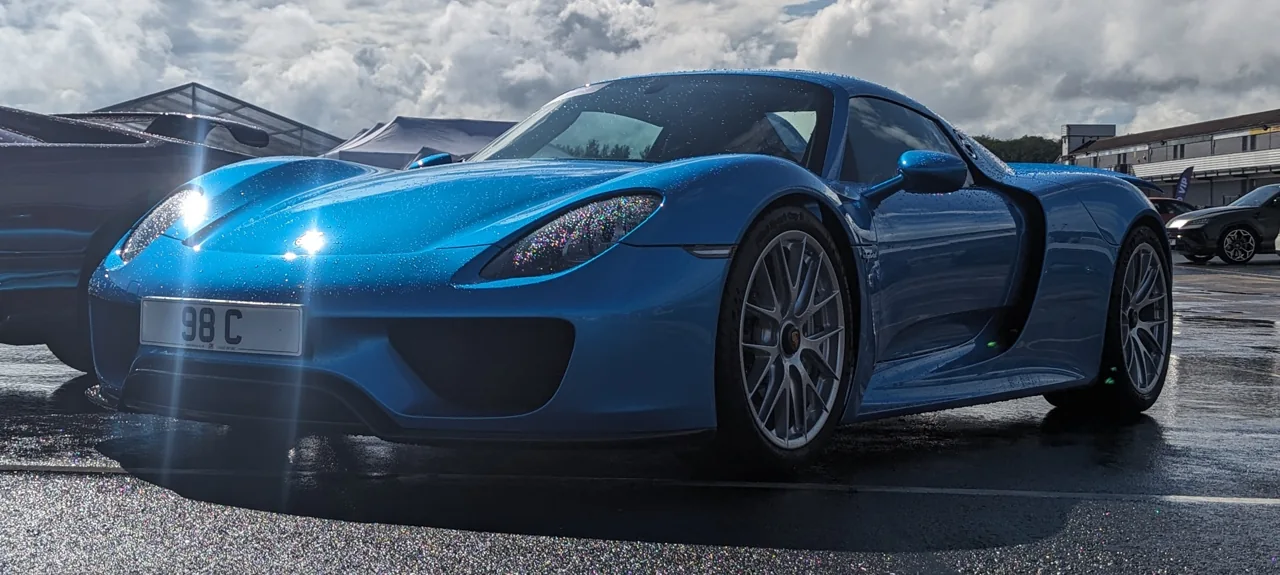

The Porsche story
The first sports car to carry the Porsche name was the 356 No. 1 Roadster in 1948, built in Gmünd. The later return to Stuttgart and development of the 356 and 911 established a recognisable sports-car lineage. Occasional departures such as Carrera GT are especially interesting against that background of continuous development.
Porsche’s performance-car history combines continuous development of the 911 with occasional projects that take a very different route. The rear-engined line runs through air-cooled 993, water-cooled 996 and the later 997, 991 and 992 generations. Alongside it, the 911 GT1 road car, Carrera GT and 918 Spyder pursued specialist architectures that cannot be understood as expensive 911 derivatives. Cayman and Boxster added a separate mid-engined sports-car tradition.
The archive is especially rewarding because the badges recur while their context changes. GT3, GT2, Turbo and RS refer to different engineering priorities, and their meaning depends on the generation. A current lineup should preserve those distinctions instead of treating every powerful Porsche as a substitute for every other one.
Current lineup & programmes
This profile focuses on Porsche’s supercars and specialist GT models. The 911 Carrera range and Porsche’s other passenger-car families are available through the official model overview. Earlier S/T and Dakar commissions are not represented as current orderable derivatives.
911 992: Turbo / Turbo S / GT3 / Touring / GT3 RS
Current performance families; derivative availability varies
911 GT3 S/C
Announced programme
718 Cayman GT4 RS / Spyder RS
Range transition
Past models
Past performance-car families relevant to our 1996–2026 archive. A surviving product page or conversion catalogue does not mean the original donor car remains in production.
911 993 Turbo / Turbo S / GT2 / Carrera RS
Archive · 1990s
911 996 Turbo / Turbo S / GT2 / GT3 / GT3 RS
Archive · 1990s
911 GT1 Strassenversion
Archive · 1990s
911 997 Turbo / Turbo S / GT2 / GT2 RS / GT3 / RS 4.0
Archive · 2000s
Carrera GT
Archive · 2000s
911 991 Turbo / Turbo S / GT3 / RS / GT2 RS / R / Speedster
Archive · 2010s
918 Spyder / Weissach
Archive · 2010s
Concepts & prototypes
These projects are kept separate from confirmed production cars.
Mission X
Concept · 2020s
The SuperCarNews view
The 993 generation was produced from 1993 to 1998 and forms the opening chapter of this archive’s 911 coverage. Porsche identifies it as the final air-cooled generation. Turbo, Turbo S, GT2 and Carrera RS belong to different branches of that family, with the GT2’s more focused brief distinct from the broader Turbo proposition.
We think the air-cooled label is historically important but can become an unhelpful shortcut for a verdict. It tells the reader something about the engineering and the period; it does not prove that every 993 is preferable to every later 911. The specific model, condition and intended use remain essential.
The generation’s design is particularly interesting for the way it preserves a familiar silhouette while refining the surfaces around it. That balance gives the 993 a visual coherence that explains part of its appeal without requiring a romantic claim about driving sensations. It can be admired as a resolved design as well as a historical endpoint.
Mission X is included as a concept reference in the flagship story. Porsche’s press material places it in conversation with earlier landmark super-sports cars. That does not establish a production specification, a customer allocation or a delivery date, and this guide does not invent those details.
Concepts are worth writing about when they raise a clear design question. They become misleading when an archive presents them with the same certainty as a completed customer programme. We can discuss the ambition and the historical context while keeping the status visible.
Sources & further reading
- Porsche official model overview
- Company origins and heritage
- Porsche: sixty years of 911 generations
- Porsche: the 993 generation
- Porsche: twenty-five years of GT3
- Porsche: the 991 generation
- Porsche super-sports-car history
- Porsche Carrera GT and 918: conceptual predecessors
- Porsche current 911 model newsroom
- Porsche 911 Turbo S T-Hybrid technical summary
- Porsche 911 GT3 S/C announcement, April 2026
- Porsche 718 model newsroom
- Porsche 718 Spyder RS powertrain