
In this article
- Why one Porsche badge can describe several ideas
- 993: the end of the air-cooled chapter
- 996: a major change, not a footnote
- 997: the family becomes more intricate
- 991: the argument about involvement
- 992: distinct jobs within one silhouette
- GT3 S/C: an open-top branch
- 911 GT1: the name does not tell the whole story
- Carrera GT: a different flagship architecture
- 918 Spyder: a hybrid with a wider technical brief
- Cayman GT4 and Spyder: the mid-engined context
- Mission X: a concept belongs in its own category
- The SuperCarNews view
Why one Porsche badge can describe several ideas
Porsche complicates any simple definition of a supercar. A 911 Turbo, a GT3 RS and a Carrera GT can all deliver an extraordinary performance proposition, yet their architectures and intended uses differ substantially. Treating them as interchangeable because they share a crest loses the most interesting part of the story.
Our view is that Porsche’s strength lies in those distinctions. It can develop a broad road-car brief and a more specialised circuit-oriented one within the 911 family, while occasionally building a flagship around a different architecture entirely. This guide covers the relevant model families across 1996–2026, with adjacent sports cars included for context. It is researched history and editorial opinion, not a claim that SuperCarNews has driven these vehicles.
993: the end of the air-cooled chapter
The 993 generation was produced from 1993 to 1998 and forms the opening chapter of this archive’s 911 coverage. Porsche identifies it as the final air-cooled generation. Turbo, Turbo S, GT2 and Carrera RS belong to different branches of that family, with the GT2’s more focused brief distinct from the broader Turbo proposition.
We think the air-cooled label is historically important but can become an unhelpful shortcut for a verdict. It tells the reader something about the engineering and the period; it does not prove that every 993 is preferable to every later 911. The specific model, condition and intended use remain essential.
The generation’s design is particularly interesting for the way it preserves a familiar silhouette while refining the surfaces around it. That balance gives the 993 a visual coherence that explains part of its appeal without requiring a romantic claim about driving sensations. It can be admired as a resolved design as well as a historical endpoint.
996: a major change, not a footnote
The 996 brought a major change to the 911’s architecture and identity, including the move to water cooling. The Turbo and GT2 continued the forced-induction performance branch, while the GT3 arrived in 1999 and later gained an RS derivative. Porsche’s GT3 history makes that debut a clear starting point for a lineage that continues today.
Our view is that the 996 deserves to be discussed without making its appearance the opening and closing argument. A generation can be stylistically divisive and historically consequential. The GT3 programme in particular established a durable relationship between a road-going 911 and a more focused technical brief.
That does not mean the early GT3 should be judged only as the ancestor of later cars. Its period-specific choices are part of its identity. A useful archive explains those choices rather than assuming that a later specification is the standard against which every older model must be found wanting.
997: the family becomes more intricate
The 997 expanded the range of ways a reader could understand a high-performance 911. Turbo and Turbo S, GT2 and GT2 RS, GT3 and successive RS versions occupied different positions. The RS 4.0 is an important specialist member of the family, but it should not become a stand-in for every 997 GT car.
We find this generation particularly useful for discussing the limits of badge-based hierarchies. A Turbo and a GT3 are not simply two rungs on one ladder. One can appeal through breadth, another through concentration. The right comparison begins with the intended experience rather than the assumption that the rarer or more expensive version must be universally superior.
The same discipline helps with the distinction between ordinary road use and circuit priorities. A specification that creates advantages in one environment may introduce compromises elsewhere. Explaining that relationship gives the reader more than a list of power increases and production totals.
991: the argument about involvement
The 991 family includes Turbo and Turbo S, GT3 and GT3 RS, GT2 RS, 911 R and Speedster interpretations. Porsche’s history records the generation’s broad development and the significance of the more specialised versions. The range offers several different answers to what an involved driving experience might mean.
We think that is the most interesting conversation around these cars. A manual transmission, an automated gearbox, a dramatic aerodynamic package and a relatively restrained body can each serve a deliberate purpose. None should be treated as a universal certificate of authenticity.
The 911 R and Speedster are particularly useful counterpoints to the more visibly circuit-oriented variants. They show that a manufacturer can make a special car by changing the interaction and occasion rather than merely increasing aerodynamic intensity. We can discuss that conceptual distinction without pretending to have assessed the steering, ride or gearbox from the driver’s seat.
992: distinct jobs within one silhouette
The 992 continues the split between the Turbo family and the GT3, Touring and GT3 RS branches, with S/T and Dakar providing further specialised interpretations. The catalogue groups the generation, but the article does not imply that every limited derivative remains in active production simply because the broader 992 range is current.
The current Turbo S introduces Porsche’s T-Hybrid arrangement, with a published 711 PS system output and two electric exhaust turbochargers. Porsche offers coupé and cabriolet forms. These are manufacturer specifications, and the relevant model year matters when comparing them with an earlier 992 Turbo S.
We find the coexistence of that hybrid direction with the naturally aspirated GT3 family especially revealing. Porsche is not applying one technical answer indiscriminately across every high-performance 911. Different briefs can justify different solutions within a recognisable shape.
The GT3 RS’s visual intensity also makes it a useful editorial subject. A large aerodynamic presence communicates a purpose, but it does not establish that every owner needs the same configuration. We would rather explain why a Touring, S/T or Turbo might appeal to a different reader than treat them as incomplete versions of the most dramatic car.
GT3 S/C: an open-top branch
Porsche announced the 911 GT3 S/C in April 2026 as a 2027 model-year car for the US market. The official account describes an open-top, manual-only interpretation of the high-revving naturally aspirated flat-six formula. The announcement date and model-year designation are different facts, and neither should be silently converted into an Australian delivery claim.
Our interest is in the way this expands the meaning of a GT3-derived experience. It gives the open-air occasion and the manual interaction a central role, rather than assuming that the logical next step is always a more aggressive circuit specification. That makes it a useful new branch to discuss alongside the Speedster and Spyder RS history.
The concept is attractive on paper, but its execution still needs scrutiny. Roof operation, airflow and the clarity of the controls matter to how often an owner might use it. We can welcome the direction without writing impressions of those qualities before we have evidence.
911 GT1: the name does not tell the whole story
The road-going 911 GT1 belongs to the homologation story of the 1990s. Porsche’s historical account explains the requirement for a small road-car series connected to the racing programme. Its relationship with an ordinary 911 is therefore not adequately described by the shared model name.
We think this is one of the clearest examples of why a good archive needs context before specifications. A homologation car exists because a competition programme and its rules created a particular requirement. That origin changes how its compromises should be understood. It is not simply a regular road car that has been made more extreme for marketing purposes.
The GT1’s significance also reaches beyond rarity. It captures a moment when the boundaries between road and racing machinery were being explored in a particularly direct way. Explaining those boundaries is more informative than using the car as a decorative entry in a list of expensive Porsches.
Carrera GT: a different flagship architecture
Porsche records Carrera GT production from 2003 to 2006, with 1,270 examples built in Leipzig. Its V10 and carbon-based construction give it a very different architecture from the 911 performance branches. It belongs in the same publication conversation, but should not be treated as merely a 911 positioned farther up the price list.
Our attraction to the Carrera GT is the clarity of its mechanical identity. The car presents a focused set of ideas and gives them a distinctive shape. That makes it a useful reference when discussing later hybrid flagships, although it should not become a rule forbidding those later cars from choosing differently.
We also think historical reputation should be handled with care. A famous car can accumulate repeated anecdotes until they begin to substitute for evidence. A researched guide should distinguish documented engineering from folklore and avoid turning borrowed experiences into a first-person verdict.
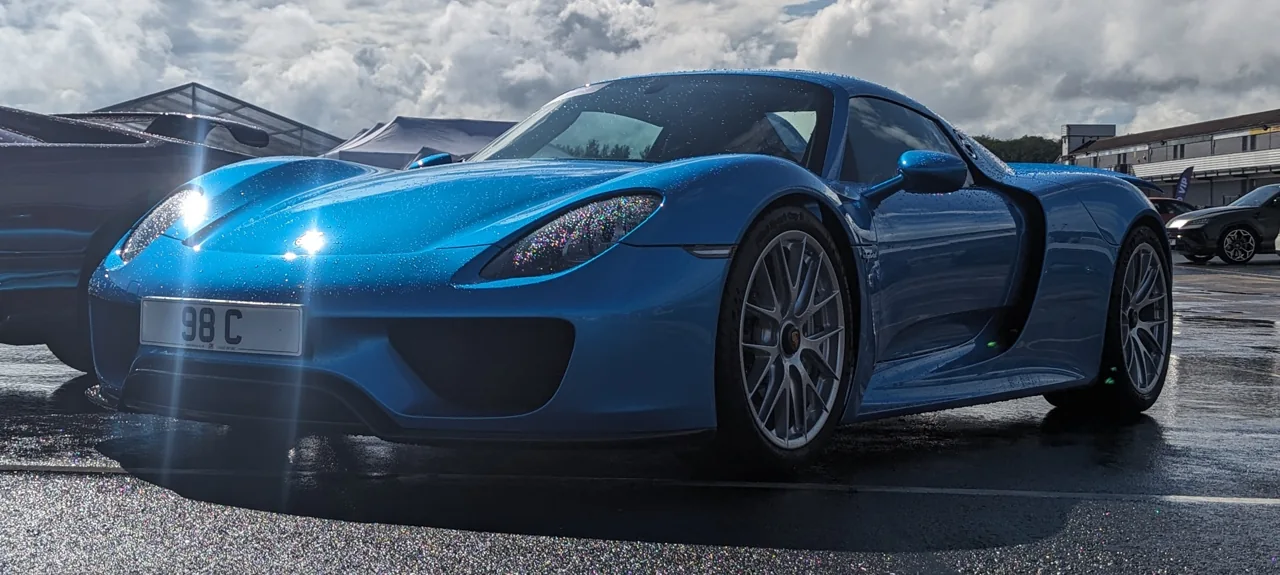
918 Spyder: a hybrid with a wider technical brief
The 918 Spyder introduced a hybrid flagship with combustion and electrical propulsion working together. Porsche’s historical account connects its development to learning from the 911 GT3 R Hybrid. The Weissach package belongs within the family as a particular specification, rather than establishing the weight or equipment of every 918.
We find the 918 important because it makes hybridisation a broad vehicle-design subject. Electrical assistance affects more than output: it changes the available operating modes, the distribution of propulsion and the control decisions the car has to make. The interesting story is the integration of those possibilities.
Its relationship with the Carrera GT is therefore best understood as two different technical responses to the flagship brief. A reader can prefer one form of machinery while recognising the ambition of the other. That is a richer comparison than a simple declaration that one is more pure or the other more advanced.
Cayman GT4 and Spyder: the mid-engined context
The Cayman GT4, later 718 GT4 and GT4 RS, and the Spyder and Spyder RS sit around the boundary between specialist sports car and supercar. We include them because they illuminate Porsche’s performance thinking. The Spyder RS technical account describes a naturally aspirated four-litre flat-six and identifies it as the final newly developed combustion-powered 718 derivative.
That statement should not be confused with a precise claim about when every market’s stock or production ended. The catalogue treats the family as a range transition and directs the reader to the model-specific sources. The GT4 RS Clubsport competition car remains a different proposition from the road-going GT4 RS.
Our view is that these cars deserve attention for their own architecture rather than as inexpensive substitutes for a 911. A mid-engined layout and a different body size create a different set of design opportunities. Their role in the archive is to show that Porsche’s performance identity is broader than one rear-engined silhouette.
Mission X: a concept belongs in its own category
Mission X is included as a concept reference in the flagship story. Porsche’s press material places it in conversation with earlier landmark super-sports cars. That does not establish a production specification, a customer allocation or a delivery date, and this guide does not invent those details.
Concepts are worth writing about when they raise a clear design question. They become misleading when an archive presents them with the same certainty as a completed customer programme. We can discuss the ambition and the historical context while keeping the status visible.
The SuperCarNews view
Porsche’s most interesting achievement across these thirty years is the ability to sustain several definitions of performance at once. The Turbo, GT3, Carrera GT and 918 do not make the same promise. The newer open-top and hybrid branches continue that pattern rather than resolving it into one approved recipe.
We think the archive should preserve those disagreements. Precise generations and variant names help readers compare intentions, while careful sourcing keeps programme facts separate from opinion. There is ample substance for long-form discussion without declaring every Porsche a supercar or pretending that we have driven the entire collection.
Sources & further reading
Reporting is based on the manufacturer material below. Photographs are credited separately.
- Porsche: sixty years of 911 generations
- Porsche: the 993 generation
- Porsche: twenty-five years of GT3
- Porsche: the 991 generation
- Porsche super-sports-car history
- Porsche Carrera GT and 918: conceptual predecessors
- Porsche current 911 model newsroom
- Porsche 911 Turbo S T-Hybrid technical summary
- Porsche 911 GT3 S/C announcement, April 2026
- Porsche 718 model newsroom
- Porsche 718 Spyder RS powertrain
Explore the manufacturer directory for company history and model lineups.