
In this article
- A broader story than straight-line speed
- Ford GT: two modern generations, two priorities
- Ford GT track cars: the names need boundaries
- Mustang GTD: a familiar silhouette under pressure
- Corvette C4 to C7: the front-engined foundations
- Corvette C8: architecture changes the conversation
- Viper: the large-engine idea gets serious
- Saleen S7: a specialist American alternative
- SSC: speed and the importance of definitions
- Hennessey: from Venom GT to the F5 family
- Czinger 21C: the manufacturing story matters
- The SuperCarNews view
A broader story than straight-line speed
American supercars are often discussed as if their only ambition were to beat Europe at a horsepower contest. The actual model history is more varied. Ford has pursued aerodynamic specialisation, Chevrolet has changed the Corvette's basic architecture, and smaller manufacturers have explored everything from top-speed programmes to unusual production methods. Large engines are part of the story, but they are not an adequate explanation of it.
We group these manufacturers in one long feature so readers can compare their choices without encountering a succession of nearly empty brand pages. The catalogue links directly to each family. Road cars, track-only derivatives and current programmes are identified separately. All judgements below concern the documented proposition; SuperCarNews has not driven the cars discussed here.
Ford GT: two modern generations, two priorities
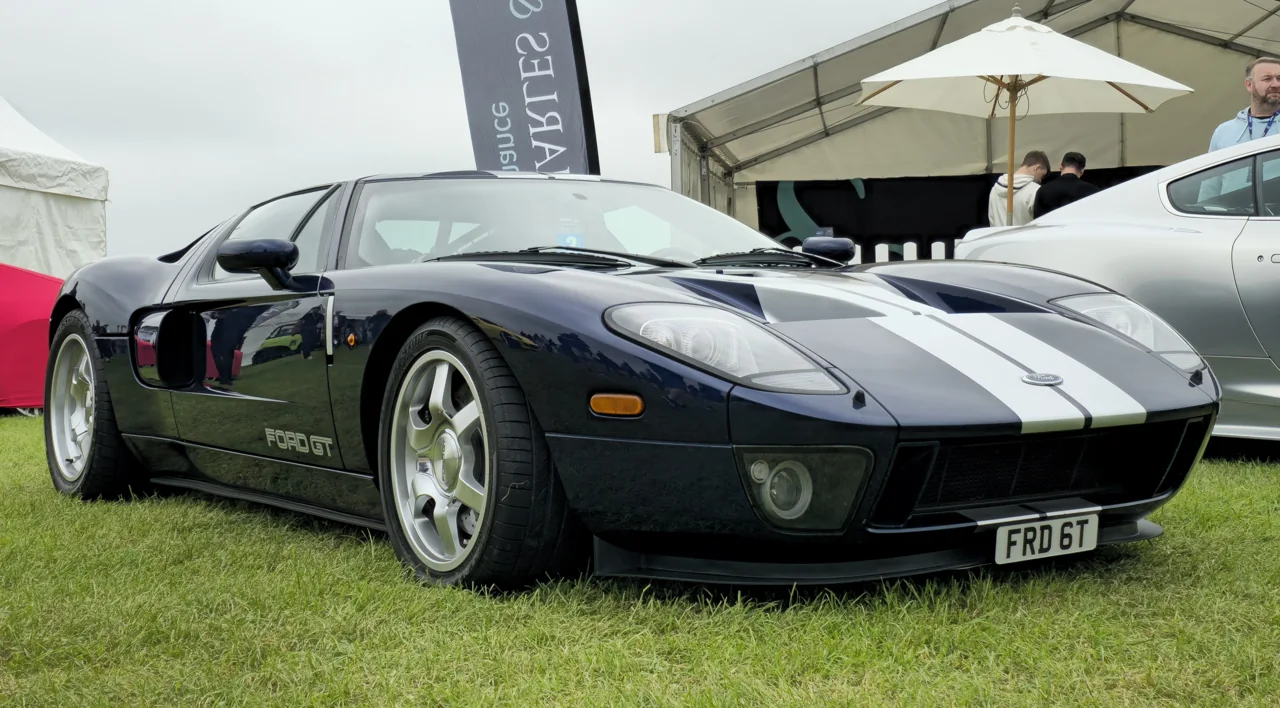
The first modern Ford GT, associated with the 2005–2006 model years, translated the appearance of the GT40 into a contemporary supercar. Its supercharged V8 and manual transmission supported a shape whose historical reference was immediately apparent. Ford's company timeline places its introduction in 2004, illustrating why calendar launch dates and model years should not be used interchangeably.
We think its appeal begins with proportion. The GT40 reference is not confined to a grille or a decorative stripe; it determines the relationship between the low roof, broad body and large rear haunches. That makes it a more complete exercise than simply attaching a heritage badge to an otherwise unrelated car. The question for an actual road test would be whether the physical controls and visibility make that dramatic shape enjoyable to inhabit.
The later GT, launched as a production car for the 2017 model year, uses a twin-turbocharged V6 and a carbon structure in a body visibly organised around airflow. The flying buttresses are central to its identity. They create a markedly different visual argument from the earlier car, even though both draw on Ford's Le Mans history.
Our preference is to treat these as two interpretations of the same inheritance. One foregrounds a historical silhouette; the other lets an aerodynamic brief reshape it. Neither interpretation wins simply because it arrived later. Carbon Series, Heritage and LM editions belong within the later road-car family, with their specific changes established before any comparison.
Ford GT track cars: the names need boundaries
GT Mk II and Mk IV are specialist track-car branches, not alternative road trims. Ford's account of the final Mk IV production wave describes extensive changes to the body, powertrain and suspension. Its more powerful V6 specification should not be imported into a guide to the road-going GT.
The distinction matters whenever a lap time appears. A track-only car operating outside road-car requirements is answering a different question from a registered production model. Both achievements can be impressive, but combining them in one unqualified ranking produces a misleading comparison. We would always want the circuit layout, tyre and vehicle category alongside the number.
Mustang GTD: a familiar silhouette under pressure
Mustang GTD belongs here because the scale and intent of its engineering go beyond a routine performance package. Ford's current programme emphasises a supercharged V8, specialist suspension and substantial aerodynamic development. The name remains Mustang, but the technical brief demands its own discussion.
This is an interesting counterpoint to the GT. Instead of beginning with an obviously exotic mid-engined silhouette, Ford has used a familiar front-engined identity to pursue a much more specialised result. We find that tension compelling. A reader should be shown how the structure, suspension and drivetrain serve the new objective rather than be asked to accept the category solely on the strength of a lap time.
Special versions and demonstration specifications, including Spirit of America and Competition references, need their own source context. A factory record run does not establish that every customer car has an identical specification or would reproduce it under different conditions.
Corvette C4 to C7: the front-engined foundations
The 1996 C4 Grand Sport overlaps the opening of this thirty-year archive. C5 then develops the modern front-engined Corvette story, with Z06 becoming a particularly important focused derivative. C6 broadens the performance range through Z06, ZR1 and Grand Sport interpretations, while C7 carries the front-engined architecture to its final generation before the major layout change.
The distinctions within those generations matter. A C6 Z06 and a C6 ZR1 do not merely differ in trim, and the same Z06 badge does not imply an unchanged engine concept when it moves between generations. Historical writing becomes useful when it explains these changes rather than treating model letters as a permanent specification.
We are especially interested in the Grand Sport idea because it complicates a simple power hierarchy. A version can emphasise chassis capability and road use without occupying the highest-output position. That provides an opportunity to ask what a buyer actually wants from the car, instead of assuming the most powerful version is the only one worth remembering.
Corvette's wider significance is that specialist performance exists within a much larger manufacturing organisation. That does not prove lower running costs or universal parts availability for every version. It does mean the car should be assessed on its own industrial and ownership context, rather than dismissed because it lacks the production scarcity of a small European marque.
Corvette C8: architecture changes the conversation
C8 moves the engine behind the occupants and makes the Corvette's change of direction visible before any specification is read. The current family includes Stingray, naturally aspirated Z06, electrified E-Ray, twin-turbocharged ZR1 and the ZR1X combination of the LT7 engine with an electric front axle. Chevrolet also announced a new Grand Sport for the 2027 model year during 2026; it belongs in the current family timeline without being confused with earlier Grand Sports.
The ZR1X's manufacturer-quoted 1,250 combined horsepower is an extraordinary headline. The more useful editorial question is how its systems interact. Adding driven front wheels and electric assistance changes traction management and the delivery of performance, while the rest of the car must manage the resulting thermal and braking demands. A total output figure cannot demonstrate how consistently that works.
The family also gives us a clear example of why electrification should be described precisely. An E-Ray and a ZR1X are not identical hybrid packages attached to otherwise interchangeable cars. Likewise, the Z06's naturally aspirated engine deserves discussion as a different proposition, not merely as a lower rung beneath a turbocharged model.
US range information does not establish Australian availability, pricing or registration arrangements. Those questions require local model documentation. This feature explains the global programme, keeping market-specific buying conclusions separate.
Viper: the large-engine idea gets serious
Viper's story extends across early RT/10 and GTS cars, the SRT-10 era and the final-generation SRT and Dodge-branded cars. A large naturally aspirated V10 remains the recognisable mechanical theme, but the versions should not be treated as if nothing changed over the programme. Dodge confirms the end of production in 2017.
The GTS body gives the early story a different character from the open RT/10, while later TA and ACR derivatives make a more explicit circuit argument. ACR in particular deserves analysis of its actual aerodynamic and chassis specification. A large wing is visually persuasive, but its effectiveness depends on the system around it and the conditions in which it operates.
We would resist two equally lazy descriptions: that the Viper is only brute force, or that its apparent simplicity makes every version inherently more involving than a complex rival. Both claims need driving evidence. The researched case for the car is already strong enough: a distinctive engine concept, unmistakable proportions and a sustained attempt to develop that starting point into increasingly focused variants.
The Viper's cultural familiarity can also conceal its specialist nature. A recognisable American badge does not make a low-volume performance car ordinary to own. Model-specific maintenance, parts and inspection evidence remain necessary when the discussion turns from history to an individual example.
Saleen S7: a specialist American alternative
Saleen's S7 family moved from naturally aspirated road cars to Twin Turbo versions, alongside the separate S7R competition story. Its long body and heavily ventilated surfaces give it a more overtly specialised visual identity than a conventional performance coupé. Later LM-labelled cars require their own provenance and specification checks rather than a blanket assumption about every S7.
The S7 is a useful reminder that America's supercar history is not limited to major manufacturers. A specialist organisation can choose a different balance of production scale, component sourcing and customer support. Those choices deserve attention alongside output. Our interest is in how the finished car turns that independence into a coherent experience, which is a question a press photograph cannot settle.
SSC: speed and the importance of definitions
Ultimate Aero provides the historical starting point for SSC's modern story. The current Tuatara range separates the high-speed road car from the higher-downforce Striker and the non-road-legal Aggressor. SSC's own model listing makes that road-legal distinction explicit, so our catalogue retains it.
Top-speed claims require unusually careful reporting. One-way and two-way runs, measured distances, timing methods, environmental conditions and the vehicle's production specification all matter. We do not turn an announced target or a manufacturer headline into an independently verified universal record.
Beyond that debate, the model split is editorially useful. Low drag and high downforce can pull a design towards different solutions. Seeing a manufacturer offer separate interpretations helps explain why there is no single body configuration that is automatically optimal for every performance objective.
Hennessey: from Venom GT to the F5 family
The Venom GT programme concluded with its Final Edition in 2017. Venom F5 is the subsequent family, including coupé, Roadster and Revolution interpretations. Evolution is an upgrade programme within that story, and the special manual LF commission should not be presented as the transmission specification of every F5.
Hennessey's published Evolution material quotes more than 2,000 bhp from the twin-turbocharged Fury V8 under its specified conditions. A serious article must keep those conditions attached to the claim. Fuel, calibration and the particular vehicle configuration are part of a power figure, not optional footnotes.
Our editorial interest lies in usable character as much as ultimate capability. How an engine responds below its headline operating point, how clearly the controls communicate and how much preparation the owner needs would determine whether such a car is satisfying between major performance demonstrations. Those remain questions for direct assessment.
Czinger 21C: the manufacturing story matters
Czinger's current 21C range includes HDF, VMax and Spyder interpretations. The manufacturer places its computational engineering and additive manufacturing approach at the centre of the programme. The unusual seating layout and the distinction between high-downforce and top-speed-oriented bodies give the technical story a visible form.
We find that more interesting than simply adding another very powerful hybrid to a list. Manufacturing methods can influence which shapes are feasible, how components are combined and how a small production programme is organised. The editorial challenge is to explain those consequences clearly, without turning a proprietary process name into proof that every outcome is superior.
The Spyder adds another reason to avoid copying a single specification across the family. A changed body and seating arrangement can alter mass, dimensions and intended use. We would verify the exact derivative before presenting numbers or drawing comparisons with a HDF or VMax.
The SuperCarNews view
The strongest American supercar stories are specific: the GT's airflow-led body, the Corvette's architectural shift, the Viper's sustained V10 identity and Czinger's manufacturing experiment. SSC and Hennessey add different interpretations of extreme speed, while Saleen provides an important specialist bridge to the earlier archive.
Our preference is to judge each on the coherence of its own brief. A large output can begin a conversation, but it should never be the entire article. The engineering choices, their compromises and the experience they are intended to create are what make this history worth reading.
Sources & further reading
Reporting is based on the manufacturer material below. Photographs are credited separately.
- Ford GT heritage and technology
- Ford company timeline, including the first modern GT
- Ford GT Mk IV final production wave
- Ford Mustang GTD current programme
- Chevrolet Corvette generation history
- Chevrolet Corvette current range
- Chevrolet Corvette ZR1X
- 2027 Corvette Grand Sport announcement
- Dodge Viper archive
- Dodge 2017 performance range brochure
- Saleen S7 Twin Turbo history
- SSC current models and Ultimate Aero history
- Hennessey Venom GT final edition
- Hennessey Venom F5 Evolution technical announcement
- Czinger current 21C range
Explore the manufacturer directory for company history and model lineups.