
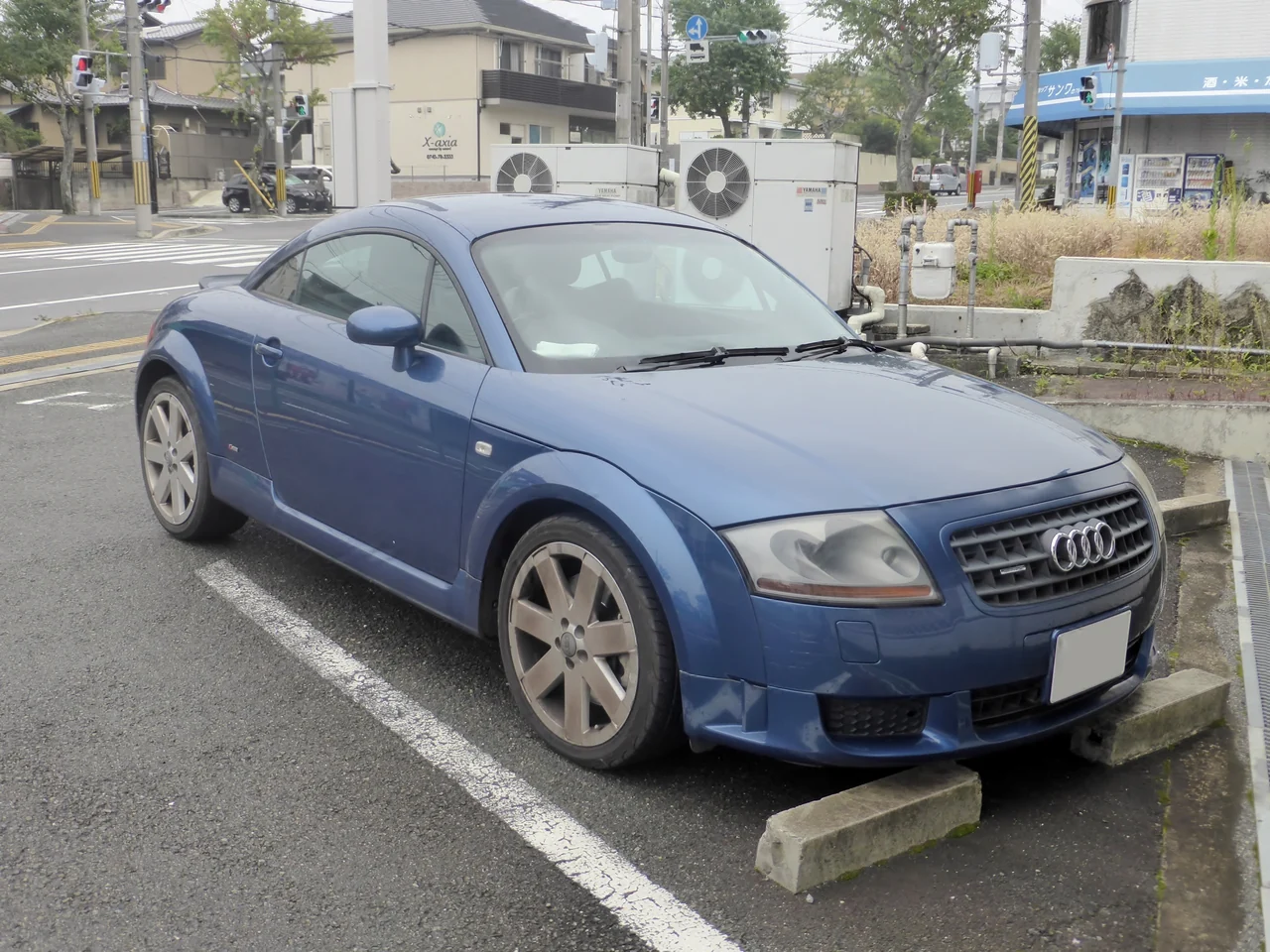
Buy the design, then investigate the specification
The first TT remains a compelling design-led choice. Its compact proportions and deliberate cabin shapes give it an identity beyond its engine output. That is a good reason to want one, but it should lead the buyer to inspect trim, switches, instruments and body condition as carefully as the performance specification. A damaged or incomplete interior weakens a substantial part of the car's appeal.
Coupé and Roadster buyers should also start with different practical expectations. The closed car presents the original roofline as part of the composition. The open car adds roof operation, seals, drains and water-entry questions to the inspection. Neither format excuses weak maintenance records, and a sunny viewing can conceal a roof or drainage problem that appears in ordinary weather.
We would decide whether front-wheel drive or quattro genuinely suits the intended use, then identify the exact engine and transmission. A quattro badge is not a reason to skip driveline history. Equally, a lower-output or front-drive example should not be dismissed automatically if its specification and condition fit the owner's plans.
An extensively modified TT needs a budget for understanding the modifications as well as maintaining the underlying car. Named components, installation records and a specialist who can support the configuration are valuable. Anonymous software and mixed suspension or brake parts make even a tidy car harder to assess. Our preference is for a coherent specification, not the largest claimed power figure.
The first Audi TT is easy to recognise and surprisingly easy to misdescribe. Body style, engine, gearbox, front-drive or quattro configuration, market origin and modifications all matter. In Australia, recall status belongs at the top of the checklist rather than at the end.
Audi says the TT concept appeared in 1995, the production Coupé arrived in 1998 and the Roadster followed a year later.12 The company describes the circle as the design’s central motif and says the production cars remained close to the show cars.1 That explains the shape; it does not prove the originality of a used example.
Australian Government recall material identifies the relevant first-generation TT as type 8N.4 Confirm that identity against the physical vehicle and manufacturer data.
Identify the exact TT
Record the full VIN, type, engine code, gearbox code, PR codes and Australian supply or import history. Do not assume all 8Ns share one drivetrain. Front-drive and quattro cars need different service and inspection branches.
Audi’s technical history describes electronically controlled multi-plate-clutch quattro applications in transverse architectures, including the A3 and TT from 1999.3 “Quattro” on the boot does not tell you everything needed for maintenance or diagnosis.
| Question | Evidence to collect | Why it matters |
|---|---|---|
| Coupé or Roadster? | VIN/type and body record | Roof and body inspection scope differs |
| Front-drive or quattro? | PR/manufacturer data and physical driveline | Changes transmission and driveline servicing |
| Which engine and gearbox? | Codes plus manufacturer lookup | Determines parts and procedures |
| Australian-delivered or imported? | Compliance and registration history | Equipment and campaign history may differ |
| Standard or modified? | Parts, tuning and engineering records | Alters condition, legality and maintenance questions |
Recall check before driving
Two Australian recall records deserve immediate VIN checking. Government material for REC-000045 lists specified 1997–2000 Audi models including the TT, and the NADI 5-AT information identifies TT 8N vehicles from specified years.4 REC-004987 covers specified 1999–2001 Audi vehicles including the TT and directs affected owners to Audi’s VIN lookup or an authorised dealer for urgent, free inspection.5
These records do not mean every 8N is affected. VIN decides. Check through official channels before a test drive and follow any stop-drive or other safety direction. Airbag work belongs with an authorised repairer.
History and modification quality
Age, use and modification make a universal fault list misleading. Ask for documentary evidence for engine-specific belt or chain work, cooling, ignition, transmission and quattro or multi-plate-clutch servicing as applicable. This guide does not state a timing-belt interval because the engine code, market schedule and previous work must be confirmed.
Modified cars need a separate evidence trail:
- Who supplied and installed the parts?
- Is the engine software identified and supported?
- Are suspension, wheel and brake changes compatible?
- Were required Australian approvals or engineering checks completed?
- Can the car be returned to a known configuration?
- Do invoices explain changes to the engine, gearbox or driveline?
A tidy engine bay is not proof of sound calibration or legal compliance. Have a specialist assess turbocharging, fuelling and driveline changes.
| Candidate | Positive evidence | Reason to pause |
|---|---|---|
| Standard car | Coherent codes and itemised maintenance | No evidence for major scheduled work |
| Lightly modified car | Named parts, installer and approval records | Anonymous tune or mixed components |
| Quattro car | Driveline identity and specific service records | Generic “AWD serviced” note |
| Roadster | Roof operation and water-management inspection | Leaks, warning symptoms or improvised repairs |
Inspection checklist
See the car cold if possible. After identity and recall checks, arrange a full inspection with an Audi/VW specialist.
- Confirm VIN/type, engine code, gearbox code and PR codes.
- Check Australian supply, compliance and registration history.
- Scan all systems and retain the report.
- Observe cold start, hot restart, idle, temperature, smoke and warning lamps.
- Assess boost and acceleration only under legal conditions and after safety checks.
- Test transmission behaviour and inspect the exact driveline fitted.
- Check ABS/ESP, instrument cluster, lighting, climate and other electrics.
- On a Roadster, inspect roof operation, seals and signs of water entry.
- Inspect tyres, brakes, suspension, underside, corrosion and crash repairs.
- Reconcile modifications with parts, tuning and approval records.
A scan result is not a mechanical inspection. Warning lamps, misfires, boost issues or driveline symptoms can have several causes and need qualified diagnosis. Turbo and fuel work, brakes, restraints, roof mechanisms and all-wheel-drive systems present safety or equipment boundaries beyond a driveway check.
Australian recalls and purchase checks
Run a PPSR search immediately before purchase. It can identify registered security interests and provide NEVDIS stolen and written-off information.67 This is particularly useful where import or modification history is unclear, but it remains relevant to every used car. Match the VIN exactly and keep the certificate.
Do not let a clean PPSR replace body inspection. It reports defined registry information, not repair quality or mechanical condition.
Keep parts research at category level until an authorised catalogue or specialist has verified fitment by VIN, engine, gearbox and PR code.
Before arranging the road test, settle the airbag status and identify the drivetrain. The remaining assessment belongs to the maintenance file, modification records and specialist report for that particular car.
Sources and further reading
References supporting the reporting and practical context on this page.