
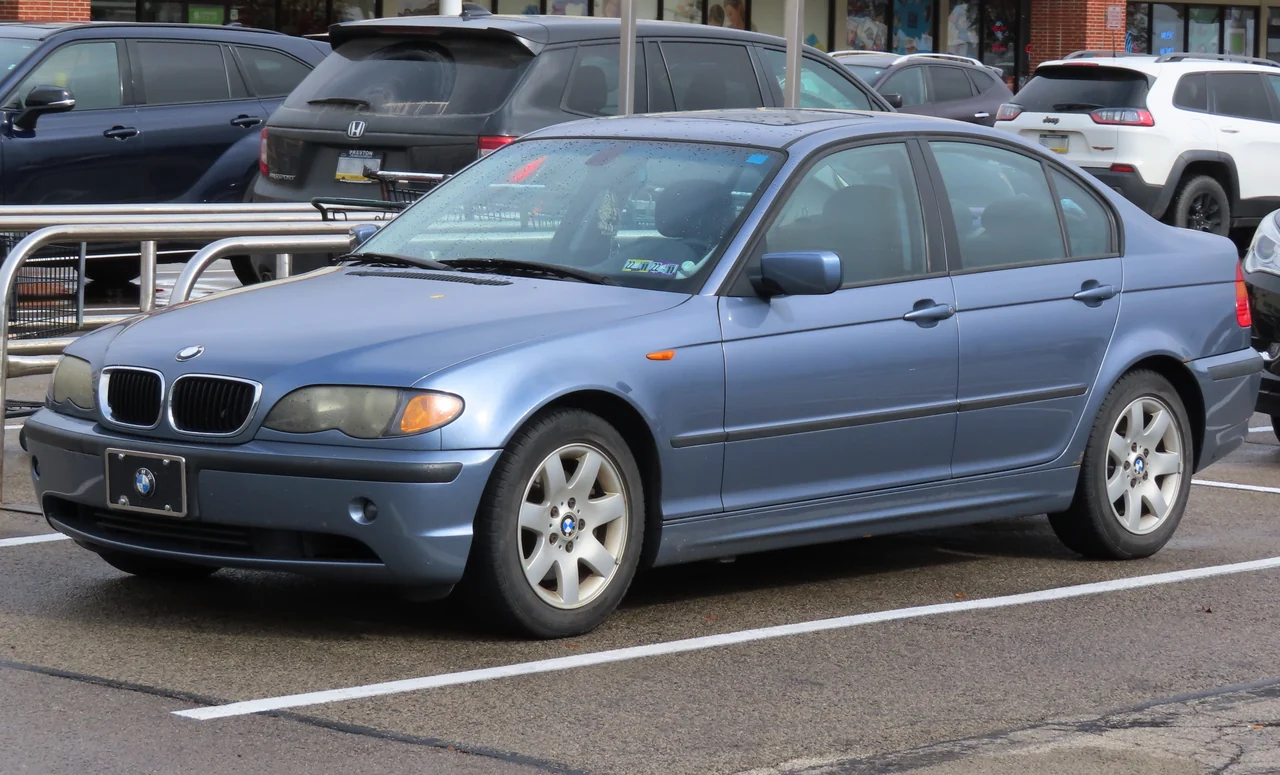
Do not order E46 brakes from the generation name or boot badge alone. Start with BMW build data, then identify the hardware fitted to each axle. A previous owner may have changed calipers, carriers or complete assemblies, so factory specification and physical inspection both matter.
Brake inspection, measurement and installation require a competent person, wheel removal and safe lifting. Never work beneath a car supported only by a jack.
Why "fits E46" is too broad
Australian secondary histories span early 323/328 and later 325/330 variants. 2 BMW’s US-market 2001 specifications show why that transition matters: documented 325 models used 300 mm front and 294 mm rear discs, while documented 330 models used 325 mm front and 320 mm rear discs. 1 The same US source says these packages grew from the preceding 323/328 sizes and that corresponding coupe models inherited the relevant changes. 1 (US dimensions and engineering context; not universal Australian fitment.)
Those dimensions prove that meaningful variation exists. They are not universal Australian specifications. M3, Compact, Touring, convertible, diesel, aftermarket conversions and prior axle swaps need their own evidence. Do not turn the US figures into an Australian ordering table.
| Identification layer | Evidence | What it can settle |
|---|---|---|
| Factory build | VIN, production date, market, body and model in BMW data | Correct original catalogue branch |
| Installed axle | Disc, caliper, carrier, pad and sensor inspection | What is physically on the car now |
| Measurement | Diameter, thickness and ventilation style | Whether installed hardware matches the candidate package |
| Parts record | Current catalogue, OE cross-reference and supersession | Exact replacement number to quote |
Step 1: establish the factory branch
Record the full VIN, production month, body, market, model, engine and transmission. Obtain a BMW AIR, ETK or dealer build report. Australian GoAuto histories can help place the advertised variant in the broad local sequence, but they are not VIN-level build proof.
Ask whether the car has modified or replacement axles, calipers, carriers or discs. Receipts and old parts can help, but the workshop still needs to inspect the car. Wheel diameter, caliper colour and badge are not authoritative identifiers.
Step 2: inspect the front axle
With the car correctly lifted and the wheel removed, have the workshop record:
- disc diameter, thickness and ventilation style;
- caliper and carrier casting marks;
- pad shape and any readable reference;
- hose and line condition;
- visible leaks, damage and uneven wear;
- signs of conversion or mixed hardware.
A photograph should include a scale or clear measurement where practical. Do not estimate disc diameter through the wheel and do not copy a minimum-thickness value from a generic listing. Service limits and measuring methods must come from exact BMW repair information for the identified build and hardware.
Step 3: inspect the rear axle and parking brake
Repeat the disc, caliper, carrier and pad record at the rear. The cited RealOEM diagram separates the drum-style parking-brake shoe assembly from the rear service disc and pad system. 6 (Third-party European 330i catalogue example; not universal fitment proof.) Treat parking-brake shoes and hardware as their own fitment line.
Ask the workshop to report whether the parking-brake assembly is serviceable and compatible with the installed rear disc. Do not assume that ordering rear discs and pads covers every required component.
Step 4: identify wear-sensor fitment
A cited RealOEM rear-brake diagram lists the pad wear sensor separately from the pads. 5 (Third-party European 328i catalogue example; verify the exact axle and build.) Confirm which axle has a sensor, along with connector style and routing. A pad set in an online catalogue may not include the correct sensor, and a sensor shown for one example build does not prove fitment to another.
The workshop record should show:
| Axle | Sensor present | Connector/routing photographed | Candidate number confirmed |
|---|---|---|---|
| Front | |||
| Rear |
Step 5: reconcile physical and catalogue evidence
A catalogue search should use the exact market, model and production date. RealOEM is a third-party mirror and its examples are keyed to particular European builds. Use its diagrams to understand assemblies or discover candidate numbers, then verify current part numbers and supersessions through BMW ETK, a dealer or a supplier willing to accept the VIN and measurement sheet.
If build data and installed hardware disagree, stop the order. The mismatch may reflect an axle swap, upgrade, mixed repair or identification error. Have the workshop determine what system is present and whether it is safe as an assembly.
Supplier hand-off checklist
Send the supplier one complete request rather than a badge-only message:
- full VIN and production date;
- Australian delivery or other market status;
- body, model and build data;
- front and rear measurements;
- caliper and carrier markings;
- pad shape and sensor photographs;
- parking-brake identification;
- existing part numbers, if reliably read;
- request for OE cross-references, current supersessions and return conditions.
Ask the quote to list discs, pads, sensors and parking-brake parts separately. This makes omissions visible and leaves an audit trail. If identity is still uncertain, return to the E46 chassis and engine guide before ordering.
Safety stop conditions
Do not road-test a car with a hydraulic leak, damaged hose, metal-on-metal noise, severe vibration, brake warning lamp or inadequate pedal. Arrange workshop assessment or recovery. Disc thickness and run-out, pad condition, hose and line integrity, caliper function and fluid condition all require professional measurement.
This page intentionally gives no torque values, wear limits, bedding procedure or replacement interval. Those instructions must come from exact factory repair data and the component manufacturer's current documentation for the verified package.
Before ordering parts
Do not request brake parts until a supplier and competent installer confirm the VIN/build branch, installed hardware, measurements and current supersessions.
Sources and further reading
References supporting the reporting and practical context on this page.
- BMW Group: Press Kit MY 2001, BMW 3 Series (US-market dimensions; not universal Australian fitment) ↗ ↩
- GoAuto: BMW 3 Series sedan range, previous E46 model ↗ ↩
- GoAuto: BMW 3 Series coupe range, previous E46 model ↗
- RealOEM: example E46 330i catalogue index (third-party example) ↗
- RealOEM: example E46 328i rear pad and wear-sensor diagram (third-party example) ↗ ↩
- RealOEM: example E46 330i parking-brake diagram (third-party example) ↗ ↩