
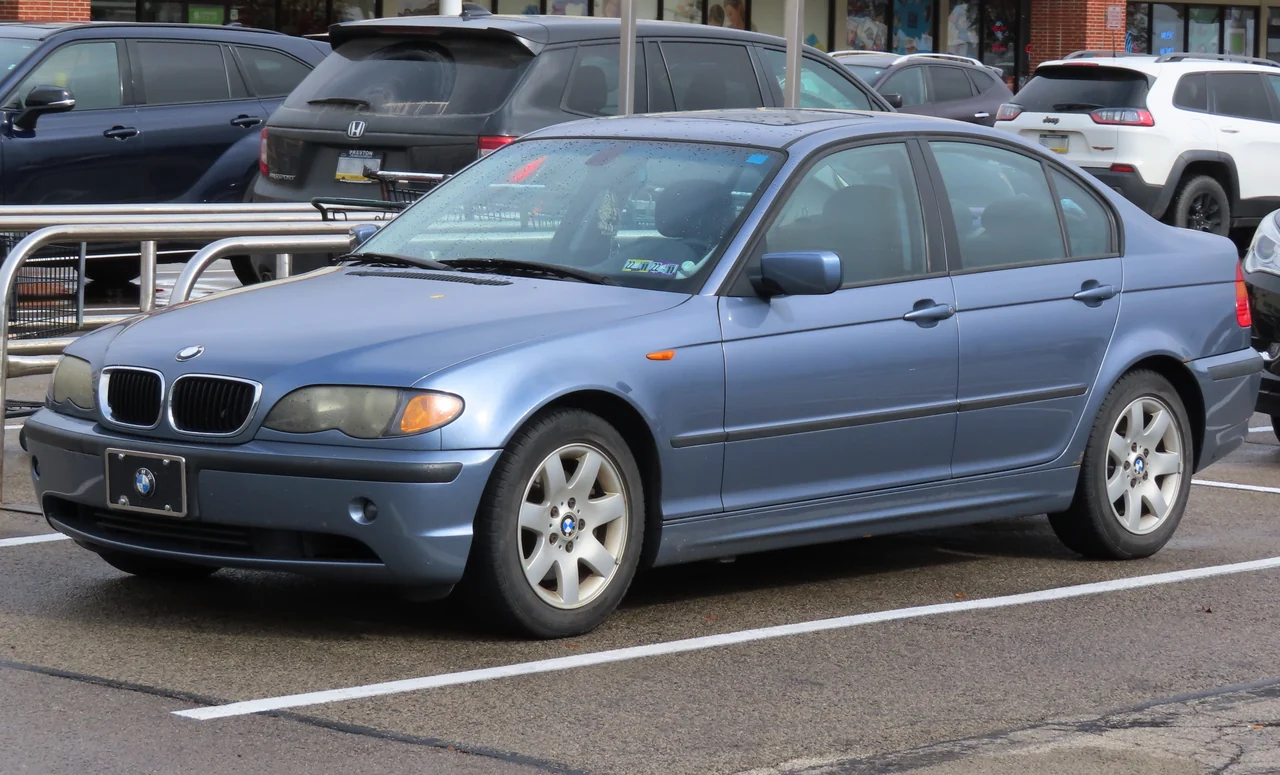
Why the E46 still makes sense
The E46 has a persuasive basic shape for an enthusiast's everyday classic: a compact cabin, rear-wheel drive and a range that lets the buyer choose between practical saloon, estate, coupé and convertible bodies. Its appeal does not depend on buying an M3. A well-kept ordinary six-cylinder car can express the generation's character without the purchase and maintenance requirements of the specialist M model. That is a preference about the car's purpose, not a claim that every version drives alike.
Our starting point would be the body and transmission that suit the intended use. A coupé bought for weekends and a saloon expected to commute have different priorities. Be honest about passengers, parking, summer heat and how much time the car can spend in a workshop. The most attractive advertisement is not necessarily the version that makes the best ownership proposition.
We would give a complete, largely standard car a strong first hearing. Missing trim, improvised electronics and undocumented modifications create extra work before normal maintenance even begins. A higher odometer with a coherent repair file can be easier to assess than a low reading attached to a car that has spent years standing. Neither is a guarantee; they simply lead to different questions.
Put the inspection and a written maintenance estimate ahead of negotiating accessories or cosmetic upgrades. A tempting discount can disappear into tyres, cooling work, suspension repairs and neglected comfort equipment. The useful buying decision is the total commitment required to make this particular E46 usable in the way you intend.
An E46 should be bought on identity, history and present condition, not its badge. Confirm exactly what the car is, preserve the evidence and commission a BMW-experienced pre-purchase inspection.
Australian range context (local guide)
GoAuto records the Australian E46 sedan arriving in October 1998 as the 318i, 323i and 328i. 2 It dates the 320i, 325i and 330i changes to October 2000 and says the convertible arrived one month earlier. 2 GoAuto’s coupe history dates Australian arrival to June 1999 and the 320Ci, 325Ci and 330Ci changes to September–October 2000. 3 It also dates the 320i Touring to June 2002 and the local range facelift to March 2003. 2 (Australian secondary chronology; none of these dates proves an individual car’s build or delivery specification.)
BMW’s US-market 2001 material documents engine, transmission and brake changes when 325 and 330 models replaced the 323 and 328 in that range. 1 That manufacturer source explains the engineering transition, but it does not prove Australian specification for an individual car.
| Evidence | Record | Purpose |
|---|---|---|
| Identity | VIN, registration and body identifiers | Connects records to the shell |
| Build | Date, market, body and options | Selects the correct research branch |
| Powertrain | Engine and transmission, physically confirmed | Finds swaps or description errors |
| History | Itemised invoices and recall evidence | Separates fact from recollection |
| Condition | Static check, cold start, scan and lift report | Shows what this car needs |
Verify identity first
Ask for a clear photograph of the 17-digit VIN, then compare it at the car with registration, compliance evidence, body identifiers and invoices. Confirm whether the car was Australian-delivered or privately imported. Equipment, parts research and recall handling can differ.
Treat the boot badge as a clue. Badges, engines and transmissions can be changed. Obtain BMW build data through a dealer or BMW-experienced workshop, then use the E46 identification guide to compare it with the installed car. Keep VIN and registration details private.
For an Australian purchase, complete a current PPSR search and the registration, insurance and roadworthiness checks required by your state or territory. Elsewhere, use the equivalent local title, finance, theft, registration and roadworthiness services. These checks complement the mechanical inspection.
Read the service file
A stamp does not say what work was done. Build a chronology from itemised invoices showing date, odometer, workshop, work and part numbers. Mark gaps without filling them with assumptions.
Ask the seller to leave the engine cold. Record arrival conditions, the key-on lamp check and one continuous cold start. Note cranking, warning messages, noises and visible exhaust in plain language. A warm engine or edited clip weakens the evidence.
Have a BMW-capable full-system scan saved before anyone clears faults. Stored codes guide diagnosis; they do not prove a component has failed.
Check recalls by VIN
An Australian Government recall record covers specified E46 variants and identifies affected vehicles by VIN list, not badge alone. 4 BMW Australia provides a live VIN or registration lookup and says affected Takata airbag work is performed free by an authorised dealer. 5 (Australian campaign context; live applicability is VIN-specific.) Save the live result and request dealer campaign evidence. A broad model or year range cannot settle applicability.
Static inspection
Inspect the car in dry daylight before starting it.
- Compare panel gaps, paint finish and body seams. Refer concerns to a body specialist with suitable equipment.
- Check cabin, boot and accessible drainage areas for dampness or staining.
- Photograph tyres, wheels and visible brakes. Wheel size and caliper colour are not fitment proof.
- Look from outside for fresh fluid, damaged covers or impact evidence. Do not crawl beneath the car.
- Compare odometer readings across invoices and official records.
- Note modifications and ask for receipts, approval or engineering evidence where required.
Structural assessment, lifting, airbag work and opening a cooling system are professional jobs. Never work beneath a jack-only vehicle.
Road test only after a safety gate
Do not drive with brake, steering, tyre, overheating, fuel-leak or restraint-system warnings. Arrange recovery if the car is unsafe.
If it passes the initial gate, use a legal route with smooth and mildly uneven surfaces, low-speed turns and normal braking. Record steering-centre behaviour, vibration, noises, shift quality and new warnings. Avoid high-load testing. A road test creates observations for the technician; it cannot predict remaining component life.
Workshop PPI hand-off
Choose a BMW-experienced workshop, preferably independent of the seller's preparation. Send the VIN/build report, invoice chronology, recall result, photographs, cold-start video and saved scan.
Request a written report covering:
- agreement between build data and installed body, engine and transmission;
- body, underbody, water ingress and structural repair evidence;
- tyres, brakes, steering and suspension;
- visible leaks and cooling-system condition;
- diagnostic faults and warning-system operation;
- urgent safety work, confirmed faults and items requiring further diagnosis.
Ask what test supports each conclusion. A seller's generic assurance or internet reputation is not evidence about this car.
Plan ownership from the result
None of the cited BMW or Australian sources establishes a universal E46 preventive interval, failure rate, market price or ownership-cost figure. Build the baseline from the matching market-specific owner manual (an Australian copy for an Australian-delivered car), BMW build data, documented history and the workshop’s written findings, then obtain current local quotes for that work.
Before ordering parts
Before requesting parts, reconfirm VIN, production date, market, body, engine, transmission and installed hardware with the supplier or workshop. "Fits E46" is not enough for a safety-critical part.
Sources and further reading
References supporting the reporting and practical context on this page.