
In this article
- Speed is the opening question
- Rimac: from Concept One to Nevera
- Pininfarina Battista: a different emotional brief
- B95: the open electric proposition
- Aspark Owl: proportions beyond the ordinary
- Yangwang U9: a new manufacturer context
- Hispano Suiza Carmen: an electric car with historical references
- NIO EP9: the track project in its own category
- Tesla Roadster: an announcement is not a delivery
- DEUS Vayanne: keeping the evidence attached
- The SuperCarNews view
Speed is the opening question
Electric hypercars have made spectacular acceleration an increasingly familiar headline. That achievement is real enough to deserve serious reporting, but it creates an editorial problem: if every new story ends after the sprint figure, readers learn little about what distinguishes one car from another. We want to know how the car manages energy, how its controls communicate and what makes its design recognisable when it is standing still.
This feature brings the principal specialist electric programmes together. Lotus Evija remains in our Lotus history, and the Lexus LFA Concept is covered in the Japanese feature. Hybrids such as Ferrari F80 and Bugatti Tourbillon stay with their own model families. Fully electric propulsion is the shared subject here; it does not imply identical architecture or intended use.
Rimac: from Concept One to Nevera
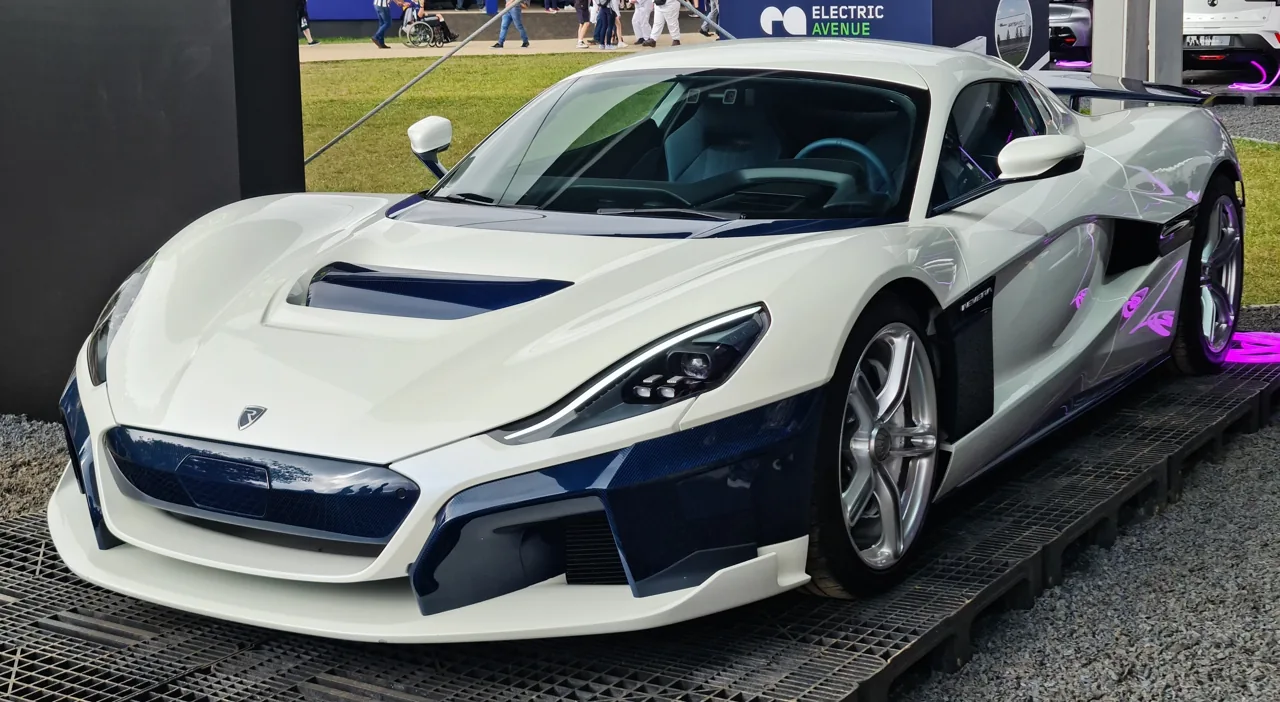
Rimac's own timeline places the Concept One prototype in 2011, its first customer delivery in 2016 and the production Nevera reveal in 2021, following the C_Two development identity. Concept S belongs to the early experimental branch. Nevera R is a later, more focused development of the Nevera family, rather than the name of every original Nevera.
The progression is important because it moves the story beyond the idea of an electric demonstrator. A production programme has to reconcile extraordinary performance with repeatable operation, support and a coherent cabin. Those are the subjects that would determine the depth of our assessment if we had a car available to test.
Rimac's current R material identifies changes to the battery, chassis, brakes and aerodynamics. We find that more informative than a power increase on its own. The meaningful question is whether the revisions work together towards a more focused brief, and what they change for an owner using the car away from its ideal performance conditions.
The R's published top-speed figure also carries a manufacturer-oversight qualification. That belongs with the number whenever it is quoted. A conditional capability should not be presented as an unrestricted everyday setting available in all circumstances.
Pininfarina Battista: a different emotional brief
Automobili Pininfarina's Battista family includes the standard car and more individual interpretations such as Anniversario, Edizione Nino Farina and the open Targamerica commission. Its presentation places craftsmanship and visual elegance alongside electric performance. The result is a different editorial subject from a car whose entire identity is a record attempt.
We think electric propulsion makes this design discussion more important, not less. When an engine's cylinder count no longer supplies an immediate identity, proportion, controls, material choices and the way performance is delivered must do more of the distinguishing work. A shared category or related technology does not automatically make two finished cars emotionally interchangeable.
The Battista's relatively flowing surfaces suggest an interest in a more composed visual statement. That is an interpretation of its appearance, not evidence about ride comfort. We would want to examine whether the cabin and low-speed behaviour sustain the same impression during ordinary use before describing it as a successful grand tourer.
Limited editions should also be explained through their actual changes. A paint treatment, a bespoke roof and a mechanical revision are different kinds of distinction. Readers deserve to know which one a particular name represents.
B95: the open electric proposition
B95 is Pininfarina's open barchetta programme. Its relevance lies partly in the way it asks an electric hypercar to create a sense of occasion without a conventional enclosed cabin. The manufacturer treats it as a coachbuilt project, and our catalogue retains that programme context.
We find the idea intriguing because it changes the sensory balance. Exposure to the surroundings becomes central, while the propulsion system contributes differently from a large combustion engine. That does not make the experience inherently richer or poorer. It gives an eventual road assessment a different set of questions about airflow, comfort and how the occupants relate to the landscape.
Aspark Owl: proportions beyond the ordinary
Aspark's Owl is immediately distinctive for its exceptionally low visual profile. The current family includes the Owl Roadster, while the SP600 speed-development car is identified separately. Prototype test results should not be copied into the road car's specification without confirming that the configuration is the same.
The body creates a powerful photographic impression, but extreme proportions also invite practical questions. Seat position, entry, visibility and the placement of the battery are part of the engineering story. We would rather investigate those choices than assume that looking lower automatically means functioning better.
The Roadster makes the relationship between the cabin and body even more visible. Its existence broadens the programme beyond a single acceleration claim. The more useful comparison is how the open version changes the intended experience, including what the occupants can see and how they are protected from airflow.
Aspark's published acceleration material uses specific testing conventions, including rollout in some claims. That convention matters when comparing numbers. A result measured after an initial movement is not directly equivalent to one timed from a complete standing start.
Yangwang U9: a new manufacturer context
Yangwang's U9 and more extreme U9X bring BYD's wider electric-vehicle engineering context into the specialist supercar conversation. The manufacturer's account identifies U9 Xtreme as an evolution of the U9 offered in China, with substantial changes for the more ambitious performance programme.
The reported speed achievement is a manufacturer claim tied to a particular run. Its significance should be discussed alongside the measurement method and vehicle configuration rather than used as a universal ranking that makes every other hypercar obsolete. Top speed is one performance objective among several.
What interests us more broadly is the changing source of technical authority in this category. A manufacturer with extensive battery and electric-drive experience can approach the problem from a different industrial starting point than a traditional low-volume combustion specialist. That creates a worthwhile comparison of architecture and priorities, without requiring a simplistic verdict about which national industry has won.
Chinese-market availability does not establish an Australian launch or registration pathway. Our current-programme label describes the manufacturer's activity, not a local buying recommendation.
Hispano Suiza Carmen: an electric car with historical references
The Carmen family, including Boulogne and Sagrera, links electric propulsion with an explicitly historical visual identity. The treatment of the rear body and the overall silhouette gives it a different character from a conventional wedge-shaped hypercar. It is a reminder that new propulsion does not oblige every designer to choose the same futuristic vocabulary.
We find that tension more useful than a generic claim of timelessness. A historical reference can create a distinctive object, but it can also constrain proportion or practicality. The car deserves criticism of how successfully those elements coexist, rather than automatic approval because the marque has a long history.
The derivatives also make clear that an electric programme can develop through battery and aerodynamic revisions as well as styling. A proper specification comparison needs the exact version and source date. Using one capacity or range figure for every Carmen would blur the development story.
NIO EP9: the track project in its own category
NIO's EP9 was a highly visible early electric performance project, introduced in 2016. Its record programme and circuit emphasis place it in the track branch of our archive. We do not use its performance as if it were evidence from a normal customer road car on road tyres.
The EP9 matters because demonstration programmes can shape the public understanding of a new technology. They show what a manufacturer considers worth proving. The next editorial step is to ask which lessons carry into production vehicles and which remain specific to an exceptional track machine. That distinction preserves the achievement while giving it a more useful context.
Tesla Roadster: an announcement is not a delivery
Tesla's current Roadster page continues to present an announced electric sports-car proposition with performance claims and a reservation invitation. The page alone does not establish a completed customer production programme. We therefore label the second-generation Roadster as announced rather than present it as a readily available new car.
The concept remains relevant because it helped frame expectations around electric supercar performance. However, a target becomes meaningful in a different way once it is attached to a final specification, homologated car and documented test. We would update the status when that evidence is available rather than allow an old promised date to silently become a fact.
DEUS Vayanne: keeping the evidence attached
DEUS Vayanne was presented with engineering partners including Italdesign. The partner's original material establishes the announced project, but an early proposed production schedule is insufficient evidence that every planned delivery subsequently occurred. Our catalogue keeps it in the announced-programme category on that basis.
This is not a verdict on the project's merit. It is an editorial distinction between an idea, a prototype, a production specification and a delivered vehicle. Those stages all deserve coverage, but they answer different questions for a reader researching the actual current line-up.
The SuperCarNews view
The best electric-hypercar writing should become more demanding as acceleration becomes more familiar. We want distinct design, well-explained control systems, honest testing conditions and a credible account of how an owner can use the performance repeatedly. A quieter powertrain does not remove the need for character; it changes where that character must be created.
Rimac's technical development, Pininfarina's coachbuilt ambitions, Aspark's proportions and the newer industrial context behind Yangwang provide genuinely different subjects. Their differences are more valuable to this archive than another undifferentiated list of very large numbers.
Sources & further reading
Reporting is based on the manufacturer material below. Photographs are credited separately.
- Rimac Nevera R and company model history
- Automobili Pininfarina current programmes
- Pininfarina B95
- Pininfarina Targamerica
- Aspark Owl model range
- Aspark Owl Roadster
- BYD Yangwang U9 Xtreme programme
- Hispano Suiza Carmen range
- NIO EP9
- Tesla Roadster announced specification
- DEUS Vayanne announcement through engineering partner Italdesign
- Rimac Concept S announcement, March 2016
Explore the manufacturer directory for company history and model lineups.