
In this article
- A marque with more than one performance identity
- The 1990s context: size, presence and performance
- DB7, DB9 and DB11: the grand touring thread
- Vanquish: three generations, one broad ambition
- DBS: the sharper grand tourer
- Vantage: a compact name with many meanings
- DB12 and the current front-engined range
- One-77: the front-engined halo car
- Vulcan: the track-only branch
- Valkyrie: a radical change in architecture
- Valkyrie AMR Pro: similar name, different machinery
- Valkyrie LM: the customer endurance branch
- Valhalla: the mid-engined idea broadens
- Victor, Valour and Valiant: the manual conversation
- Speedsters and coachbuilt interpretations
- The SuperCarNews view
A marque with more than one performance identity
Aston Martin’s recent history is often described as a move from elegant grand tourers towards serious supercars. That is too simple. The long-bonnet cars remain a deliberate and important part of the range, while Valkyrie and Valhalla introduce different architectures and ambitions. The interesting story is the coexistence of those ideas, not a claim that one has made the others obsolete.
This guide follows the main performance families relevant to 1996–2026, with broader grand tourers included as context and track programmes clearly separated. Our opinions concern documented design and engineering choices. SuperCarNews has not driven these cars, and the article does not borrow a manufacturer test driver’s experience as its own.
The 1990s context: size, presence and performance
The V8 Vantage models of the 1990s, including the V550, V600 and Le Mans references, belong to a different world from the later compact Vantage family. The shared name can hide that difference. A useful archive should make the generation clear before discussing the car’s role or specification.
We think these cars are important context because they represent a particularly forceful version of the traditional Aston Martin idea: substantial proportions, a powerful engine and a strong sense of occasion. They should not be criticised simply for failing to resemble a later mid-engined hypercar. Their purpose was different, and the visual presence of that purpose remains part of their appeal.
DB7, DB9 and DB11: the grand touring thread
DB7, DB9 and DB11 form a major part of the marque’s recent grand touring history. DB7 V12 Vantage and GT variants, later special interpretations and the transition through successive DB generations belong around the supercar archive’s boundary. We include them to explain the range rather than insist that every version fits a strict supercar definition.
Our view is that this context improves the discussion of the more extreme cars. A flagship makes more sense when the reader understands the normal design language and ownership brief it develops or challenges. The DB line gives Aston Martin a continuing argument for a car centred on a journey, with proportion and accommodation carrying weight alongside performance.
Vanquish: three generations, one broad ambition
Aston Martin’s 2026 anniversary account identifies three distinct Vanquish generations: the original V12 Vanquish of 2001–2007, the later generation introduced in 2012, and the current car introduced in 2024. S and Volante derivatives belong with their respective generation rather than being treated as one continuous specification.
The current Vanquish uses a 5.2-litre twin-turbo V12, with the manufacturer quoting 835 PS and 1,000 Nm. The July 2026 Vanquish 25 announcement adds a commemorative programme of 25 coupés and 25 Volantes. This is a current special edition connected to the latest car, not the same project as independent reinterpretations of an earlier Vanquish.
We find the name’s continuity persuasive because the broad ambition remains understandable. Each generation is intended to make the front-engined flagship feel like an event. The details change, but the idea does not require apology in an era of mid-engined hybrids. A very capable grand tourer is a legitimate destination for engineering effort, not a preliminary stage on the way to a different kind of car.
Our reservation is that the word flagship can obscure the need to distinguish the generations carefully. A buyer researching one should not inherit the maintenance assumptions, equipment or technical description of another simply because the badge is familiar.
DBS: the sharper grand tourer
The modern DBS and DBS Volante, followed by the DBS Superleggera family and 770 Ultimate, give the grand touring line a more emphatic performance identity. The exact generation matters. The 770 Ultimate belongs to a concluding special-series chapter rather than representing the specification of every DBS ever built.
We think the family is most interesting as an exploration of how much intensity can be added while retaining the appeal of a long-distance road car. That is a different problem from designing a machine primarily around circuit use. The best discussion would examine the balance, not simply celebrate that a grand tourer has become more extreme.
Visually, the DBS name also tends to invite a stronger sense of muscularity. We find that effective when it reinforces the basic proportions. It becomes less persuasive when aggression is treated as a substitute for a coherent shape. Those are design judgements readers can assess through photographs without any invented driving narrative.
Vantage: a compact name with many meanings
The later V8 and V12 Vantage families differ fundamentally from the large Vantage models of the 1990s. Within the modern line, S, GT8, GT12, Roadster, F1 Edition and subsequent V12 and S programmes identify distinct interpretations. A badge alone is therefore insufficient for a useful technical or historical account.
Our preference is to see the Vantage as a place where Aston Martin can make a more concentrated road-car argument without losing its visual identity. The limited GT derivatives and larger-engine versions are interesting branches, but they should not make the standard car disappear from the story. Different owners can reasonably want different balances of occasion, usability and intensity.
The 2026 Goodwood programme includes Vantage S among the marque’s current performance offerings. That confirms its contemporary range context, but does not establish an Australian allocation or delivery date for any individual specification.
DB12 and the current front-engined range
DB12 and DB12 S, including Volante forms, continue the current grand touring branch alongside Vanquish and Vantage. The S model appears in Aston Martin’s 2026 programme. These cars belong in the archive as adjacent performance GTs, with that role stated plainly.
We think their continued importance makes Aston Martin’s range more interesting. The company can develop a highly specialised hypercar without requiring every customer to want its compromises. A clear, attractive long-distance brief remains valuable. The challenge is to make that brief convincing through the actual interface, accommodation and refinement, qualities that cannot be established from a name or a launch photograph alone.
One-77: the front-engined halo car
The One-77 combines a 7.3-litre V12 with a carbon-fibre monocoque and aluminium bodywork. Aston Martin records completion of the 77-car programme in 2012. Its position is distinct from both the regular grand tourers and the later mid-engined hypercars.
Our attraction to it is the way the traditional Aston Martin silhouette becomes a vehicle for a much more specialised construction programme. It demonstrates that a long bonnet does not prevent a car from being technically ambitious. The design remains legible as an Aston Martin while the scale of the undertaking changes underneath.
We would not let the production total become the entire verdict. A halo car needs to reward attention through proportion, engineering and the quality of its intended interaction. The One-77 is worth studying because of how it combines those ambitions, not simply because the number in its name is small.
Vulcan: the track-only branch
Aston Martin’s corporate documentation identifies the Vulcan as a carbon-fibre, V12 track-only supercar limited to 24 examples. The AMR Pro development belongs within that specialist programme. The car should not be presented as a normal road-going alternative to a Vanquish or One-77.
We think the Vulcan is interesting as a deliberate change of environment. Removing ordinary road requirements changes the engineering brief and the support an owner needs. A track-only car can be an exceptional object without being broadly usable. The article’s job is to explain that purpose, rather than make its limitations vanish beneath a dramatic performance description.
Valkyrie: a radical change in architecture
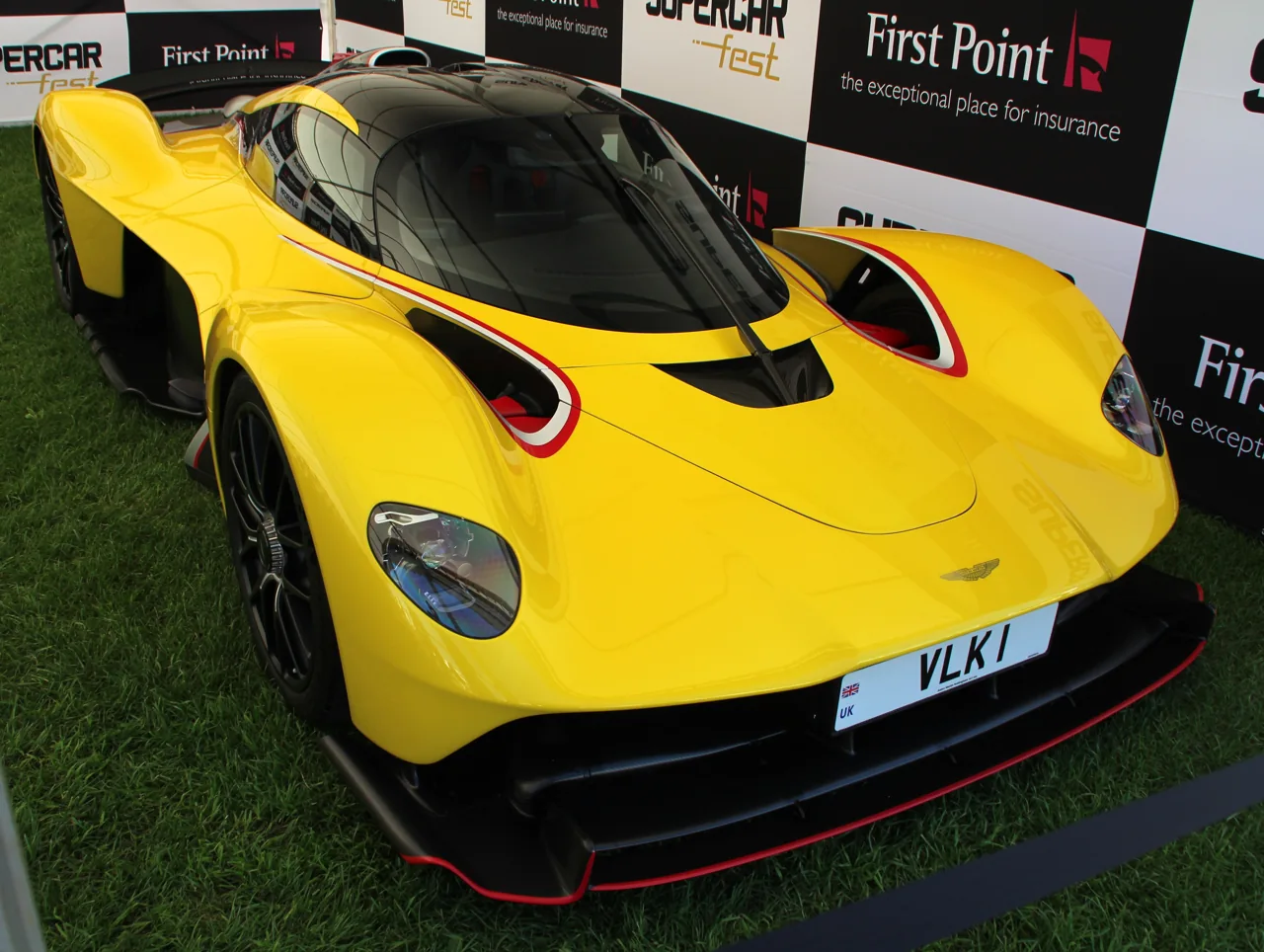
The road-going Valkyrie introduces a naturally aspirated 6.5-litre Cosworth V12 with hybrid assistance, in a car shaped around an unusually demanding aerodynamic brief. The Spider creates an open version of that programme. Manufacturer information identifies the hybrid system as part of the road car’s powertrain; that distinction becomes important when discussing its track relatives.
The visible architecture is the most striking part of the proposition. The passenger compartment appears tightly contained within a body organised around air passages and working surfaces. We find that a compelling expression of purpose, even though it raises obvious questions about access, accommodation and ordinary use.
Those questions are central rather than hostile. A road-going hypercar can choose substantial compromises, but they should be understood as choices. We would want future evaluation to explain what the car asks of its occupants as carefully as it explains the aerodynamic capability. A specification cannot establish whether that exchange is rewarding for a particular owner.
Valkyrie AMR Pro: similar name, different machinery
The developed Valkyrie AMR Pro uses the V12 without the road car’s hybrid system. Aston Martin’s later programme account describes it as a track-only car unconstrained by normal road or racing regulations. The endurance racing Valkyrie is another distinct branch, operating within competition requirements.
This is an important example of why early concept announcements must not be mixed with later specifications. A programme can change substantially during development. The final track-car description is not interchangeable with an earlier projected hybrid configuration, and neither should be copied into a road-car table without checking the version.
Our view is that the distinctions make the story better. They show engineers adapting an idea to different purposes rather than applying one fixed package everywhere. That is more interesting than treating every Valkyrie as the same car with a different wing.
Valkyrie LM: the customer endurance branch
Valkyrie LM adds another distinct track programme. Aston Martin's June 2025 announcement describes a ten-car customer version derived from its endurance racing Valkyrie, with a naturally aspirated 6.5-litre V12 and a supported driver-development programme. It is a non-homologated track car, not a road-going trim level or another name for AMR Pro. The announcement planned customer activities during 2026; it is not evidence of an available allocation today.
This distinction matters because a racing-derived customer car sells a different kind of participation. Preparation, instruction and support become part of the proposition alongside the machine. We find that a more meaningful subject than asking which Valkyrie badge sounds most extreme. The relevant question is what environment each version was designed to serve, and what its owner needs to make use of it.
Valhalla: the mid-engined idea broadens
The current Valhalla programme uses a four-litre twin-turbo V8 and three electric motors, with Aston Martin quoting 1,079 PS and 1,100 Nm combined. The technical account identifies an eight-speed dual-clutch transmission and a 999-car programme. Earlier concept-stage figures should remain attached to their original announcement rather than being blended into the current specification.
We find Valhalla particularly interesting because it asks the mid-engined Aston Martin to cover a broader road-and-track brief than the most radical halo programme. Integration becomes the key subject: propulsion, aerodynamics, braking and the interface must work as one car. A large output is only the starting point.
The challenge is also one of identity. Valhalla should not need to impersonate a front-engined grand tourer to feel connected to Aston Martin. It needs a convincing interpretation of the marque’s design and quality within a different architecture. That is a worthwhile ambition, but the published concept does not prove the quality of the resulting driving experience.
Victor, Valour and Valiant: the manual conversation
Victor, Valour and Valiant belong to the bespoke and limited-series conversation around a more tactile interaction. Aston Martin’s Valiant announcement describes a 5.2-litre twin-turbo V12, six-speed manual transmission, road legality and a 38-car programme. It also explains the relationship with Valour and the Q division’s individual commissions.
We think these cars raise a useful alternative to the usual progression towards ever more automated performance. A manufacturer can spend considerable engineering effort on making a particular action satisfying rather than eliminating it. That does not mean a manual is the right answer for every car. It means interaction itself is a legitimate product goal.
Their design references should also be considered as interpretations, not as proof that the cars recreate an earlier era. Modern materials, power and control systems give them a contemporary context, whatever memories their silhouettes evoke.
Speedsters and coachbuilt interpretations
The V12 Speedster, DBR22 and Zagato-related commissions broaden the special-project story. They deserve to be identified by programme and format rather than treated as ordinary variants of whichever production model looks most similar. A bespoke body can create a distinct design subject without necessarily introducing a wholly new mechanical family.
Our view is that the best coverage asks what the commission is trying to express. Open-air exposure, historical proportion or a different material treatment can be meaningful ambitions. Rarity alone is a less useful subject. Readers should be given enough context to judge the result as a car and a design, even when ownership is entirely outside their circumstances.
The SuperCarNews view
Aston Martin’s most compelling recent development is the expansion of its vocabulary. Vanquish can remain a persuasive front-engined flagship while Valkyrie pursues an extreme aerodynamic idea and Valhalla develops a broader mid-engined hybrid brief. The manual special series then open another conversation about interaction.
We think that variety deserves careful organisation rather than a single ranking. The cars become easier to appreciate when the reader can see what each is intended to do, which generation is being discussed and what the sources actually establish. Their real engineering and design choices provide ample material for opinion without a fictional road test.
Sources & further reading
Reporting is based on the manufacturer material below. Photographs are credited separately.
- Aston Martin Vanquish: three generations
- Aston Martin Vanquish 25 announcement
- Aston Martin 2026 performance range at Goodwood
- Aston Martin One-77 history
- Aston Martin Valhalla technical overview
- Aston Martin Valkyrie hybrid powertrain
- Aston Martin Valkyrie AMR Pro final programme description
- Aston Martin Valiant and the Q special-series context
- Aston Martin 2018 registration document: Vulcan and GT models
- Aston Martin DBS 770 Ultimate
- Aston Martin Valkyrie LM customer track programme
Explore the manufacturer directory for company history and model lineups.