
In this article
At a glance
Manufacturer specifications. Performance figures have not been independently tested by SuperCarNews.
- Engine
- 8.3-litre naturally aspirated V16
- Hybrid system
- Three electric motors
- Combined output
- 1,800 hp (Bugatti’s published unit)
- Battery
- 25 kWh / 800 V architecture
- Driven wheels
- All four
- Announced production
- 250 cars
What should a Bugatti be when power is plentiful?
The Bugatti Tourbillon poses a more interesting question than how fast the next Bugatti will be. What makes an extremely expensive car feel extraordinary when enormous power is no longer confined to a handful of combustion engines? The Tourbillon’s answer is to make the machinery itself an attraction: a naturally aspirated sixteen-cylinder engine, a hybrid system and an instrument display conceived with watchmaking in mind.
We think that is a shrewd creative direction. A car at this level needs an identity that survives the next record announcement. Mechanical fascination, proportion and the pleasure of operating something carefully made can remain compelling long after a performance figure is overtaken. The Tourbillon is interesting because its specification appears to acknowledge that distinction.
SuperCarNews has not driven the Tourbillon or heard its engine in person. This is a researched model guide with editorial interpretation. The photographs are credited archive images, and the performance and engineering details are attributed to the manufacturer rather than presented as our own measurements.
From W16 to V16
Bugatti’s launch material describes an 8.3-litre naturally aspirated V16 developed with Cosworth, supported by two front electric motors and one at the rear. It quotes 1,800 hp combined and a 25 kWh battery within an 800 V electrical architecture. The announced programme comprises 250 cars. Bugatti used “hp” in the release, so we retain that unit rather than silently recasting it as bhp.
The change in layout is important. A V16 and a W16 are not two names for the same engine arrangement, and the absence of turbochargers changes the engineering conversation again. The Tourbillon is not simply the previous concept with a battery added. It gives electrical assistance a role alongside an engine whose character is meant to be a central part of the attraction.
There is an appealing extravagance to that decision. Once a car has electrical assistance available, a manufacturer has considerable freedom to decide what it wants the combustion engine to contribute. Bugatti has chosen a form of mechanical spectacle that is difficult to reduce to a rational necessity. That is exactly why it may matter in this category. An object can be technically sophisticated and still be desirable for something beyond efficiency.
Hybridisation as a design opportunity
It is easy to discuss a hybrid only in terms of what it adds: motors, battery mass, cables and cooling circuits. The more useful question is what those additions allow the rest of the car to do differently. Electrical assistance creates another way to deliver torque, and a separate means of propelling the car under appropriate conditions. It changes the possibilities available to the engineers.
None of that removes the need for careful integration. The driver encounters one accelerator and one brake pedal, not a collection of independent engineering departments. Those controls have to communicate a consistent response while the systems behind them manage different temperatures, speeds and energy states. That is the demanding part of the proposition, and it cannot be judged from a combined power figure.
For the Tourbillon, the key editorial question is whether the electrical system supports the sense of occasion or distracts from it. A car can be technically accomplished while asking too much attention of its owner. We would want the complexity to be available for an interested reader to understand without becoming a constant task for the person using the car.
Why the instruments matter
The mechanical instrument cluster is the most revealing part of the cabin concept. Bugatti places it within a fixed steering-wheel hub and combines it with a deployable central screen. The seats are mounted low and fixed in position, while the pedal box adjusts. These choices give the interior a distinctive architecture rather than treating it as a conventional cockpit with more expensive materials.
We like the decision to make essential information a permanent physical feature. Screens are useful, but a cabin designed around them can inherit the visual habits of consumer electronics. A carefully resolved mechanical display has a different relationship with time. It can remain appealing even when a newer digital interface becomes available elsewhere.
That argument should not be stretched into a claim that mechanical instruments are automatically better. Readability, glare, serviceability and the clarity of secondary information still matter. An intricate object can be beautiful and inconvenient at the same time. Our enthusiasm is for the ambition to make the instruments worth looking at, with practical judgement reserved for evidence about their use.
Shape, speed and the luxury brief
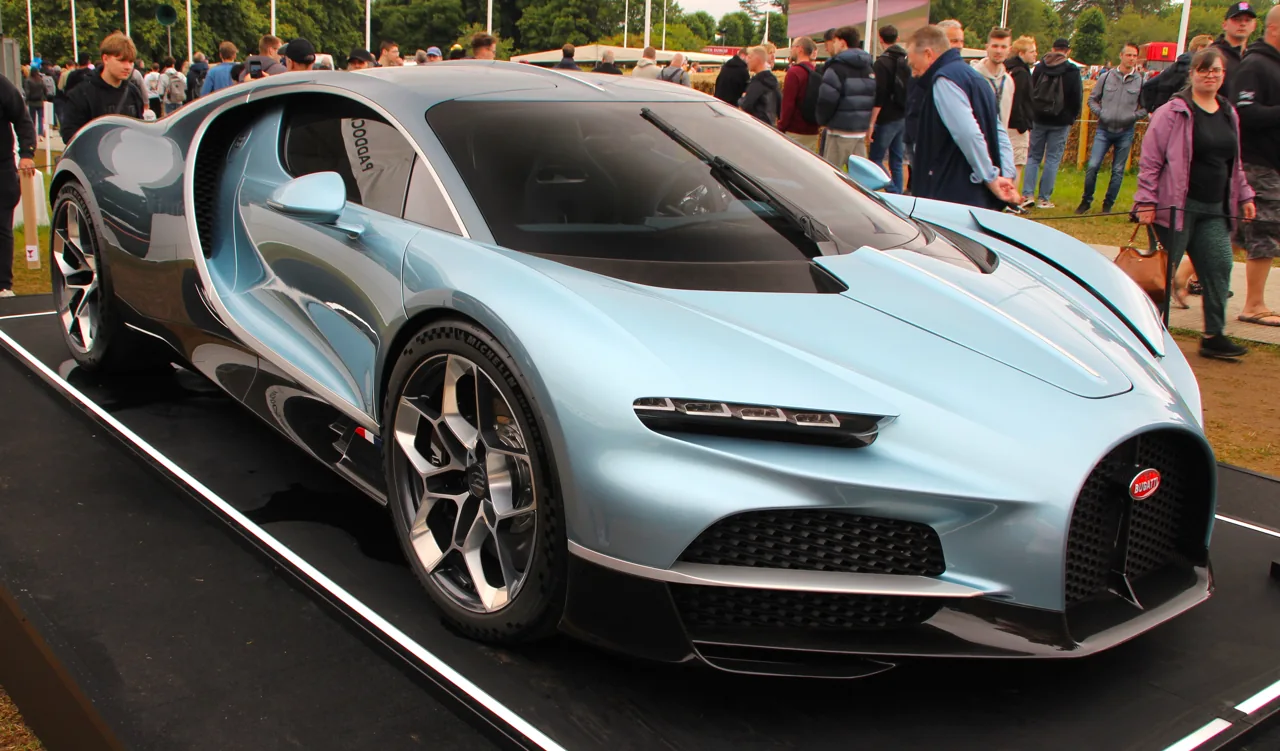
In the published imagery, the Tourbillon’s long, low body and prominent side treatment make it recognisably connected to recent Bugattis without appearing identical to them. We think the design is strongest where it balances a concentrated passenger compartment with the substantial volume needed around the powertrain. The car looks as though it has a demanding physical job to do.
The challenge is that a Bugatti is expected to be both a remarkable machine and a luxurious object. Those priorities can pull in different directions. Cooling needs openings; aerodynamic requirements influence surfaces; access and luggage space compete with tightly packaged equipment. The quality of the result lies in how convincingly those demands are reconciled, not in pretending they do not exist.
This is why we resist ranking it solely against a circuit-focused hypercar. A machine organised around repeated lap times and a machine organised around mechanical theatre and very high-speed touring can both be exceptional. Their success has to be assessed against their intended roles. The Tourbillon’s apparent willingness to be a recognisable kind of Bugatti is more interesting than an attempt to win every comparison at once.
Development is not the same as delivery
Bugatti’s original announcement targeted customer deliveries in 2026. A target published at launch does not establish that handovers have begun. The manufacturer’s September 2026 sound-development update describes an acoustic milestone; it should not be treated as a statement about every remaining part of the vehicle programme.
That distinction is particularly useful with small production programmes, where a reveal, a development car, a pre-production example and a customer car can appear in similar photographs. This guide identifies the Tourbillon as a development programme on the evidence cited. A later manufacturer confirmation can change that status without rewriting the original announcement into something it never said.
The same care applies to Australian availability. A global production total does not tell a reader how many cars are allocated locally, what registration requirements apply or what a delivered example costs. Those details are not verified here.
The SuperCarNews view
The Tourbillon’s best idea is to make a technological change feel like an expansion of Bugatti’s identity. The V16, electrical system and mechanical instruments all give us something to discuss beyond acceleration. We find the cabin concept especially persuasive because it addresses a long-term design question: what should still be pleasurable to see and operate after the novelty has faded?
Our reservation is that permanence is an ambition, not an achievement that can be declared at launch. Complex mechanisms and electrical systems will need support, and the car’s everyday interactions will need to justify the beauty of their execution. The Tourbillon is a compelling proposition on the published evidence. Its eventual place among the great Bugattis will depend on how that proposition is fulfilled over time.
Sources & further reading
Reporting is based on the manufacturer material below. Photographs are credited separately.
- Bugatti: Tourbillon launch release · 21 June 2024
Explore the manufacturer directory for company history and model lineups.