
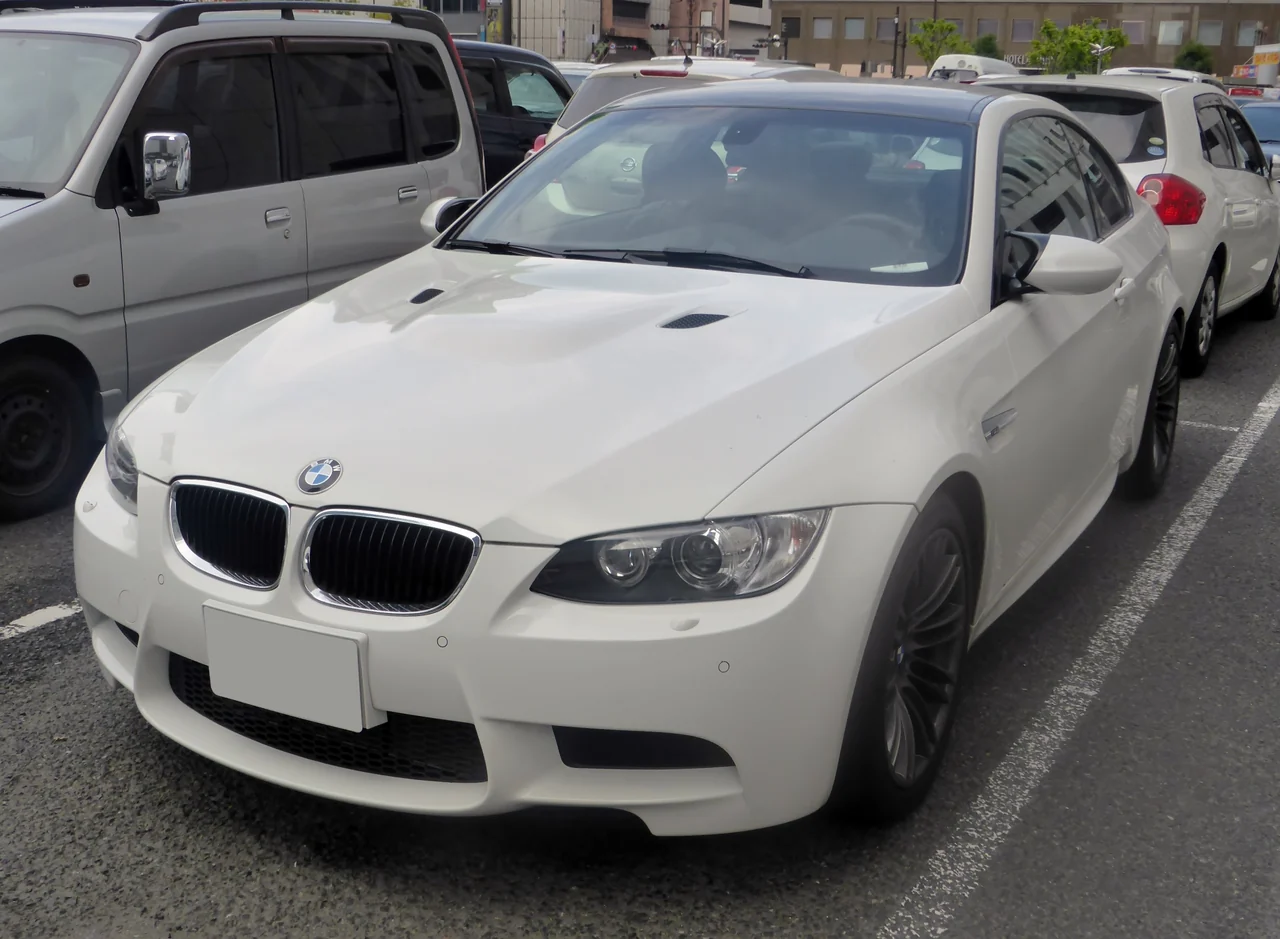
An E92 M3 needs a car-specific file, not a checklist copied from internet folklore. Confirm the S65 car and its transmission through BMW build data, preserve the cold-start and scan evidence, then commission an M-experienced workshop to interpret what it finds.
Confirm the exact M3
BMW identifies E92 as the coupe within the fourth-generation M3 family, alongside the E90 sedan and E93 convertible. BMW’s global launch material specifies the S65 as a 3,999 cc naturally aspirated V8 producing 309 kW and 400 Nm. 1 (Global manufacturer specification; verify the individual car and market.) Those figures identify the published model; they are not targets for a used-car test.
BMW M’s retrospective says the E92 M3 had a carbon-fibre roof as standard. 2 (Manufacturer heritage overview; market and individual equipment still need checking.) A sunroof, roof repair or other discrepancy should be reconciled with build data and assessed by a body specialist rather than judged from a photograph.
| Identity item | Evidence |
|---|---|
| E92 M3 body and S65 engine | BMW AIR or dealer build report plus physical identifiers |
| Production date and market | VIN-linked build data and compliance history |
| Transmission | Manual or M DCT in build data, confirmed on the car |
| Options and roof | Build record, whole-car photographs and body inspection |
| Recall status | BMW Australia live result and dealer campaign printout |
Turn service history into evidence
Photograph the VIN and compare it with registration, body identifiers and every major invoice. Build a chronological spreadsheet with date, odometer, workshop, work description and part numbers. Mark unsupported seller statements separately.
The owner manual must match model year, market and iDrive configuration. A third-party archive can help locate a document, but it warns that its copies are US specification. Prefer the matching market-specific owner manual, including the Australian glovebox copy for an Australian-delivered car, and exact BMW service information for this VIN.
Look for itemised records covering engine oil and filter work, diagnostic investigations, transmission work, brakes, tyres, cooling and repairs after any track event or accident. This guide gives no universal interval, fluid specification or torque value because the cited sources do not establish one for every car.
Record the cold start
Ask the seller not to start the engine. Note arrival conditions and capture one continuous video from key-on through the initial running period. Record warning lamps, cranking, noises, misfire behaviour, warning messages and visible exhaust without naming a cause.
Give the video to an M-experienced specialist. Internal-engine diagnosis and actuator testing require proper equipment and judgement. An unusual noise or code is not permission to order a part.
Preserve diagnostic history
Have the workshop save a full-system fault report before clearing anything. An S65-specific BMW bulletin ties rough-running or reduced-performance complaints and stored fault 2AF9 to an ISTA diagnosis and exact repair instruction. 6 (US S65 service information for the listed fault; not a blanket diagnosis or Australian warranty statement.) Preserve the original report and follow the applicable S65 test plan rather than borrowing a procedure from another engine.
A clean scan does not prove mechanical health. Recently cleared history can reduce the value of the evidence. Ask the technician to comment on warning operation, saved faults, readiness/history and any live-data or mechanical tests considered necessary.
Ask sensible S65 questions
Online discussions often present rod bearings and throttle actuators as universal certainties. The cited manufacturer sources do not establish universal failure rates, kilometre thresholds or mandatory preventive replacement for these concerns. Treat them as questions for the specialist:
- Do invoices show prior internal-engine or actuator work, and can the claimed parts and workshop be verified?
- Does cold-start, scan, live-data or mechanical evidence justify further testing?
- What do oil and filter records show? If analysis is used, who will interpret it and within what limits?
- Are reduced-power events, misfires or abnormal noises documented?
- Does the workshop recommend action for this car, and on what evidence?
Do not promise that a preventive replacement removes risk. Ask for written reasoning and exact BMW repair information before authorising work.
Follow the correct transmission branch
BMW produced both manual and M DCT configurations for this M3 generation.
Manual
Ask the specialist to assess clutch engagement, shift quality, leaks and driveline noise during a restrained road test and lift inspection. Records should identify what was done, not simply say "clutch checked".
M DCT
A US BMW recall bulletin applied to S65 M DCT E90, E92 and E93 cars produced up to 10 September 2008 and prescribed reprogramming. 3 (US campaign only; do not infer Australian applicability.) Do not assume that campaign applied in Australia. Run the Australian VIN through BMW's live lookup and ask a dealer to confirm campaign status.
During specialist operation, record faults, harshness or neutral events without deciding their cause. Campaign completion and current mechanical condition are separate questions. DCT adaptation or software work belongs with an M-experienced workshop.
Body, roof and underbody
Inspect the car in dry daylight, then use a qualified body specialist for paint-depth readings, seams and repair assessment. The carbon-fibre roof needs composite expertise if there is damage, lifting, poor finish or evidence of repair. Ask for invoices and photographs from any body work.
Have the underbody and suspension pick-up points inspected on a lift. Look for impact damage, poor repair and modification, but do not crawl under the car. A clean upper body can hide an event underneath.
Brakes, tyres and use history
Before any road test, a competent person should clear the tyres, brakes, fluids/leaks and warning state. Do not conduct a high-load test. Stop immediately for oil-pressure, overheating, brake, steering, fuel-leak, severe-misfire or drivetrain-neutral warnings.
Record tyre specification, condition and date codes, plus measured brake condition. Track use is not proof of abuse. Ask instead for preparation records, consumable history, temperature or setup records where available, and post-event maintenance.
Modifications and final sign-off
List each modification and ask whether it is reversible, approved or engineered where required, registered correctly and disclosed to the insurer. Retain receipts and original parts where supplied. Modified brakes, suspension, wheels, engine software or exhaust can alter fitment and the inspection path.
Use the broader E90/E92 buyer’s guide for body, delivery and recall context. The final M3 workshop report should divide findings into immediate safety work, confirmed faults, further diagnostic questions and optional work. Require the report to cite the test or evidence behind each conclusion.
Before ordering parts
Any parts request must follow specialist diagnosis and be tied to VIN, production date, market, transmission, installed hardware and current supersessions.
Sources and further reading
References supporting the reporting and practical context on this page.
- BMW Group: The new BMW M3 ↗ ↩
- BMW M: BMW M3 E90, E92 and E93 ↗ ↩
- BMW recall bulletin 08V-595: M3 M DCT reprogramming (US campaign; Australian applicability is not assumed) ↗ ↩
- BMW Australia recall status tool ↗
- BMWSections: BMW 3 Series owner-manual archive (third-party, US-specification archive) ↗
- BMW SI B12 07 12 — S65 coolant-temperature sensor diagnosis (US S65 service information; applies only to the listed complaint and fault) ↗ ↩