
In this article
- A supercar that rewards close attention
- Zonda C12 and S: establishing a signature
- Zonda F, Cinque and the long afterlife
- Zonda R and Revolución: the track branch
- Huayra: a different mechanical character
- Roadster BC: a version with its own programme
- Imola and Tricolore: concentrated commissions
- Codalunga and Speedster: the attraction of less
- Huayra R and R Evo Roadster: keep the distinction clear
- Utopia: the manual becomes a design statement
- The SuperCarNews view
A supercar that rewards close attention
Pagani offers a useful challenge to the way supercars are normally discussed. Its cars invite attention at the scale of a hinge, a control or the weave of a panel, while also making a forceful statement as complete shapes. That is a different kind of attraction from simply knowing the maximum speed. The details are not an incidental luxury layered over the engineering; they are a large part of the proposition.
Our view is that Pagani is most compelling when those details support a coherent whole. The risk of such an elaborate approach is visual overload. The reward is a car that continues to provide things to notice after its headline specification has become familiar. This researched guide follows the Zonda, Huayra and Utopia families and their important derivatives, with track-only projects identified separately. It does not claim driving experience of these cars.
Zonda C12 and S: establishing a signature
The Zonda C12 was presented at Geneva in March 1999. Pagani’s anniversary history identifies it as the first major public expression of the company’s road-car ambition. The S and Roadster developed the family, establishing a visual identity that later models could reinterpret rather than invent from scratch.
We think the Zonda’s defining design achievement is the way its passenger cell and surrounding body volumes make the mid-engined layout legible. The central exhaust arrangement gives it an immediately memorable rear identity, but the broader proportions do much of the work. It is a car that can be recognised without relying on a badge or a fashionable lighting signature.
The early cars are worth discussing independently of their later, more elaborate relatives. A first expression often has a clarity that becomes harder to see as a programme accumulates variants. That does not make it automatically preferable, but it gives the C12 and S a legitimate appeal beyond being the starting point of a famous family tree.
Zonda F, Cinque and the long afterlife
The Zonda F and Roadster F, Cinque and Cinque Roadster, Tricolore and HP Barchetta show how long one design language can remain productive. Pagani’s account of the F identifies its name as a tribute to Juan Manuel Fangio and records separate coupé and Roadster production. The more individual programmes should not be treated as an endlessly available normal range.
Our interest is in the balance between continuity and elaboration. A mature shape can support new interpretations, but every added detail changes the composition. Some readers will prefer the visual concentration of an earlier car; others will be drawn to the more specialised later projects. A good archive should make room for both preferences instead of assuming that rarity determines aesthetic quality.
The Zonda also demonstrates why production history can be complicated at this end of the market. Bespoke work, refurbishment and later commissions do not always fit a simple model-year sequence. The catalogue therefore groups the family while the article identifies the nature of the important branches. That is more honest than giving every photographed configuration an invented independent production period.
Zonda R and Revolución: the track branch
The Zonda R and Revolución belong to the track-only side of Pagani’s work. Their relationship with the road-car name is important, but it should not encourage a reader to assume ordinary road usability or shared specifications. They operate under a different brief.
We find these programmes most interesting as a way to examine how priorities change when the car is intended for a circuit environment. Equipment, access, noise and maintenance have a different context when a machine is supported for specialist use. That does not make the road car less serious. It means the two products answer different questions, and each becomes easier to appreciate when those questions are stated clearly.
Huayra: a different mechanical character
The Huayra was introduced in 2011, with active aerodynamics forming an important part of its identity. The family includes the coupé, Roadster, BC and Roadster BC. Pagani’s BC technical account describes a Mercedes-AMG-developed twin-turbo V12 and a seven-speed automated manual transmission from Xtrac. Those are meaningful choices, rather than just familiar exotic-car vocabulary.
The active surfaces give the Huayra a particularly visible relationship with airflow. We like the way an observer can identify that the body is doing a job beyond maintaining a static shape. At the same time, visible movement should not be confused with proof of superior behaviour in every situation. Aerodynamic effectiveness depends on the complete car and its operating conditions.
The gearbox is another useful point of distinction. An automated manual is not the same architecture as a dual-clutch transmission. The choice should be discussed in terms of the intended balance of packaging, mass and interaction, rather than assuming that the most familiar modern solution is obligatory. We can examine the reasoning without inventing impressions of shift quality.
Roadster BC: a version with its own programme
Pagani describes the Roadster BC as a distinct development project, revealed in 2019 and limited to 40 examples. Its published account quotes 800 HP and 1,050 Nm from the V12. The official source presents these as characteristics of that particular version; they should not become the specifications of every Huayra by association.
Our view is that open-top hypercars deserve more thoughtful treatment than a routine comparison of roof weight. Removing the roof changes how the interior is seen and how the occupants relate to the surroundings. For a manufacturer that places such emphasis on materials and visible mechanisms, that is a substantial design opportunity. Whether the resulting car is comfortable or refined in use remains a separate question requiring direct evidence.
Imola and Tricolore: concentrated commissions
The Imola, Imola Roadster and Huayra Tricolore appear in Pagani’s Grandi Complicazioni collection. They sit within the broader Huayra-era story while exploring more specialised identities. The catalogue records them as bespoke programmes rather than implying ordinary stock availability.
We think these cars are most worthwhile editorially when the discussion looks past the production total. A small series should create room for a strong design or technical position. The question is what that position adds to the parent family. Simply listing expensive materials and declaring the result exclusive does not explain why the car is interesting, especially to a reader who will encounter it through photographs and history rather than ownership.
Codalunga and Speedster: the attraction of less
The Huayra Codalunga and Codalunga Speedster give Pagani’s design language a more elongated, flowing interpretation. The Speedster’s official specification describes a twin-turbo V12 with 864 HP, 1,100 Nm and a seven-speed gearbox available in automated-manual or manual forms. Its place in the Grandi Complicazioni division gives it a bespoke context rather than making it a routine replacement for every Huayra.
We find the direction particularly appealing because it shows that a highly detailed manufacturer can also explore restraint. A long, clear silhouette can be a stronger statement than another layer of visible aggression. The Speedster’s roof and glazing are part of that composition, not simply accessories attached to a finished coupé shape.
The manual option also changes the editorial conversation. At this level, the act of operating the car can be a product goal in itself, even when another transmission might produce a more convenient or quicker result in some circumstances. That is a legitimate choice. It should be explained as a preference for a particular interaction rather than as proof that every other gearbox is less authentic.
Huayra R and R Evo Roadster: keep the distinction clear
The Huayra R and R Evo Roadster belong to Pagani’s track activity. The Roadster name in this context should not be mistaken for the road-going Huayra Roadster or Roadster BC. A similar word can describe a different vehicle programme, and abbreviated captions can easily obscure that difference.
Our editorial interest is in the freedom a specialist track brief gives the engineers. It can permit a different relationship between the powertrain, body and occupant environment from that of a road car. The resulting machine deserves to be judged within that setting. We would rather explain the distinction carefully than use the track car’s most dramatic claims to make the entire road-car family sound more extreme.
Utopia: the manual becomes a design statement
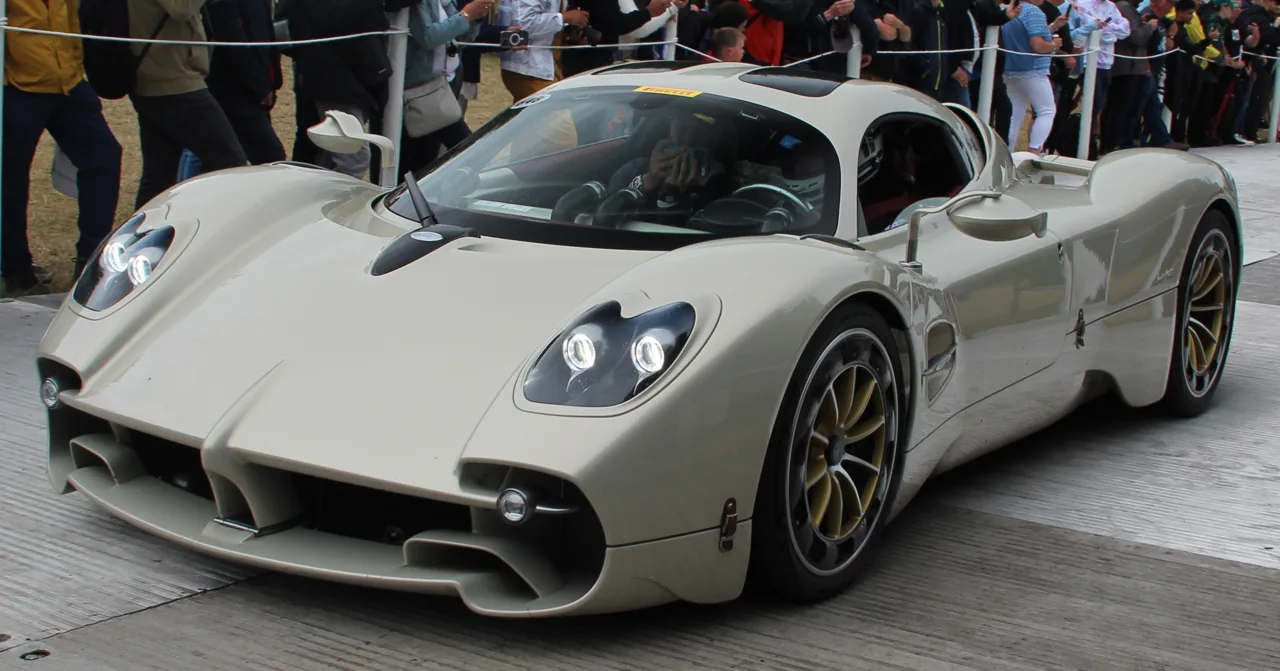
Utopia is Pagani’s third core family, following Zonda and Huayra. The manufacturer describes a non-hybrid V12 programme and a deliberate emphasis on visible mechanical controls. Its published material quotes 864 hp for the coupé, while the Roadster announcement identifies a 130-car programme and a claimed 1,280 kg dry weight.
The Roadster and coupé were developed together, according to Pagani, rather than the open version being conceived only after the closed car. That is a useful factual detail because it explains the intended relationship between the two designs. The dry-weight claim is a manufacturer measurement condition and should not be compared directly with a rival’s ready-to-drive kerb weight.
We think Utopia’s strongest idea is that modern engineering can be used to preserve a particular kind of physical interaction. A manual gearbox capable of handling a contemporary hypercar’s demands is not an absence of development. It is a development effort directed towards a different goal. That makes the car a useful counterpoint to the highly automated hybrid flagships elsewhere in the catalogue.
Our reservation concerns the difference between an attractive philosophy and a successful interaction. Beautiful controls still need to be clear and comfortable to use. Elaborate visible mechanisms should reward the driver as well as the photographer. The published concept is compelling, but the quality of the actual experience cannot be concluded from that concept alone.
The SuperCarNews view
Pagani’s contribution to the past thirty years is the insistence that a supercar can be judged at several scales. The overall silhouette matters, the engineering matters, and the small things a person sees and touches matter. That gives the cars a lasting editorial richness beyond their output figures.
We are most persuaded when the detail serves a clear composition, and least persuaded by the idea that more decoration or fewer examples automatically create a better car. The Zonda, Huayra and Utopia families offer enough distinct answers to sustain that argument. Their differences are worth exploring carefully, with sources attached and without borrowed claims of first-hand experience.
Sources & further reading
Reporting is based on the manufacturer material below. Photographs are credited separately.
- Pagani: twenty-five-year history
- Pagani official model collection
- Pagani Huayra BC technical overview
- Pagani Utopia and model history at Minardi Day
- Pagani Utopia Roadster
- Pagani Huayra Codalunga Speedster
- Pagani Zonda F and Huayra Roadster BC history
Explore the manufacturer directory for company history and model lineups.