
In this article
- More than a sequence of outrageous shapes
- Diablo: the archive begins with a V12
- Murciélago: continuity through change
- Gallardo: a second centre of gravity
- Aventador: the long V12 chapter
- Huracán: one engine, several personalities
- Revuelto and SV: the V12 becomes a hybrid
- Temerario: the smaller car changes its voice
- Reventón: the shape becomes the event
- Sesto Elemento: a different kind of extravagance
- Veneno: spectacle without understatement
- Centenario: a commemorative idea
- Sián: an early electrical chapter
- Countach LPI 800-4: the burden of a famous name
- Fenomeno: the limited series continues
- Essenza SCV12 and the competition branch
- The SuperCarNews view
More than a sequence of outrageous shapes
Lamborghini has spent the past thirty years turning a recognisable attitude into several different kinds of car. The V12 flagship remained central, but the Gallardo and Huracán created a second major line, limited series gave the design team a different stage, and the latest hybrids changed the mechanical recipe again. The continuity lies in the desire to make the cars unmistakable, not in preserving every component of an old formula.
Our view is that Lamborghini becomes more interesting when its engineering is taken as seriously as its theatre. The appearance is part of the product, but it is not the whole explanation. This archive follows the road-car families relevant to 1996–2026, including the earlier-born Diablo, and distinguishes customer track projects. It is researched history and editorial analysis, without claims that SuperCarNews has driven the cars discussed.
Diablo: the archive begins with a V12
The Diablo was introduced in 1990 and remained central to Lamborghini as this archive’s period began. Its family includes the VT, SV, GT, Roadster and later 6.0 interpretations. Those badges matter because the Diablo did not stand still throughout its life. The later cars belong to a changing industrial context as well as a continuing visual lineage.
We think the Diablo’s strongest design quality is the confidence of its basic proportion. It does not need an elaborate explanation to communicate where its machinery sits or what sort of occasion it is intended to create. That clarity can be obscured when every discussion becomes a story about intimidation. A useful historical appraisal should distinguish specific versions and documented changes instead of treating all Diablos as one colourful anecdote.
Murciélago: continuity through change
The Murciélago arrived in 2001 as the first entirely new Lamborghini of the Audi-Volkswagen period. The official history identifies its V12 and standard four-wheel drive. Roadster, LP640 and SV versions developed the family further, but its most important initial task was to establish that greater industrial support did not have to erase the marque’s identity.
Looking at the design, we find its relatively clear surfaces particularly persuasive. The shape is dramatic without requiring every panel to carry a separate visual event. That restraint gives the more specialised versions room to add emphasis. The Murciélago is therefore a useful counterargument to the idea that a Lamborghini must become ever more visually complicated to remain recognisable.
Gallardo: a second centre of gravity
The Gallardo’s 2003 arrival gave Lamborghini a V10 model alongside its V12 flagship. The range expanded through Spyder, Superleggera, LP560 and later specialised derivatives, including Super Trofeo Stradale and Squadra Corse. The related Super Trofeo racing cars should be identified separately from the road-going versions whose names reference the programme.
Our view is that the Gallardo’s importance is structural. It gave the company another way to express itself, with a car whose dimensions and role differed from the flagship. Calling it merely the smaller Lamborghini understates that achievement. A broader range can make a brand more coherent when each product has a clear reason to exist. The Gallardo helped establish that two different Lamborghini experiences could be equally legitimate.
Aventador: the long V12 chapter
The Aventador arrived in 2011 with a new V12 and carbon-fibre chassis. Its family developed through the S, SV, SVJ and Ultimae, alongside open-top versions. That long sequence should be read as several interpretations of an architecture rather than a simple ladder in which every later badge invalidates the earlier car.
We are drawn to the Aventador’s role as a sustained commitment to the flagship idea. It made the V12 Lamborghini a recognisable cultural object for another generation. The more extreme derivatives amplify that identity, but the original design still deserves attention for establishing the vocabulary. A thoughtful archive should explain what each version changes while allowing a reader to prefer the appearance or purpose of an earlier one.
The same principle applies to the Roadster. Removing the roof changes the nature of the occasion, not merely a line in the specification. An owner choosing that format may be prioritising a different experience from someone attracted to the most focused fixed-roof derivative. Neither choice needs to be defended with a fastest-lap argument.
Huracán: one engine, several personalities
The Huracán replaced the Gallardo in 2014. Lamborghini’s history identifies its V10, dual-clutch transmission and original all-wheel-drive configuration. The family subsequently encompassed rear-driven versions, Spyder, Performante, EVO, STO, Tecnica and Sterrato. That variety makes the exact version especially important to any useful discussion.
We find the Huracán’s later development particularly interesting because it did more than keep increasing intensity. The STO, Tecnica and Sterrato suggest different answers to the question of where and how an enthusiast might enjoy a supercar. The Sterrato is the clearest challenge to the assumption that the next desirable derivative must move closer to a circuit car.
That willingness to diversify is worth celebrating as an editorial idea, without pretending to have assessed the resulting cars from the driver’s seat. A manufacturer can create interest by changing the intended setting, not just the power figure. The Huracán family shows why grouping related variants together is useful: the differences become a conversation about purpose rather than an unconnected list of badges.
Revuelto and SV: the V12 becomes a hybrid
The Revuelto introduced Lamborghini’s current V12 plug-in hybrid direction in 2023. Its place after the Aventador makes it a major architectural transition, even though the cylinder count preserves an obvious connection. The manufacturer’s current Revuelto SV page describes a further version with 1,065 CV and an ongoing approval context. We record the family as a current programme rather than assuming every derivative has reached customers in every market.
The editorial appeal is the attempt to use new systems in support of a familiar central attraction. Hybridisation does not have to mean making the combustion engine less important to the car’s personality. It can change the way that personality is supported. The difficult question is whether the additional capabilities remain easy for the driver to understand and use.
We would judge the SV against its own stated purpose instead of granting it an automatic verdict on the strength of a famous suffix. A focused derivative should make a clear case for its changes. Scarcity and a higher output help create attention, but the relationship between its intended use and engineering is the more durable story.
Temerario: the smaller car changes its voice
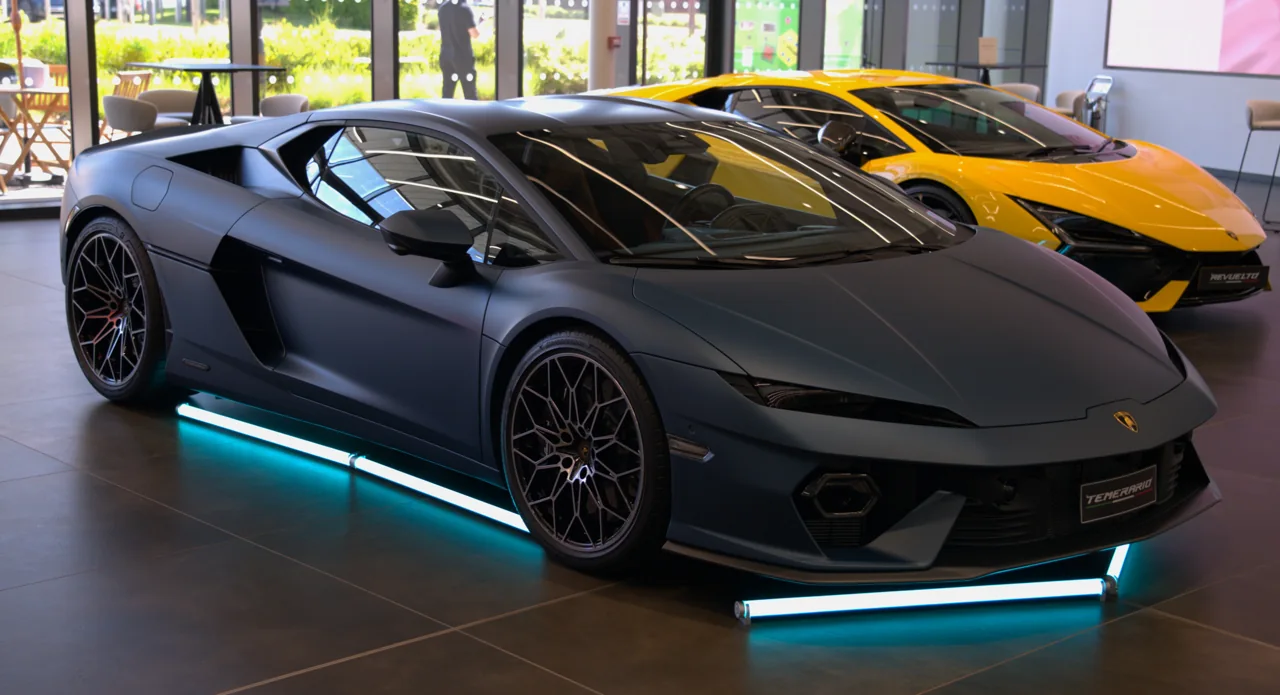
The Temerario replaces the Huracán’s V10 formula with a twin-turbo V8 hybrid. Lamborghini’s current specifications quote 920 CV combined, 343 km/h and 0–100 km/h in 2.7 seconds. Its 10,000 rpm engine-speed ceiling gives the new layout a specific point of interest beyond the expected increase in output.
Our dedicated model guide explores the trade-offs. Here, its historical importance is the willingness to change the central ingredient of an established favourite. We think the right question is whether the Temerario creates a persuasive new attraction, rather than whether it can imitate the old one. The Alleggerita package and bespoke Ad Personam configurations should be read as specifications within the road-car family, with racing derivatives identified separately.
Reventón: the shape becomes the event
The Reventón, introduced in 2007 and followed by a Roadster, began Lamborghini’s modern sequence of very small series. It gave the design itself an unusually prominent role in the product’s identity. The underlying family relationship is important, but it does not make the visual work irrelevant.
We think these cars deserve a more demanding discussion than whether their rarity justifies their price. A limited design programme can be valuable when it explores a coherent direction that would be difficult to attempt across a larger range. The Reventón is interesting as a statement of that possibility. Its influence is best considered through the visual ideas it made memorable, rather than by treating production totals as an artistic verdict.
Sesto Elemento: a different kind of extravagance
The Sesto Elemento sits in the track-only branch of the limited-series story. Its emphasis on carbon-based construction makes it a useful contrast with cars whose exclusivity is expressed principally through luxury materials or elaborate finishes. It asks the collector to value a concentrated technical idea.
That is the aspect we find most appealing. Spending extravagantly to remove material can be a more interesting supercar argument than spending extravagantly to add decoration. The practical limits of a track-only car remain part of the ownership proposition, however. It should not be presented as a normal road-car option simply because its appearance is familiar from shows and photographs.
Veneno: spectacle without understatement
The Veneno and Veneno Roadster take Lamborghini’s limited-series design towards a particularly emphatic visual extreme. In photographs, their layered surfaces and prominent aerodynamic elements make understatement irrelevant to the brief. They are intended to be discussed as objects with a forceful presence.
Our response is deliberately mixed. We admire the refusal to make every special car broadly agreeable, but visual complexity still needs an overall composition. A reader can enjoy the ambition while preferring the cleaner shape of a different Lamborghini. That is a more useful conversation than insisting that a rare car must be beautiful because few people can own one.
Centenario: a commemorative idea
The Centenario and its Roadster counterpart occupy the commemorative part of Lamborghini’s limited-series history. They belong alongside the regular model families, with the purpose of the special programme kept visible. A commemorative car is making a statement about the marque as well as providing a particular mechanical specification.
We think the strongest such projects connect the occasion to a convincing design. Commemoration alone is not enough to make a car important. The work needs to reward attention after the anniversary has passed. The Centenario is therefore worth examining for the way it interprets Lamborghini’s visual identity, rather than merely recording that an anniversary produced another scarce badge.
Sián: an early electrical chapter
The Sián FKP37 and Sián Roadster belong to Lamborghini’s move towards electrified supercars before the current mainstream hybrid range. They should not be treated as mechanically interchangeable with the later Revuelto simply because both can be described with the word hybrid. The term covers different implementations and intentions.
Their place in the archive is valuable for that reason. Technology rarely arrives as one clean, universal answer. A small programme can explore an approach that differs from the eventual larger-volume solution. We prefer to understand the Sián within that development story rather than making it carry the burden of representing every possible argument for or against electrification.
Countach LPI 800-4: the burden of a famous name
The Countach LPI 800-4 revived an exceptionally recognisable name in 2021. It belongs in this archive as a contemporary limited series; the original Countach predates the thirty-year window. Keeping the two distinct is essential even when the newer car intentionally invites comparison.
We are cautious about nostalgia as a design brief. The attraction is obvious, but a famous name can make the audience judge a new car against an imagined memory rather than its actual purpose. The most productive reading is as a modern interpretation of selected ideas, not as a replacement for the original. Whether that interpretation appeals is a question of taste that rarity cannot settle.
Fenomeno: the limited series continues
Lamborghini revealed the Fenomeno coupé in 2025 with an announced 29-car programme. The Fenomeno Roadster followed in May 2026 with 15 planned examples. The manufacturer describes a 6.5-litre V12 with three electric motors and 1,080 CV combined. Those announcements establish the programme and its intended specification, rather than confirming individual delivery status.
The Fenomeno is interesting because it extends the limited-series tradition into the current hybrid architecture. We would look for a clear distinction between what the design programme explores and what the regular range already provides. A very small production run creates an opportunity to take a stronger position, but the resulting car still needs more to say than that it is difficult to obtain.
Essenza SCV12 and the competition branch
The Essenza SCV12 belongs to Lamborghini’s customer track activity. Super Trofeo and GT3 derivatives of the Gallardo, Huracán and Temerario belong to the competition story, with their own technical requirements and intended environments. They can illuminate the road cars, but they should not be blended into a road-car specification table.
This distinction improves the editorial discussion. A competition car is not simply a road car that has become universally better. Its priorities have changed. Comfort, noise, service intervals and equipment can take on a different meaning when the machine is supported for circuit use. Understanding that change makes the engineering more impressive, because the reader can see the problem the team was actually solving.
The SuperCarNews view
Lamborghini’s most persuasive achievement across the period is its ability to change substantially while remaining easy to recognise. The move from Diablo to Murciélago, the creation of the V10 branch and the latest hybrid programmes are not minor variations on one old idea. They are significant decisions about how the company should develop.
We think the archive is strongest when that diversity remains visible. The cleanest shape, the most specialised derivative and the newest flagship can each appeal for different reasons. Our job is to explain those reasons with enough care that a reader can form a view of their own. There is no need to invent a drive, or to declare every new model the greatest Lamborghini, to find plenty worth discussing.
Sources & further reading
Reporting is based on the manufacturer material below. Photographs are credited separately.
- Lamborghini historical milestones
- Lamborghini historical model collection
- Lamborghini: few-off heritage
- Lamborghini 2024 sustainability report and model history
- Lamborghini Fenomeno reveal
- Lamborghini Fenomeno Roadster announcement
- Lamborghini Revuelto SV model page
- Lamborghini Temerario specifications
- Lamborghini Squadra Corse programme history
Explore the manufacturer directory for company history and model lineups.