
In this article
At a glance
Manufacturer specifications. Performance figures have not been independently tested by SuperCarNews.
- Engine
- 4.0-litre twin-turbo V8 + three electric motors
- Combined power
- 920 CV
- Engine speed limit
- 10,000 rpm
- 0–100 km/h
- 2.7 seconds
- Top speed
- 343 km/h (current model page)
- Driven wheels
- All four
The difficult job of replacing a favourite
The Lamborghini Temerario has a harder assignment than its output suggests. Replacing the Huracán means replacing a car whose engine configuration became part of its public identity. A V10 was an easy thing for an enthusiast to understand and desire. A twin-turbo V8 working with three electric motors asks for a longer explanation. Lamborghini’s challenge is to make that explanation feel like the beginning of a new attraction, rather than an apology for the old one disappearing.
Our starting position is sympathetic to change. A successful successor should not have to preserve every mechanical ingredient of its predecessor. It should preserve a convincing reason to choose it. In the Temerario’s case, the published emphasis on very high engine speed is especially interesting: Lamborghini is trying to give a turbocharged hybrid its own form of theatre instead of relying solely on effortless low-speed torque.
This is an editorial assessment of the design and manufacturer information. We have not driven the Temerario, assessed its sound in person or tested its performance. That distinction matters particularly when a car’s appeal is so closely connected to what its engine feels and sounds like.
A V8 built around a different idea of excitement
Lamborghini revealed the Temerario in August 2024. Its four-litre twin-turbo V8 and three-motor hybrid system produce a claimed 920 CV combined, with a 10,000 rpm engine-speed ceiling. The current model page lists all-wheel drive, 0–100 km/h in 2.7 seconds and 343 km/h. These remain manufacturer claims, with the units preserved as published.
The engine-speed limit is the most revealing number. A turbocharger does not prevent an engine from revving enthusiastically, but high engine speed creates its own demands on internal components, lubrication and thermal management. Choosing to pursue it says something about the character Lamborghini wants this engine to express. It is an attempt to make the climb through the rev range part of the attraction.
The electric system gives the engineers another way to shape what happens during that climb. A combustion engine’s output changes with speed and load; an electric contribution can be coordinated around it. The worthwhile question is how those sources are blended, rather than whether one makes the other philosophically impure. A hybrid can have an engaging identity, but that identity has to be designed deliberately.
What the motors change
Three motors are more than a conspicuous addition to a brochure. Their placement and control create opportunities to distribute torque and influence the car’s response. They also introduce mass, cooling requirements and operating states that a purely combustion-powered predecessor did not have to manage in the same way. A fair appraisal needs to acknowledge both sides of that engineering exchange.
It is tempting to treat all-wheel drive as a simple traction advantage and stop there. In practice, the way front and rear contributions are coordinated matters to how a car reacts. Different software strategies can make similar hardware serve different intentions. We would want a future driving assessment to explain whether the Temerario’s responses remain clear and predictable as the system moves between those states.
For an owner, this adds a second kind of literacy to the traditional supercar experience. Fuel level is no longer the only energy consideration. Understanding the car’s modes and charging behaviour becomes part of using it well. That need not be a chore, provided the interface makes the relevant information obvious and the car’s normal operation does not require constant management.
Design: a new face for the smaller Lamborghini
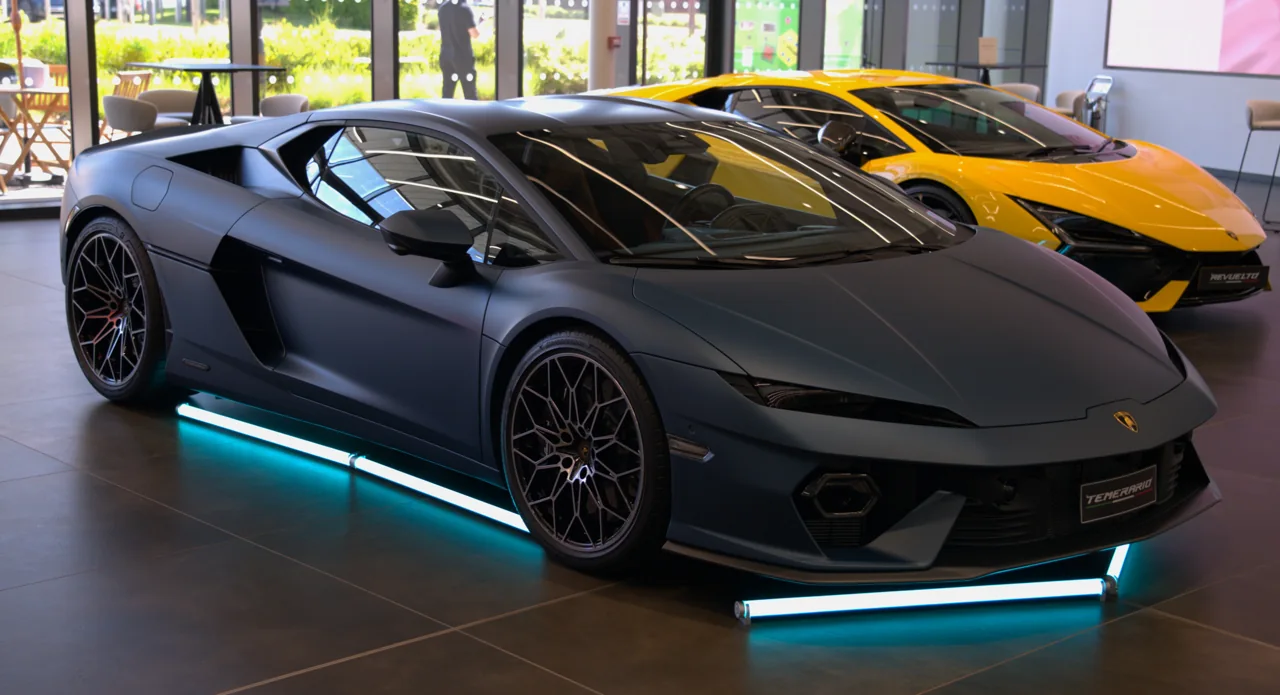
The official photographs show a car that keeps Lamborghini’s low, angular stance while changing the detail vocabulary. Hexagonal lighting and a more openly displayed engine area give the Temerario identifiable features of its own. We think that is the correct ambition. A replacement model should be recognisable without needing a badge close-up or a lesson in model-year differences.
Our preference is for the cleaner specifications, where the body’s underlying shape can be read without too many competing accents. That is a taste judgement, not a technical conclusion. Lamborghini’s more expressive customers will reasonably disagree. The point is that a strong base design should support both approaches rather than depend on an elaborate colour scheme to become memorable.
The cabin deserves the same scrutiny as the exterior. A modern supercar has to present more modes and information than its predecessors, but more screens do not automatically create a better interface. The important issue is whether the driver can understand the car quickly. A clear hierarchy between essential driving information and secondary functions is more useful than sheer display area.
Alleggerita, personalisation and racing derivatives
The Temerario name can describe more than one kind of product discussion. A lightweight option package changes a road car’s specification; an Ad Personam commission changes its individual presentation; a competition derivative operates under a different brief altogether. These distinctions matter because photographs and abbreviated headlines can make unlike cars appear directly comparable.
The Tricolore configuration is a useful example. Lamborghini’s announcement centres on colour, materials and a national motif, while retaining the familiar hybrid powertrain. It should be read as a design and personalisation story. It is not evidence that every Temerario now has a new performance specification, nor that the show car represents a separately available Australian trim level.
We would apply the same care to any lightweight or circuit-oriented specification. Compare the complete car being described, including equipment and tyres. An attractive claim about a particular configuration should not quietly become the standard model’s specification. Readers deserve to know what would actually need to be selected to obtain the advertised result.
Rivals and the question of identity
The Temerario enters a category in which hybridisation is becoming a platform for different personalities. Ferrari and McLaren do not make the same decisions about engine layout, driven wheels or the relationship between electrical assistance and the combustion engine. It would be a mistake to assume that electrification makes these cars interchangeable. Their disagreements are increasingly found in how the systems work together.
For Lamborghini, the difficult part is emotional continuity. The Temerario needs to feel like a desirable Lamborghini without asking its buyers to pretend that a V8 is a V10. We think the high-revving concept is a more persuasive response than simply making the new car faster. It offers an idea enthusiasts can become interested in on its own merits.
That does not guarantee success. A dramatic specification can still produce a confusing or distant interaction, just as an apparently conservative layout can be wonderfully coherent. We can identify the questions the Temerario raises without inventing answers from the driver’s seat.
The SuperCarNews view
We find the Temerario more interesting when discussed as a deliberate reinvention than as a numerical upgrade. The decision to combine turbocharging, substantial electrical assistance and a very high rev ceiling suggests Lamborghini understands that output alone cannot replace the appeal of its outgoing engine. There is an attempt here to create a fresh reason to care.
Our reservation concerns complexity and communication. The car has more ways to produce and distribute performance, and that makes the clarity of its controls and responses especially important. The best outcome would be a car whose engineering feels natural to use while remaining fascinating to understand. That is the standard we would apply to future evidence, rather than expecting it to impersonate the Huracán.
Australian price, allocation and delivery details have not been verified in this guide. Source dates distinguish the original reveal from later specifications. Readers looking at bespoke configurations should use the relevant announcement alongside this model guide, with attention to exactly which car is pictured and described.
Sources & further reading
Reporting is based on the manufacturer material below. Photographs are credited separately.
- Lamborghini Temerario: current model specifications
- Lamborghini: Temerario launch announcement · 16 August 2024
Explore the manufacturer directory for company history and model lineups.