
In this article
A bespoke configuration at Monterey
Lamborghini's 24 August 2026 announcement presents Temerario Tricolore as a bespoke configuration shown at The Quail during Monterey Car Week. It revives a name last used for the Gallardo LP 550-2 Tricolore in 2011. The statement describes an exercise in personalisation and Italian identity, rather than a new high-output mechanical derivative.
The exterior combines Blu Marinus on the lower body with Bianco Monocerus above, an Italian-flag treatment across the bonnet and contrasting dark details. Red brake callipers and a black-and-red cabin continue the composition. The underlying Temerario remains the V8 hybrid model described in our dedicated guide; the Tricolore announcement does not establish a separately offered Australian trim.
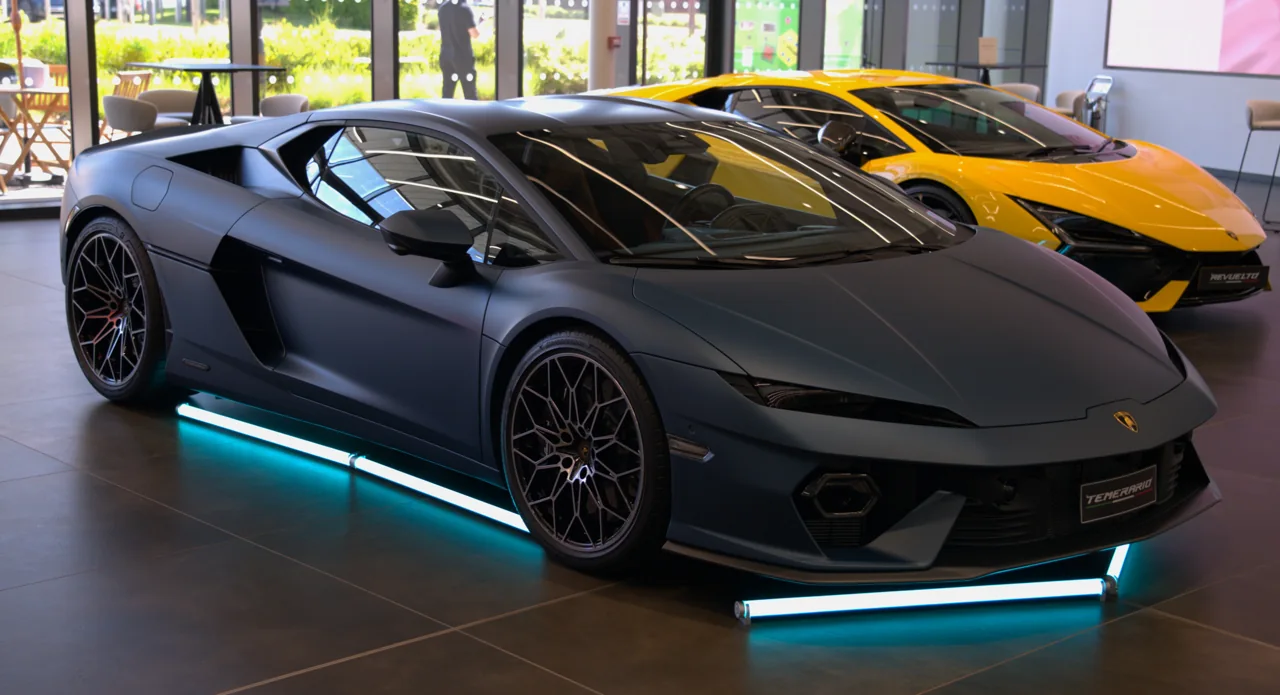
The photograph accompanying this article shows a standard Temerario, as its caption states. It illustrates the underlying model rather than the bespoke Tricolore colour scheme. Lamborghini's source page provides the official configuration imagery.
Colour is part of the design
It is tempting to dismiss a special paint treatment as a minor story compared with an engine announcement. That overlooks how strongly colour can change the way a body is read. A dividing line can emphasise a low nose, interrupt a continuous surface or make the cabin appear more separate from the lower structure.
In our view, the interesting test is whether the colour scheme works with the car's architecture. A successful treatment can make an existing proportion clearer. A less convincing one can scatter attention across the body until the overall shape becomes difficult to understand. Complexity by itself does not establish craftsmanship or good design.
The Tricolore's upper-and-lower division gives us a specific composition to discuss. It invites the eye to read the body in layers, while the national-colour element supplies a direct symbolic reference. We would judge the scheme by how those elements relate across different viewing angles, not merely by how dramatic one carefully chosen photograph looks.
Heritage without confusing the models
The reference to Gallardo Tricolore provides historical continuity, but it should not imply that the two cars share a mechanical proposition. The name is the link. The modern Temerario belongs to a different platform and propulsion era, and an archive should preserve that distinction.
We think heritage references work best when they are selective. Repeating a name or a motif can create a useful connection without requiring a modern car to imitate every feature of an earlier one. The new object still needs a coherent identity of its own. Otherwise historical recognition becomes a substitute for design rather than an ingredient within it.
This is particularly relevant for a marque with so many recognisable visual themes. A limited configuration can draw from national colours, racing associations or earlier special editions. The editorial job is to identify which reference is actually being made, instead of treating all of them as interchangeable evidence of pedigree.
Personalisation and the ownership story
Bespoke programmes give a buyer more influence over the finished object, which changes the relationship between manufacturer and customer. That can produce a car with a clear personal identity. It can also create a specification whose individual details are expensive or unusual without forming a convincing whole.
Our preference is for restraint in the decision-making, even when the result is visually bold. A strong principal idea usually gives the secondary materials and accents something to support. Adding every available contrast treatment can make a car less distinctive because the eye has no clear place to settle.
None of this establishes a future resale premium. Individuality and financial desirability are different questions, and a manufacturer's bespoke label does not resolve the latter. The more useful editorial discussion concerns the design choices themselves and the experience the owner hopes to create.
What the announcement does and does not change
This news does not replace the need for a proper account of the underlying Temerario. Its hybrid system, high-revving V8, packaging and relationship to Lamborghini's earlier smaller supercars are substantial subjects in their own right. We cover those in the model feature and marque history linked alongside this story.
The Tricolore gives that wider discussion a different entry point. Readers who arrive for the colour scheme should be able to continue into the engineering and historical context, rather than reach the end of a short promotional caption with nowhere useful to go.
It also demonstrates why edition names need careful classification. A bespoke display configuration, a limited production series and a mechanically revised model are not the same kind of announcement. Treating them accurately makes the site more useful to someone trying to understand an increasingly complicated current range.
The SuperCarNews view
We welcome a design story that can be discussed on its own terms. A supercar is a visual and material object as well as a powertrain, and colour deserves criticism rather than automatic applause. The strongest personalisation makes the car's underlying shape more legible while giving it a recognisable individual character.
Temerario Tricolore is an opportunity to ask whether that balance has been achieved. Our judgement concerns the published design and its intent. It is not a road-test verdict, and the car does not need an invented driving impression to support a worthwhile editorial discussion.
Sources & further reading
Reporting is based on the manufacturer material below. Photographs are credited separately.
- Lamborghini: Temerario Tricolore announcement · 24 August 2026
Explore the manufacturer directory for company history and model lineups.