
In this article
At a glance
Manufacturer specifications. Performance figures have not been independently tested by SuperCarNews.
- Engine
- 4.0-litre twin-turbo V8 + hybrid
- Combined power
- 1,275 PS / 1,258 bhp
- 0–100 km/h
- 2.7 seconds
- 0–200 km/h
- 5.8 seconds
- Top speed
- 350 km/h
- Driven wheels
- Rear
The significance of leaving the front wheels alone
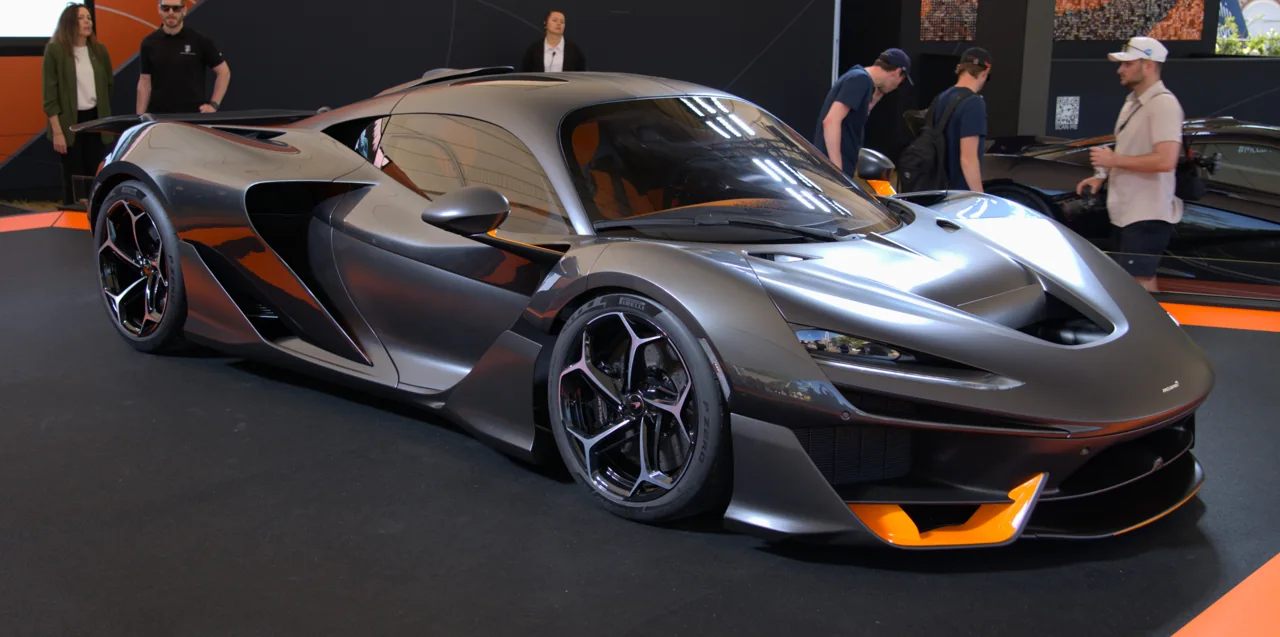
The most interesting line in the McLaren W1’s specification is not the one announcing its power. It is the one identifying the driven wheels. In an era when electrification makes an extra driven axle an attractive answer to traction, McLaren has chosen to send the W1’s combined output to the rear. That decision gives this flagship a clear engineering identity before anyone begins comparing acceleration claims.
It also gives us a better starting point for an opinion. We value supercars that pursue an identifiable idea, because the alternative is a category of machines chasing the same impressive but increasingly remote numbers. The W1’s appeal on paper is the way its hybrid system, aerodynamic bodywork and driver-focused choices appear to serve a recognisable brief. Whether they feel convincingly integrated is something a specification cannot establish.
SuperCarNews has not driven the W1. This guide analyses McLaren’s published material and the implications of its design, rather than presenting a road test. References to likely trade-offs are editorial reasoning, not claims about behaviour we have experienced.
The engine and the electric contribution
Revealed on 6 October 2024, the W1 combines a four-litre twin-turbo V8 with an electric module and an eight-speed dual-clutch transmission. McLaren publishes a combined output of 1,275 PS, also expressed as 1,258 bhp, and 1,340 Nm of torque. It places the car in the lineage of the F1 and P1. Those connections create expectations, but the W1 needs to explain itself on its own terms.
An electric contribution can be valuable for more than a short burst of peak power. It creates another means of shaping the torque arriving at the gearbox, potentially filling in where an engine is less responsive. The word “potentially” is doing useful work here. The quality of that interaction depends on calibration, temperature and operating conditions. Quoting a combined total does not tell a reader how consistently the system can deliver it.
Rear-wheel drive also makes tyre capacity and torque management central to the car’s job. It would be simplistic to frame that as an automatic advantage over all-wheel drive. Different layouts solve different problems. We find McLaren’s choice interesting because it establishes a constraint and then asks the rest of the car to work intelligently within it. A strong design often begins with exactly that kind of commitment.
A tail that changes the car’s proportions
In Race mode, the W1’s Active Long Tail extends rearwards by 300 mm. McLaren says the complete aerodynamic package can generate up to 1,000 kg of downforce. The moving tail is unusually easy to grasp visually, but its significance lies in how it changes the working area of the rear aerodynamic system. This is a car whose circuit configuration is meant to be materially different from its road configuration.
We think that is a more compelling story than simply fitting a taller wing. It treats the body as something with different jobs under different conditions. High-speed stability, drag, cooling and cornering load do not all ask for the same shape. A mechanism that changes the aerodynamic arrangement gives the engineers another way to negotiate those competing demands.
It brings questions of its own. Moving surfaces need to be dependable, and the driver needs to understand when a mode is available and what it changes. In an eventual test, we would want a clear account of the transition between configurations and of how the car communicates its limits. Dramatic motion in a launch film is the beginning of that story, not its conclusion.
Hydraulic steering and the meaning of involvement
McLaren retains hydraulic steering for the W1. Enthusiasts often treat that phrase as a guarantee of good feedback, but the mechanism alone cannot settle the question. Tyre construction, suspension geometry, friction, assistance and the forces reaching the front wheels all contribute to what a driver feels. We welcome the choice as a statement of priorities while resisting the temptation to write a verdict on steering we have not used.
More broadly, driver involvement need not mean making a car difficult. A clear control response, a comprehensible relationship between input and outcome, and confidence in what the chassis is doing can matter more than heavy effort. The W1 will be most interesting if its exceptional capability remains legible to a human being rather than merely available to the software controlling it.
This is where the F1 connection should be handled carefully. A modern hybrid flagship cannot reproduce the circumstances that created an early-1990s supercar. What it can inherit is a habit of making deliberate choices about the driver’s role. We would rather see that principle developed than see familiar visual references used as a substitute for it.
How to read the performance claims
McLaren lists a lightest dry weight of 1,399 kg, 0–100 km/h in 2.7 seconds, 0–200 km/h in 5.8 seconds and a 350 km/h maximum. These are manufacturer figures. The lightest dry specification should not be compared directly with another car’s kerb weight, and a launch sprint should not be mistaken for a complete account of the car’s performance envelope.
For a powerful rear-driven hybrid, the context around a result is particularly valuable. Tyres, surface temperature, battery state and launch procedure can affect what happens. Repeated circuit running presents a different set of demands from one acceleration measurement. A reader deciding which engineering solution is more convincing deserves that context rather than a league table built from incompatible conditions.
The figures also say little about the roads most owners will actually use. Width, visibility, access and the ability to manage the car at low speed can determine how often an extraordinary machine leaves its garage. Those details rarely lead a launch presentation, but they are not trivial. A car that is easier to use may create more memorable journeys even when a rival has the stronger headline statistic.
The SuperCarNews view
The W1’s strongest quality in the published material is the clarity of its priorities. The rear-driven layout, changing aerodynamic body and attention to steering create a coherent subject for discussion. We are particularly drawn to the way the extending tail makes a functional change visible. There is pleasure in understanding why an extraordinary object looks and behaves differently in different settings.
Our reservation is the familiar one for highly specialised flagships: capability can outrun the opportunities to appreciate it. The challenge is to make the road configuration feel complete in its own right, rather than like the interval before a circuit session. Nothing in a specification proves that this has been achieved, and we will not imply otherwise.
Against Ferrari’s F80 and Bugatti’s Tourbillon, the W1 therefore stands as a distinct proposition rather than an obvious winner or loser. We prefer that diversity to a single accepted recipe for a hypercar. Australian pricing, allocation and delivery timing are not verified here; an announced global programme does not establish local availability or customer handover status.
Sources & further reading
Reporting is based on the manufacturer material below. Photographs are credited separately.
Explore the manufacturer directory for company history and model lineups.