
In this article
At a glance
Manufacturer specifications. Performance figures have not been independently tested by SuperCarNews.
- Engine
- 3.0-litre twin-turbo V6 + hybrid
- Combined power
- 1,200 CV
- 0–100 km/h
- 2.15 seconds
- Top speed
- 350 km/h
- Driven wheels
- All four
- Announced production
- 799 cars
A flagship with something to argue about
The Ferrari F80 makes a useful demand of enthusiasts: decide what you actually want from a flagship. If the answer is the most theatrical engine Ferrari can package behind two seats, a hybrid V6 might sound like an awkward starting point. If the answer is an expression of the company’s contemporary competition thinking, that same engine becomes much easier to understand. The interesting argument is between those priorities, rather than between six cylinders and twelve in isolation.
Our view is that the F80 deserves to be judged on the coherence of its engineering. Nostalgia is a legitimate part of buying an extraordinary car, but it is a poor substitute for understanding one. Equally, Ferrari cannot expect a technical explanation to settle every emotional objection. A flagship has to make people care about its solution. The F80 is fascinating because it places those two requirements in open tension.
This is research and editorial analysis. SuperCarNews has not driven the F80, measured its performance or assessed its controls from the driver’s seat. Where we discuss the implications of its layout, those are reasoned expectations rather than observations from a road test.
Why Ferrari chose a V6 hybrid
Ferrari announced the F80 in October 2024 with a three-litre twin-turbo V6, an electric front axle and a rear electric motor. The manufacturer quotes 1,200 CV overall, split between 900 CV from the engine and 300 CV from the hybrid contribution. It links the combustion engine’s development to its endurance-racing work. Those are the foundations of the car’s identity; they are more revealing than the total power figure alone.
A compact engine can make room for other priorities. In a car designed around airflow, cooling and tightly controlled body movement, the engine is one component in a much larger arrangement. The relevant question is what the whole package gains from its dimensions and position. Simply counting cylinders overlooks that relationship. It also overlooks the electrical hardware, which has to earn its place through useful performance rather than merely swelling a specification table.
There is a trade-off. A hybrid adds another source of torque, another thermal system and another set of control decisions. Delivering power convincingly means coordinating them. We would want any eventual evaluation to explain how the car responds after repeated acceleration, how its braking transitions behave, and whether its modes communicate their intentions clearly. Those questions are more demanding than reproducing the quickest advertised sprint.
Aerodynamics are the main event
Ferrari specifies active suspension and an adjustable rear wing, with 1,050 kg of downforce at 250 km/h. That last qualification matters. A downforce figure without its corresponding speed can make aerodynamic grip sound like a permanent attribute, as if the same load were present while manoeuvring through a slow bend. It is not. The relationship between road speed, ride height and airflow is central to understanding this kind of car.
The appeal of active suspension here is not simply that it sounds advanced. A body that remains where the aerodynamic surfaces expect it to be gives the airflow a more consistent operating environment. That creates an engineering conversation between suspension and bodywork. It also explains why judging the car from a single photograph of the rear wing misses much of the story beneath it.
For road use, the unresolved question is how much of this capability feels meaningful at ordinary speeds. An owner can admire exceptional engineering without exploiting every part of it, just as a collector can appreciate a competition watch without timing a race. But a road-going flagship should still offer a rewarding relationship with its driver when its most dramatic numbers are inaccessible. The specification cannot tell us whether the F80 achieves that balance.
The shape and the asymmetric cabin
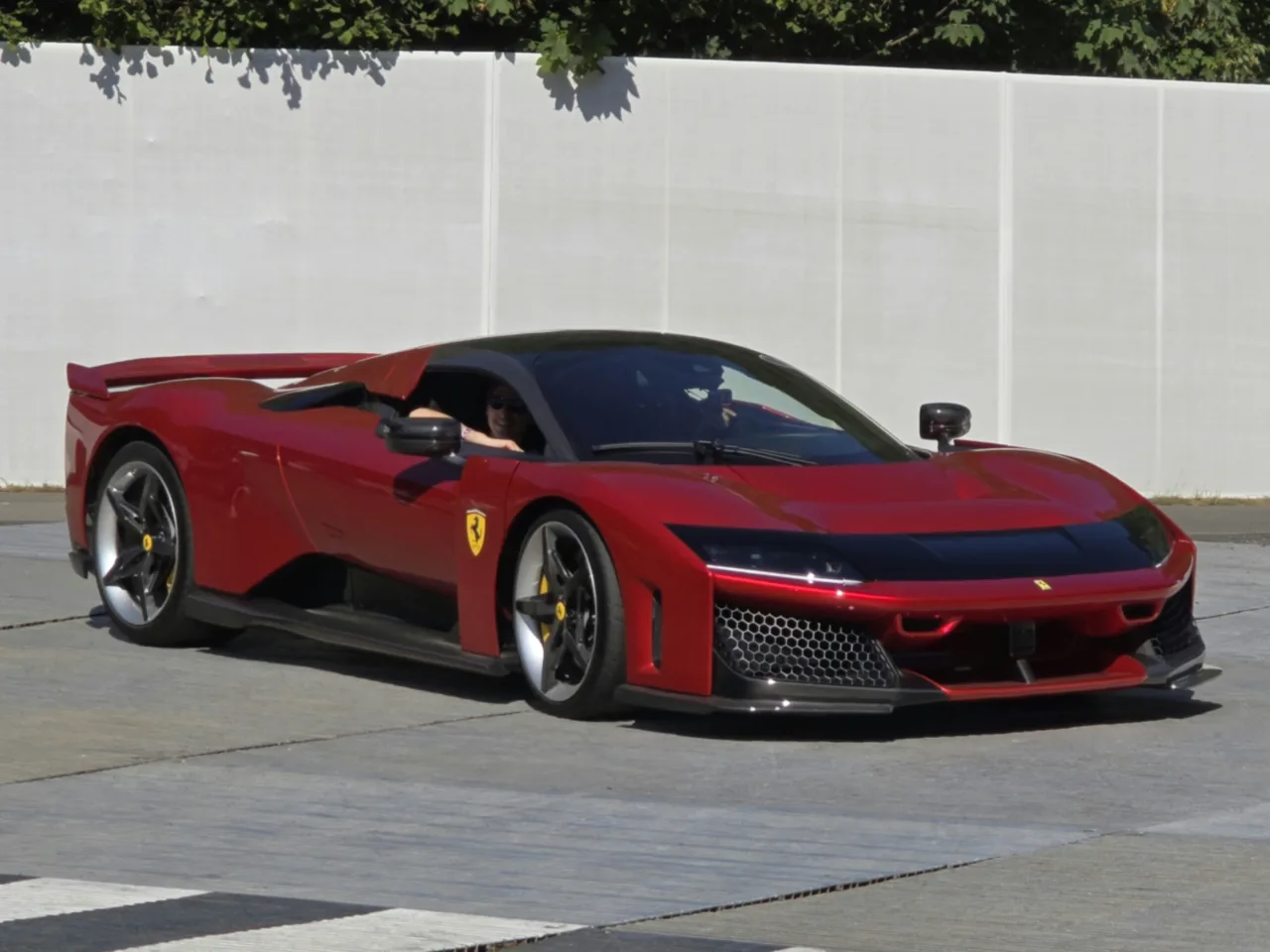
The F80’s published photographs show a deliberately assertive shape, with sharply defined surfaces and a strong visual separation between the passenger compartment and the surrounding body. We think the design is at its most convincing when read as a piece of working equipment. It does not have to borrow the delicate proportions of an older Ferrari to justify its badge. It does, however, invite a harder look at whether every dramatic element supports a clear overall composition.
Ferrari’s asymmetric two-seat cabin gives the driver greater visual emphasis. That is a telling decision in a car likely to be discussed as much as a collectible object as a machine. The passenger remains part of the experience, but the architecture declares who the car is built around. Whether that arrangement is comfortable, accessible or easy to see out of requires physical assessment; photographs do not establish those qualities.
For us, the best part of this approach is its willingness to have a viewpoint. A hypercar interior need not resemble a luxurious lounge. It can express concentration. The risk is that visual drama becomes an excuse for awkward daily interactions. Clear instruments, understandable controls and a workable driving position remain important even when production is tiny.
F80, W1 and Tourbillon: different ambitions
The F80 belongs in a conversation with McLaren’s W1 and Bugatti’s Tourbillon, but lining up their power outputs is an incomplete comparison. Our separate guides explain the W1’s rear-driven hybrid arrangement and the Tourbillon’s naturally aspirated V16. Each represents a different judgement about what an extraordinary car should prioritise. Their differences are the reason the category remains interesting.
We would compare them through intended use and character before ranking them. How much of the design is organised around a circuit? How much around high-speed touring, mechanical spectacle or the rituals of ownership? What does each car ask its driver to learn? These are editorial questions that can be explored from engineering choices, while conclusions about actual steering feel, ride and confidence must wait for evidence from driving.
The same discipline applies to weight and power. Dry weight and ready-to-drive kerb weight are not interchangeable. CV is metric horsepower, and should not silently become bhp in a comparison. Small inconsistencies in units can create impressively precise tables that are less informative than a careful paragraph.
The SuperCarNews view
The F80’s strongest argument is that a Ferrari flagship should reflect the company’s present ambitions, not only its most beloved past achievements. We like the intellectual boldness of that position. It gives the car a reason to exist beyond a larger number and a smaller production run. Ferrari announced 799 examples, but scarcity alone is not what makes the design worth discussing.
Our reservation is about emotional accessibility. The more a car’s advantages depend on speed, control systems and specialist conditions, the more carefully its everyday character needs to be considered. The F80 could be admired for its engineering and still divide people over what they want from a Ferrari. That disagreement would not make it a failure. It would make it a flagship with a clear, consequential set of choices.
Australian pricing, allocations and registration details have not been verified for this guide. Global production plans are not evidence of local availability. The figures above remain manufacturer claims, and our verdict concerns the published concept and execution rather than a driving experience we have not had.
Sources & further reading
Reporting is based on the manufacturer material below. Photographs are credited separately.
- Ferrari F80 launch announcement · 17 October 2024
- Ferrari F80 technical specifications (Italian, PDF)
- Ferrari: 2025 Red Dot Awards, F80 engineering summary
Explore the manufacturer directory for company history and model lineups.