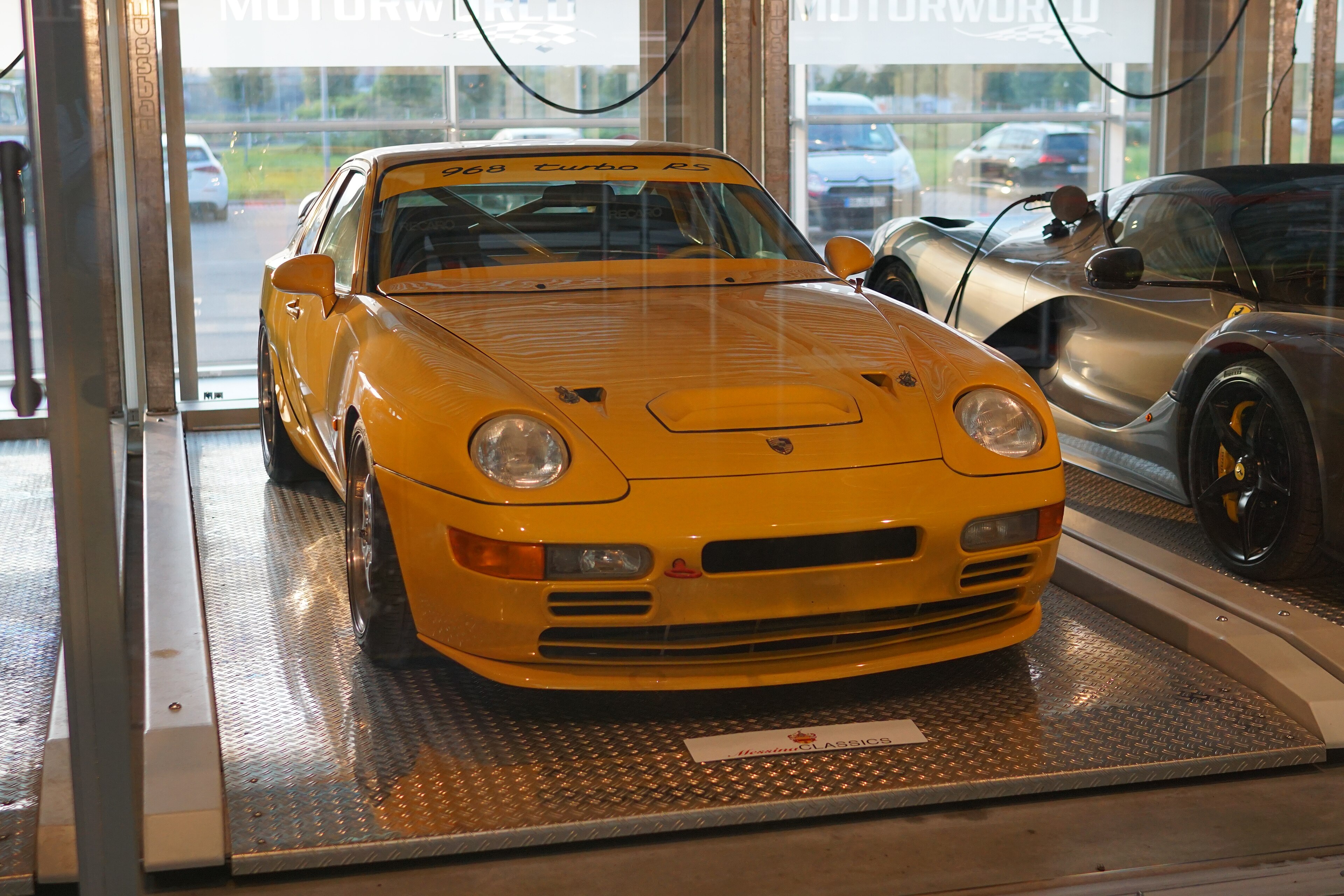
The name "968 Turbo RS" covers two related but different histories. Specialist histories describe Porsche's German group as one prototype and three left-hand-drive production racing cars.2 The current-owner registry describes four right-hand-drive cars created in Australia by Fitzgerald Racing Services (FRS), drawing on the factory competition idea and parts supply.4 Treating the two groups as one factory production run makes a rare story sound simpler than it is, and makes individual cars harder to authenticate.
That distinction matters because the regular 968 was already the end point of Porsche's front-engine, rear-transaxle line. Porsche dates 968 production from 1991 to the middle of 1995 and gives total series production as 11,245. The standard car used a naturally aspirated 3.0-litre four-cylinder producing 240 hp and 305 Nm.1 It was an unusual base for a racing special: large four-cylinder engine in front, gearbox at the rear, and a body descended from the 924 and 944 rather than the rear-engined 911.
The factory cars
Specialist histories describe the German Turbo RS population as one prototype and three production chassis, all left-hand drive.2 The competition engine combined a turbocharged 3.0-litre block with an eight-valve cylinder head. In its full specification, published figures reached 257 kW (350 PS) and 500 Nm.2 Those numbers should not be transferred automatically to every car carrying Turbo RS badges. Race tune, boost, management and event regulations could alter specification, while the Australian cars have their own build histories.
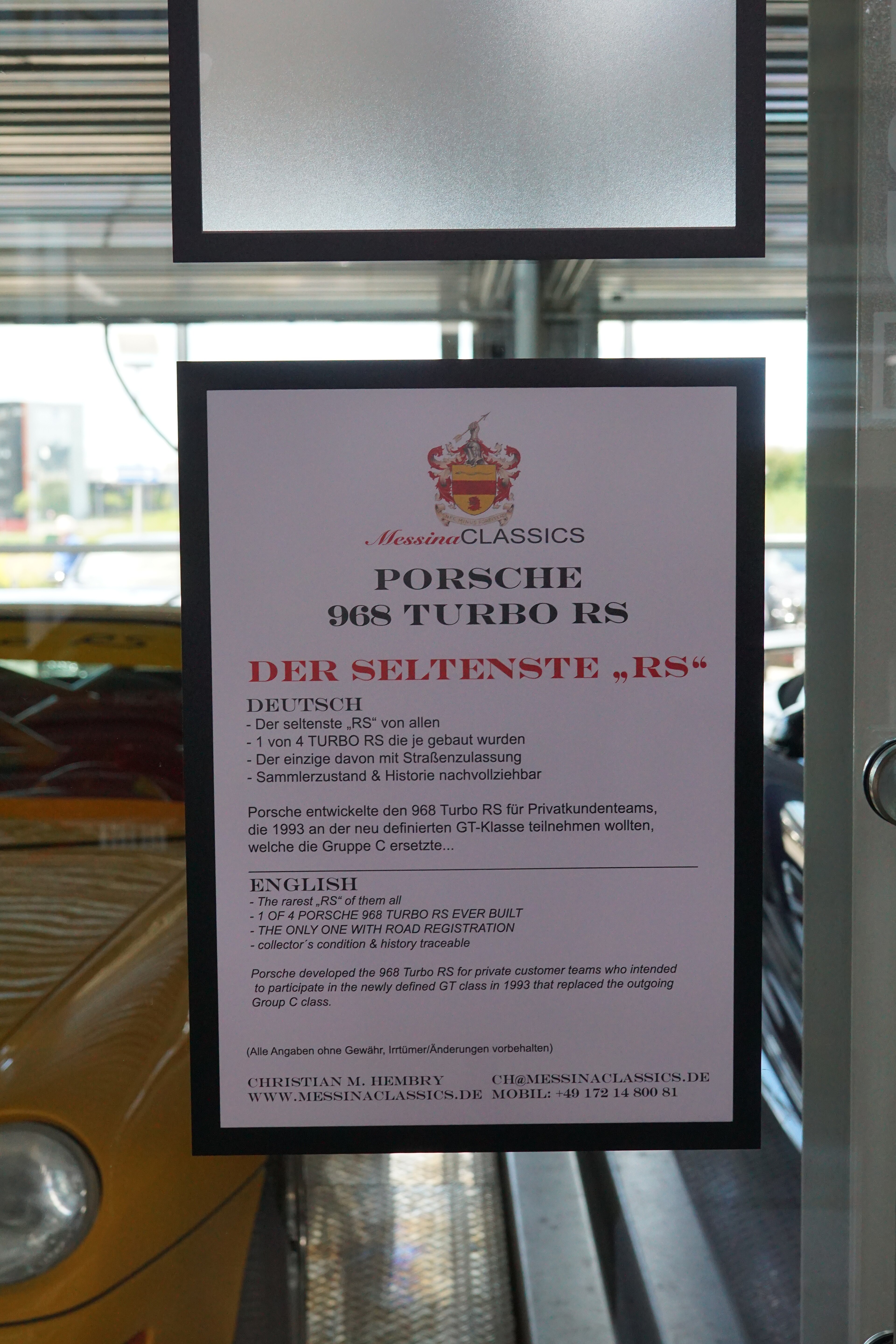
The small factory count also creates a language trap. A reference to "four Turbo RS cars" may mean the German prototype plus three race cars. In Australian discussion, the same number commonly means the four local right-hand-drive conversions. The two groups are not interchangeable.
Why Australia had its own group
Australia's connection began with competition use of the 968 Club Sport. Shannons' racing history records Club Sports in the 1993 and 1994 Bathurst 12 Hour. Cars that finished in 1993 were later excluded over wheel offsets; in 1994, 968s were classified second and third.3 That record establishes a local racing setting before the Turbo RS conversions, but it does not turn an Australian Club Sport into a factory Turbo RS.
The current-owner registry for the Australian cars describes four right-hand-drive examples associated with FRS.4 Specialist accounts describe locally completed conversions using factory parts or assistance.2 The careful description, then, is "Australian-built right-hand-drive conversion", not "one of four factory-built Turbo RS cars". This is more than pedantry. Factory identity affects how a chassis is catalogued, valued and represented to a future buyer.
The Australian project can still be understood as serious competition engineering. A 968 Club Sport gave it a stripped, focused base. Turbocharging changed heat load, torque delivery and the supporting systems required around the engine. Race preparation could add another layer of variation as cars were repaired or updated. The result is a group linked by concept and builder, not necessarily four cars frozen in an identical specification.
Reading the evidence on a surviving car
A badge, body kit or period colour scheme proves very little by itself. Start with the underlying Porsche identity: VIN, stamped chassis number, model labels and the specification recorded for the donor. Then build a dated chain around the conversion. FRS invoices, correspondence, parts lists, photographs taken during the build and workshop records can show what was done and when.
Competition claims need their own evidence. CAMS or Motorsport Australia logbooks, event entry lists, scrutineering records and published results can connect a chassis to a race. A story that a car "ran at Bathurst" is not the same as a logbook tying that exact identity to an entry. Components also move between competition cars, so an engine or body panel with race history does not necessarily give the whole vehicle that history.
Inspect current specification against the documents. Record engine numbers and casting details, turbocharger, intake and exhaust arrangement, engine management, gearbox, brakes, suspension, wheels and safety equipment. Period modifications may be historically important, but later replacements should be dated rather than quietly described as original. Old photographs are most useful when landmarks, dates and identifying details can be checked.
The owner registry is a useful map to the four Australian examples, but it is not independent certification.4 Owners have close knowledge of their cars and may hold records unavailable elsewhere; they also have an interest in how those cars are described. A sound provenance file combines owner material with invoices, governing-body records and contemporary results.
What remains uncertain
Public sources do not settle the exact donor identity, build date, initial tune and complete race history of every Australian car. Those details belong at chassis level. They should not be filled in from another example, even when the cars look alike. Nor should published power for the full factory race engine be presented as a dyno result for an Australian conversion.
The defensible history has two branches: Porsche's one-prototype, three-production left-hand-drive factory group, and four right-hand-drive cars created in Australia by FRS. The overlap is technical inspiration and parts lineage. The difference is who built each car and the documentary trail attached to it. Keeping both branches visible gives the Australian cars a better story, not a lesser one.
That approach also gives future research somewhere to go. A chassis register can be revised when a logbook, invoice or dated photograph emerges; a blanket claim that every car shared one origin is much harder to unwind. Owners and historians should preserve scans alongside the physical documents, note who supplied each item and avoid separating competition paperwork from the chassis it describes. Provenance is not a slogan attached to rarity. It is a sequence that another researcher can follow.
Sources and further reading
References supporting the reporting and practical context on this page.