
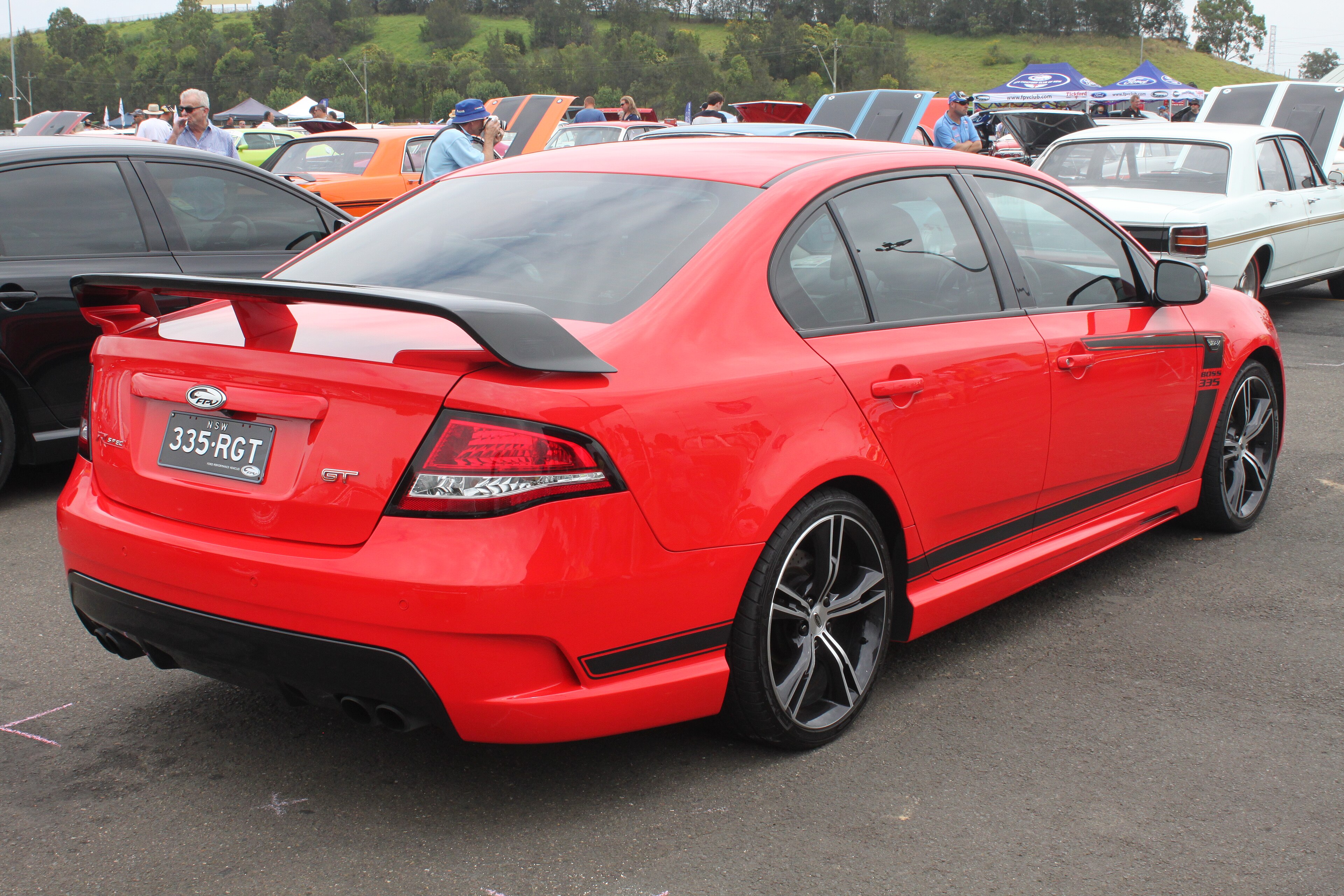
These cars sit forty years apart and answer different Australian questions. The 2012 FPV GT R-Spec tried to make a supercharged Falcon use its existing power more effectively.1 The Holden HQ, built from 1971 to 1974, spread one locally engineered family across passenger, prestige, sporting and commercial roles.45 One is a limited performance derivative; the other is a range broad enough to become street furniture.
Combining them only works if the differences stay visible. The R-Spec story is about identifying a precise mechanical package. The HQ story is about body families, factories and the difficulty of counting such a wide program.
Part one: FPV GT R-Spec
FPV announced the GT R-Spec in August 2012 as a run of 350 sedans, priced from $76,990 before on-road costs.12 Its supercharged 5.0-litre "Miami" Boss 335 V8 remained at 335 kW and 570 Nm.13 Buyers could choose a six-speed manual or six-speed ZF automatic.13 The important work happened downstream of the engine.
FPV added launch control, stiffer transmission mounts and revised springs and dampers. Rear lower control arms were reinforced, the rear anti-roll bar became thicker, and the front bushes and strut mounts were stiffened.12 Nine-inch rear wheels carried 275/35 R19 Dunlop tyres, wider than the standard GT rear package.13 The objective was traction and cornering grip, not another peak-power claim.
Contemporary reports associated the car with a 4.5-second internal 0-100 km/h result, but FPV did not publish that as a formal specification.13 It should remain an attributed test figure, not a certified production claim. Premium six-piston front and four-piston rear Brembo brakes were optional rather than standard.1
The visual treatment included a C-stripe inspired by the 1969 Boss Mustang and a "335" identifier.12 Half of the sedan run was black with red accents. The other 175 cars were white, red or blue with black accents.12 Colour and stripes help recognition, but neither establishes identity without a build record.
Drive also reported 75 Pursuit utes with related presentation.3 Those vehicles did not receive the sedan's suspension, wheel or power package and should not be added to the 350 sedans as if all 425 shared one mechanical specification.3
For a surviving car, record the VIN, FPV build identifiers and original colour, then obtain the factory build specification if available. Check that wheels, tyre sizing, suspension hardware, transmission and stripe treatment agree with the record. Options such as the larger Brembos should be described as fitted equipment, not proof of the model. Later modifications can be valuable, but the sale description should separate them from the R-Spec package.
Part two: Holden HQ
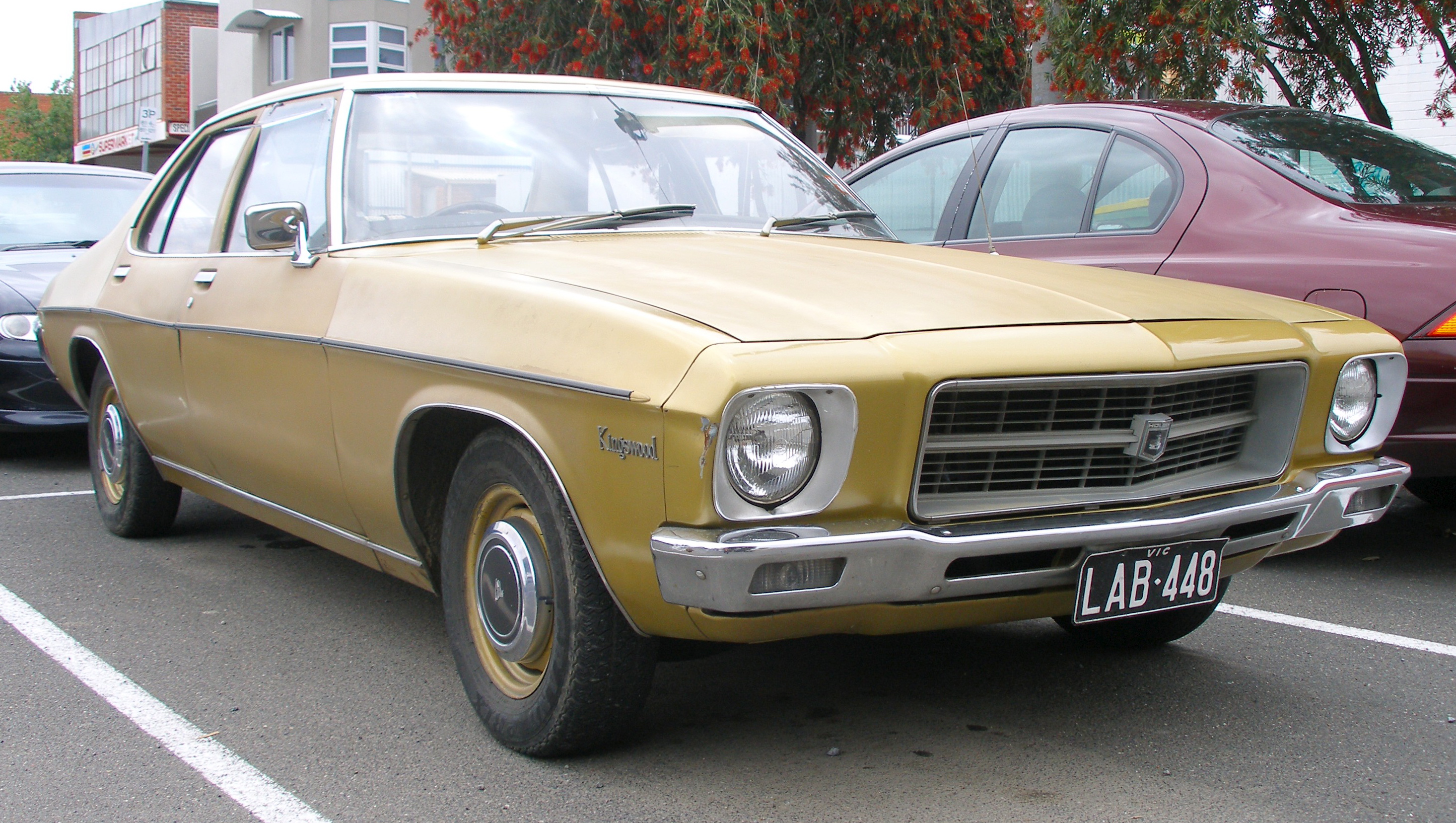
The State Library of South Australia dates HQ production from July 1971 to October 1974.4 Its collection timeline includes Premier, station wagon, Statesman and Monaro and links to original sales material.4 Holden Historical Services describes the broader HQ-to-HZ body families as sedan, wagon, coupe utility, panel van, cab-chassis, Monaro coupe and Statesman.5
That breadth is the HQ's defining fact. A family sedan, prestige model, sporting coupe and working commercial could share the wider program without being counted or marketed in exactly the same way. It is why a single production total can mislead unless the author defines whether Statesman and every commercial derivative are included.
Manufacturing was distributed and rationalised across plants. Holden Historical Services says Monaro coupes were built only at Dandenong and Pagewood. Cab-chassis manufacture was concentrated at Elizabeth before final assembly elsewhere.5 Pagewood panel-van manufacture ran from April 1973 for twelve months. Dandenong ended Monaro production in November 1973 and other HQ passenger-body manufacture in April 1974.5
Those details replace a vague image of every version rolling from every plant. They also give restorers and historians a way to test provenance. A body style, build date and plant claim should agree. Plant records and body plates are stronger than assumptions based on where a car spent most of its life.
The HQ belongs to the longer Holden manufacturing history that began with the first production Holden in November 1948 and ended with Australian production in 2017.6 That context should not flatten the individual model into a national symbol. Its specific achievement was range coverage during three years and three months of production.
Claims around total HQ output and early Sandman identity need restraint. Secondary totals often count different sets of vehicles. Sandman timing and the use of that name on early vehicles require brochure and order-code confirmation. A neat round number or later badge is not a substitute for GM-H documentation.
Two different authentication problems
The R-Spec asks whether a Falcon carries a defined 2012 FPV package and which options or later changes are present. The HQ asks first which branch of a very broad family the car belongs to, where and when that body was made, and how later specifications have been applied to it.
For both, numbers should be recorded before restoration work obscures them. Build sheets, invoices, service records and dated photographs should be kept with the car. Modifications are not historical defects when they are described honestly. The problem begins when a desirable specification is inferred from paint, badges or oral history.
Sources and further reading
References supporting the reporting and practical context on this page.

.jpg)

