
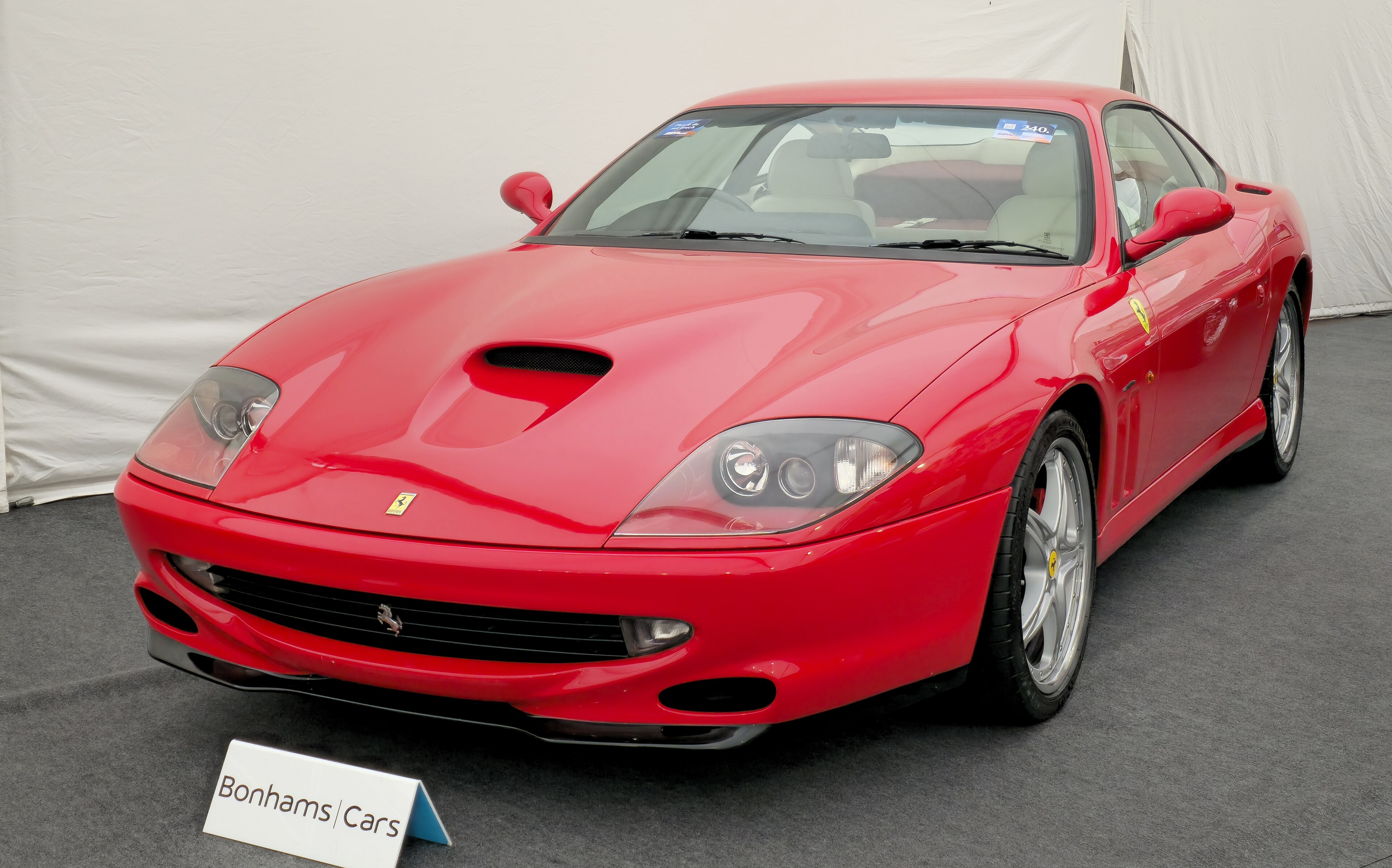
Ferrari chose the Nürburgring for the 550 Maranello's press launch in 1996.1 The setting advertised speed, but the car's bigger historical move was architectural. Ferrari's new flagship put a naturally aspirated V12 in front of the occupants and the gearbox at the rear, replacing the mid-engined F512M.1 It returned the company to a front-engine grand-touring format without asking buyers to accept old-car behaviour.
That layout now feels familiar because Ferrari kept developing it. In 1996 it was a reset. The 550 had to carry luggage and cover distance while meeting expectations created by a twelve-cylinder flagship. A retrospective should judge how the design made those jobs coexist, not pretend to reproduce a road test conducted decades ago on a different car.
The package
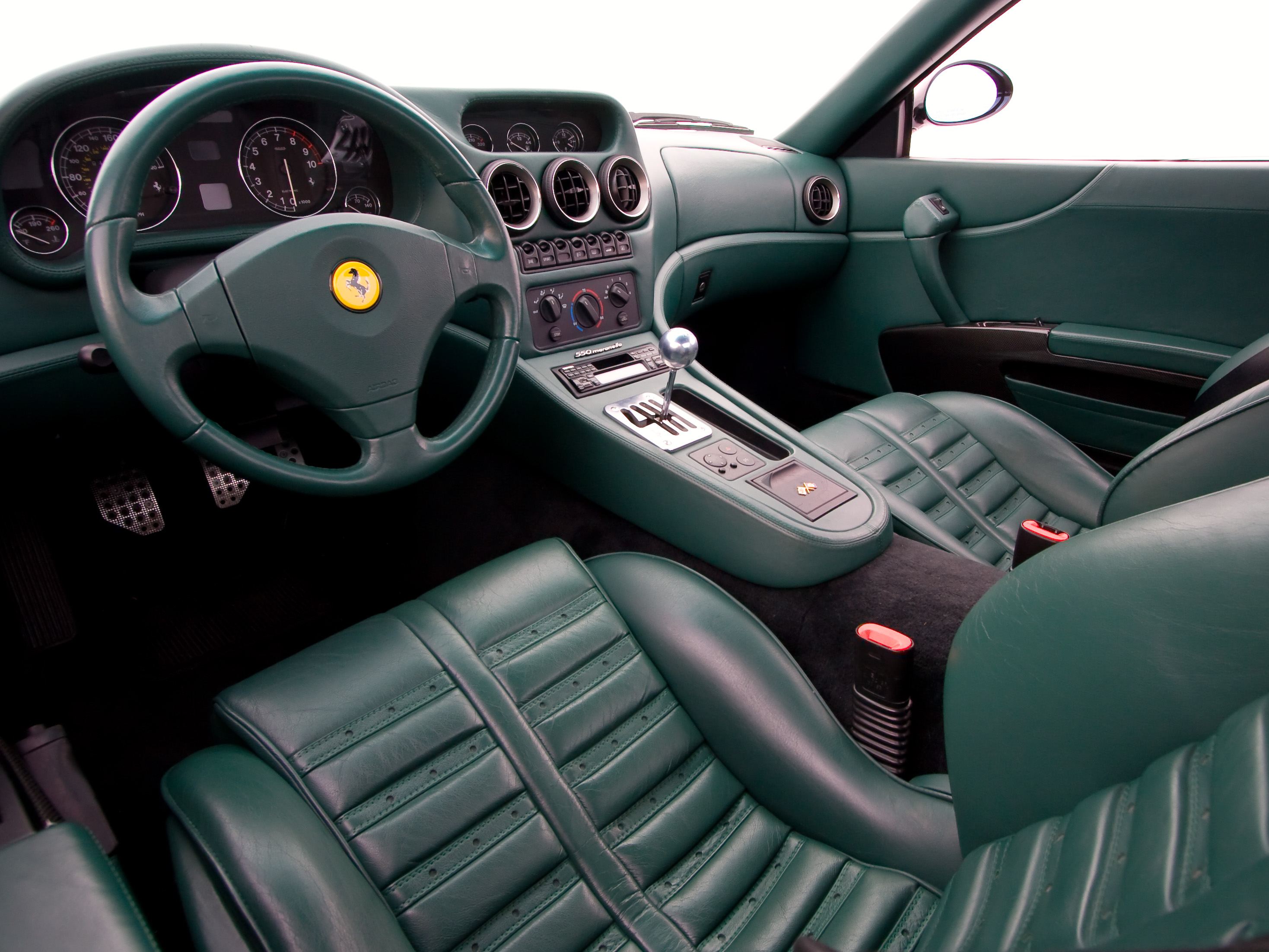
Ferrari records 550 production from 1996 to 2001 and credits Pininfarina with the design.1 The 65-degree V12 displaced 5,474 cc and produced 485 cv at 7,000 rpm, with 568 Nm at 5,000 rpm.1 Drive went to the rear wheels through a six-speed manual gearbox plus reverse. The open metal gate and lever became a defining cabin detail, but the transaxle location mattered more to the car's balance.
Aluminium body panels were mounted on a steel chassis.12 With the engine at the front and transmission at the rear, the car approached even weight distribution.12 That did not make it small: the long bonnet, broad track and cabin placed well aft signalled a traditional grand tourer. The engineering task was to keep that shape stable at speed without making it clumsy on ordinary roads.
Ferrari gives a drag coefficient of 0.33.1 In October 1998, a 550 set production-car distance records at Marysville, Ohio, an exercise intended to demonstrate sustained performance rather than one short acceleration run.1 Ferrari's page gives inconsistent miles-per-hour conversions beside the metric record figures, so the metric values should be used if those records are discussed in detail.
Power is another place where apparent disagreement is mostly units. Ferrari's 485 cv becomes roughly 478 bhp in British references.12 That is conversion and rounding, not evidence of two engine specifications.
What a current drive can and cannot tell us
A well-maintained 550 should make its size easier to manage once moving. The engine's broad torque and the transaxle layout are central to that impression. The manual shift requires deliberate inputs when cold, while steering, brake and damper condition strongly influence whether the car feels coherent.
No present-day drive can recreate the launch-car experience. Tyres have changed, dampers age, alignment drifts and individual cars collect repairs. A retrospective should state the example's tyre type, mileage, service history and major replacements. Without that context, praise or criticism can become a report on deferred maintenance.
The cabin is part of the touring argument. Seating, visibility, climate control and luggage space matter alongside the engine. Trim condition also reveals age. Dashboard leather can shrink, and switches and plastics may show heat exposure.3 These flaws do not rewrite the model's engineering, but they can dominate the ownership experience.
Maintenance belongs in the story
Specialist guidance calls for documented annual maintenance and cambelt replacement on a three-year schedule.3 A buyer should verify dates and work performed rather than accept a stamp alone. If belts, tensioners, seals or related parts were addressed, the invoice should say so.
Start the car cold and assess gear selection before the oil warms. Check cooling-fan operation, stable temperature and evidence of coolant leaks.3 Inspect dampers for leakage and make sure selectable suspension functions, where fitted, operate without warning lights. A road test should include low-speed manoeuvres, rougher surfaces and a fully warm restart, not only a fast road.
The mixed-material body needs informed inspection. Aluminium panels can corrode and react around repairs or dissimilar metals, while the steel structure has its own risks.23 Paint depth and panel gaps can identify areas for investigation, but a Ferrari body specialist is needed to assess the quality of earlier work. Stone chips are ordinary; distorted structure hidden beneath attractive paint is not.
Service records should also explain clutch work, engine mounts, hoses, fuel-system attention and electrical repairs. Low annual mileage does not stop seals and flexible components from ageing. A car driven and maintained regularly may be a better proposition than an inert display piece with fewer kilometres.
Why the 550 still makes sense
The 550's importance lies in a set of practical choices. Ferrari gave its flagship a front V12, rear transaxle, six-speed manual and body shaped for high-speed stability. The result connected older front-engine Ferrari tourers with a new generation of usable performance cars.
It is easy to romanticise the manual gate or the absence of later driver interfaces. The more persuasive qualities are less theatrical: weight distribution, visibility, a wide operating range and the ability to travel. Those qualities only show when the car is maintained correctly. A tired 550 can feel heavy and expensive; a sorted one explains why Ferrari kept the basic template.
Any published drive should finish with a condition note, not a verdict on the whole model. Record tyre age and pressures, ambient temperature, warning lights, suspension setting and whether the car was fully warm. If a fault appears, describe the symptom and refer it for diagnosis rather than assigning a cause from the driver's seat. That discipline makes the retrospective useful to readers and fair to a design now encountered through cars with very different histories.
Sources and further reading
References supporting the reporting and practical context on this page.


.jpg)
