
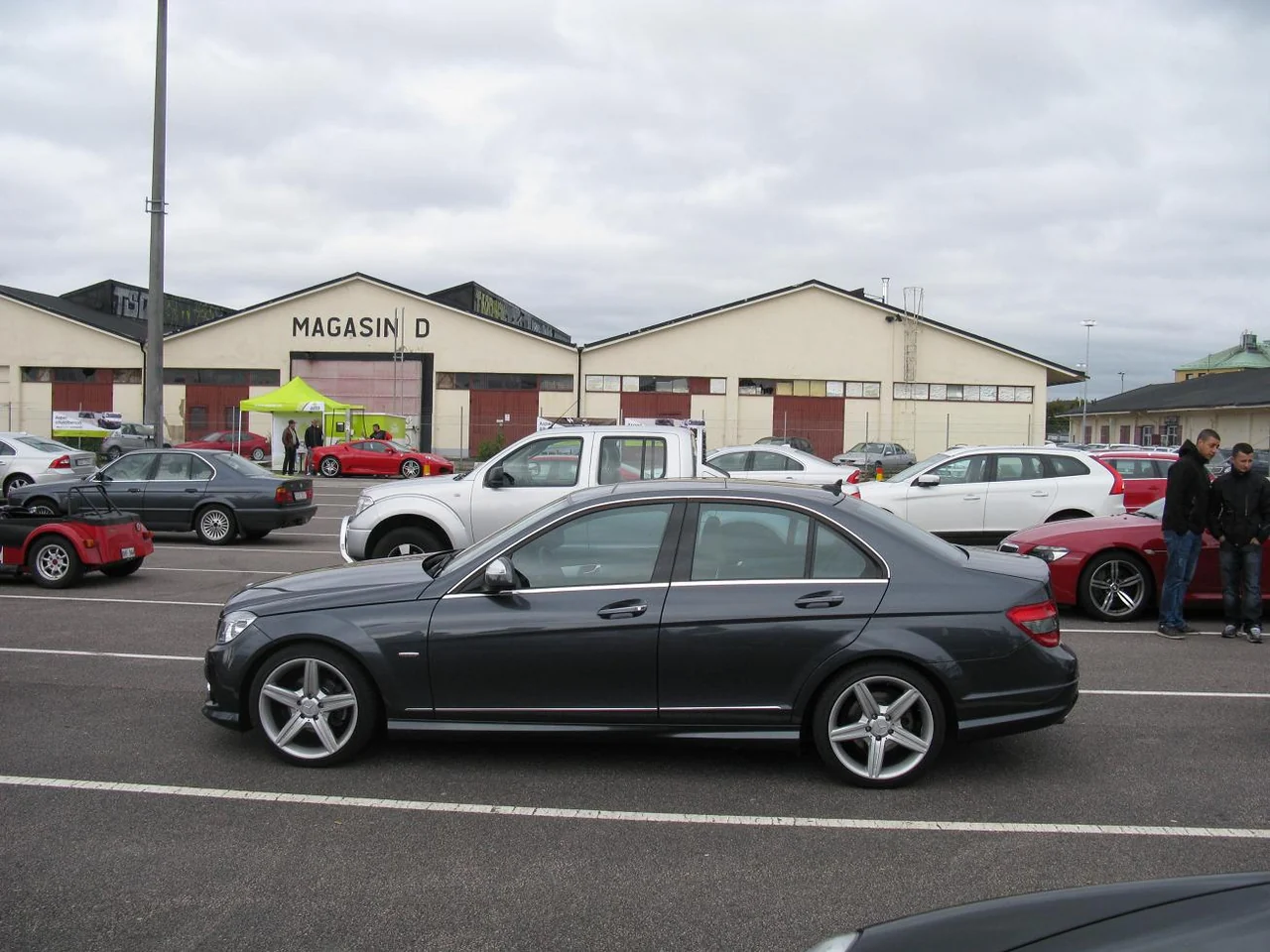
A W204 can wear wheels that show you plenty of brake hardware and still leave the important questions unanswered. Calipers and discs may differ by model, equipment or later modification. Paint, wheel style and an AMG badge are not a parts lookup.
Mercedes-Benz's own archive makes the variation plain. Its C 180 KOMPRESSOR example lists 288 mm ventilated front discs, 278 mm solid rear discs and floating calipers.2 The C 63 AMG record describes different hardware, and the range history records an optional AMG Performance Package Plus with a composite front high-performance brake system.34 These are global examples, not an Australian fitment table.
The evidence has to agree
Use three layers of evidence, in this order:
- VIN and build identity. Record the full VIN, type, build date and Australian compliance history. Obtain current Mercedes-Benz parts/build data for that VIN. XENTRY Parts Information describes a VIN-based search and vehicle-specific parts lists adjusted for construction year and equipment variant.1
- Installed hardware. Have a qualified technician identify the caliper and carrier, record legible casting or part numbers, and measure the disc diameter and thickness using the correct equipment.
- Current catalogue confirmation. Reconcile the VIN result and physical measurements with the current Mercedes-Benz parts system, including supersessions. Resolve any disagreement before ordering.
A build record describes how the car left production. It cannot prove that the same calipers, carriers, discs, hubs or sensors remain fitted. A used W204 may have received a documented upgrade, a repair assembled from another variant, or an undocumented conversion.
| Evidence | Useful for | Limitation |
|---|---|---|
| VIN-specific Mercedes-Benz parts/build data | Original model, equipment branch and candidate part numbers | May require paid access or an authorised parts desk; does not prove present hardware |
| Caliper and carrier identifiers | Distinguishing installed assemblies | Dirt, paint or superseded numbers can obscure the result |
| Disc diameter and thickness | Checking the installed disc specification | Measurement is not a wear-limit or serviceability verdict by itself |
| Invoice for a conversion or major repair | Explaining why the car differs from build data | The installed work still needs inspection |
| Wheel or badge | Prompt to investigate | Not fitment evidence |
What to record at the workshop
Give the parts desk or brake specialist one page containing:
- full VIN, type, build date and market history;
- front and rear axle positions recorded separately;
- caliper and carrier part or casting numbers where legible;
- measured disc diameter and thickness;
- disc construction noted without guessing from colour alone;
- wear-sensor arrangement and connector details;
- clear photographs with the wheel position labelled;
- invoices for any conversion, replacement hub, knuckle or brake package;
- the VIN-specific catalogue result and its date.
Do not copy the C 180 dimensions above into an order form unless the VIN data and installed hardware establish that exact configuration. Do not assume a C 63, Sport, AMG-styled or imported car carries one universal brake package. Australian-delivered combinations must be checked against the individual vehicle; overseas records only help frame the questions.
Handling a mismatch
A mismatch is a stop sign for the parts search, not proof of wrongdoing. Ask whether Mercedes-Benz superseded a component, whether a complete brake package was installed, and whether the hubs, knuckles, master-cylinder coding or wheel clearance were affected. Keep the invoice and current part-number chain with the service history.
If the data remains ambiguous, an authorised Mercedes-Benz parts desk or a workshop familiar with W204 brake variants should identify the assembly. Do not solve uncertainty by buying several safety-critical parts and keeping whichever appears to fit.
Brake and lifting boundary
This page identifies evidence; it is not a brake repair procedure. Wheel removal and accurate measurement may require professional equipment. Use approved lifting points and a rated lift or stands on suitable ground. Never work beneath a car supported only by a jack.
Do not drive a car with a hydraulic leak, unsafe pedal, brake warning or uncertain brake assembly. Brake removal, hydraulic work, tightening, bedding and final verification require the correct Mercedes-Benz procedure and a qualified technician. This guide supplies no torque values, wear limits, fluid specification or repair sequence.
Parts research should remain at category level until the VIN result, current catalogue and installed hardware agree. That agreement matters more than the badge on the boot or the colour of the caliper.
Sources and further reading
References supporting the reporting and practical context on this page.