
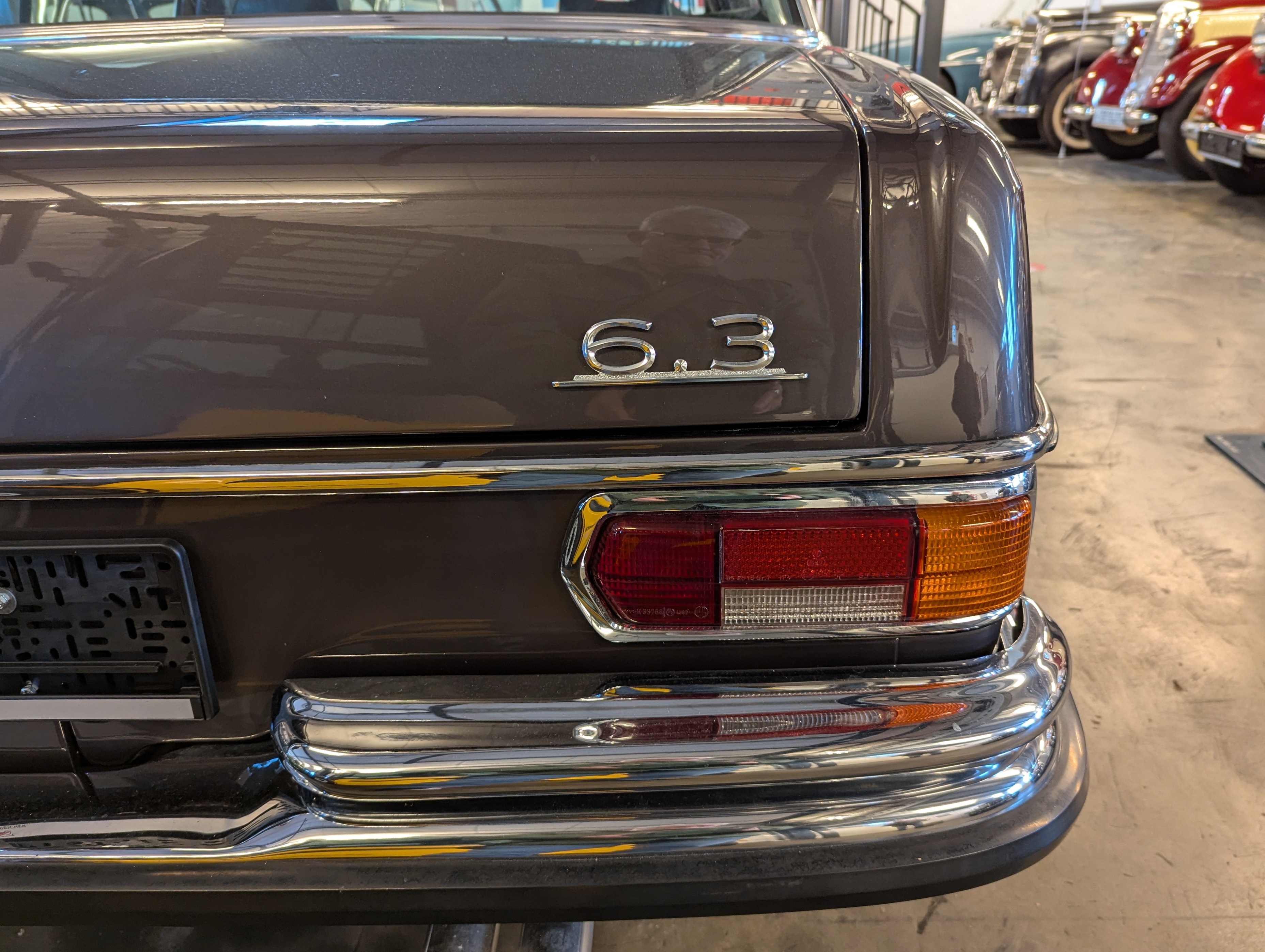
Mercedes-Benz built both of these long-wheelbase sedans around an M100 V8, automatic transmission and self-levelling suspension.12 That family resemblance can obscure how differently they answer the same question. The 300SEL 6.3 put the engine from the 600 limousine into the older W109 body.1 The 450SEL 6.9 arrived a generation later as a complete W116 flagship, heavier and more mature, with more engine capacity and a different suspension system.2
The numbers do not produce a simple winner. Mercedes' archive makes the earlier 6.3 quicker to 100 km/h, while the 6.9 has the higher stated maximum speed and more torque.12 The reason to compare them is not to stage a notional drag race. It is to see how Mercedes changed its idea of a very fast luxury saloon between the late 1960s and late 1970s.
The disruptive 6.3
Mercedes lists type 109.018 in production from December 1967 until September 1972, with 6,526 built.1 Its 6,332 cc M100 V8 produced a stated 250 hp and 51 mkg of torque, sent through a four-speed automatic.1 Published factory performance was 0-100 km/h in 6.5 seconds and 220 km/h, at a kerb weight of 1,780 kg.1
Those figures explain the car's reputation, but its architecture explains the character. The W109 retained air springs at both axles.1 The big engine sat in a formal body whose basic visual language belonged to an earlier Mercedes generation. A driver saw upright glass, restrained trim and a narrow cabin compared with later luxury cars. The acceleration available beneath that presentation was startling for its time.
The 6.3 was not merely an engine transplant in the backyard sense. Cooling, braking, suspension, driveline and packaging had to work as a production Mercedes. Today, those integrated systems also make condition more important than headline performance. Air suspension, mechanical fuel injection and M100-specific components demand knowledge and records. A car that sits correctly in a photograph may still need expensive recommissioning.
The 6.9 changes the formula
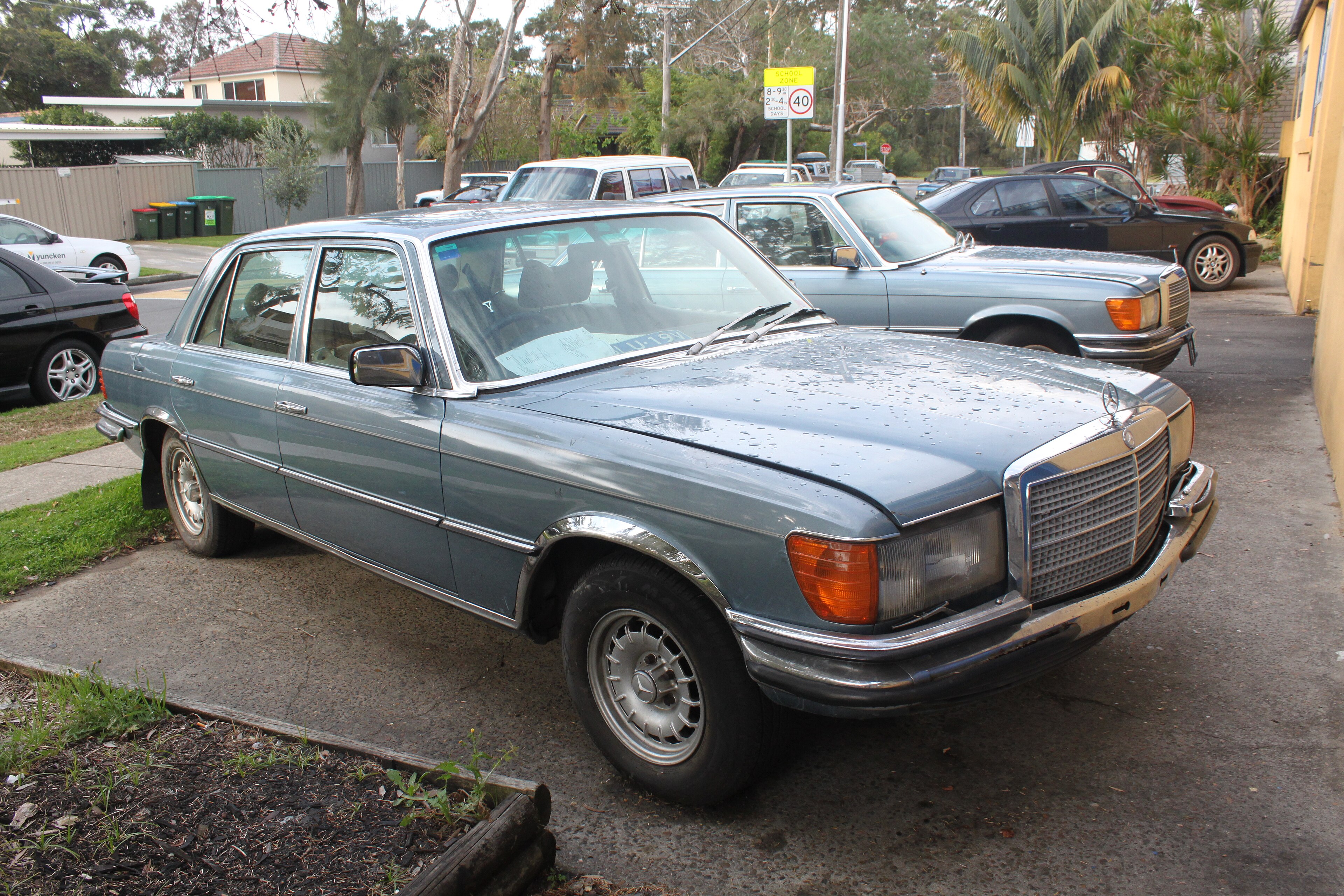
The W116 450SEL 6.9, type 116.036, entered pre-production in February 1975, with standard production beginning in September. Production ran to May 1980 and totalled 7,380 cars.2 Those two 1975 dates are sometimes presented as a contradiction; Mercedes uses them for different stages of manufacture.
Capacity grew to 6,834 cc. Mercedes records 286 hp (210 kW) and 56 mkg, delivered through a three-speed automatic.2 Despite the extra power and torque, the factory's 0-100 km/h figure is 7.4 seconds. Kerb weight had risen to 1,935 kg. Maximum speed edged up to 225 km/h.2 The later car traded some launch performance for a broader, more substantial package.
Suspension is one of the most important differences. The 6.9 did not simply repeat the 6.3's air-spring arrangement. Its specification lists coil springs with hydropneumatic struts and level control.2 The system maintained ride height and gave the W116 its particular blend of body control and ride, but age, leaks and incorrect repairs can turn that sophistication into a major ownership job.
Braking technology also moved on. Mercedes offered anti-lock braking as an option from December 1978.2 An ABS-equipped 6.9 therefore needs to be identified by build date and equipment, not by the assumption that every example has the system.
What the figures actually say
In factory data, the 6.3 has 155 kg less mass and reaches 100 km/h 0.9 seconds sooner. The 6.9 brings another 502 cc, a larger torque figure and five additional kilometres per hour at the top end.12 Different test conditions may affect any cross-era comparison, so these are best read as Mercedes' stated specifications, not the result of one back-to-back test.
Power units cause avoidable confusion. Period sources may quote DIN horsepower, SAE horsepower, PS, bhp or kilowatts and then round conversions. This page retains Mercedes' own units. The 286 hp/210 kW pairing for the 6.9 and the 250 hp figure for the 6.3 come from Mercedes' model records and should not be mixed with uncited SAE claims.12
On the road, condition can overwhelm the paper difference. Incorrect ride height, tired dampers, worn steering joints, poor tyres or an engine out of tune will change either car. A comparison between two restored examples is still a comparison between those examples. Service records and specialist inspection are the only sensible starting point.
Choosing between two kinds of flagship
The 300SEL 6.3 appeals through contrast: compact formal body, comparatively low mass and the 600's V8. Its four-speed automatic and air suspension belong to that original package. The 450SEL 6.9 is less of a surprise and more of a system. Its larger W116 body, greater torque, hydropneumatic level control and later safety technology make it feel like the engineered flagship of its own series.
Neither car should be reduced to a modern performance statistic. The 6.3 was the earlier shock; the 6.9 was the developed successor in concept, not a copy. The historical link is clear, but the mechanical difference is just as important. Buying either one means buying the suspension, fuel system, cooling hardware and decades of prior workmanship along with the M100 engine.
A pre-purchase comparison should therefore use two separate specialist reports, each written for the actual chassis. Ask the inspector to record ride height after standing, cold-start behaviour, fluid leaks, pressure-system operation, brake condition and evidence of previous conversion work. Originality has value, but a correctly rebuilt suspension with traceable invoices is more informative than untouched components whose condition is unknown. The archives define the cars; current records explain whether an individual example can still deliver that specification.
_6.9_sedan_(22053440410).jpg)
Sources and further reading
References supporting the reporting and practical context on this page.