
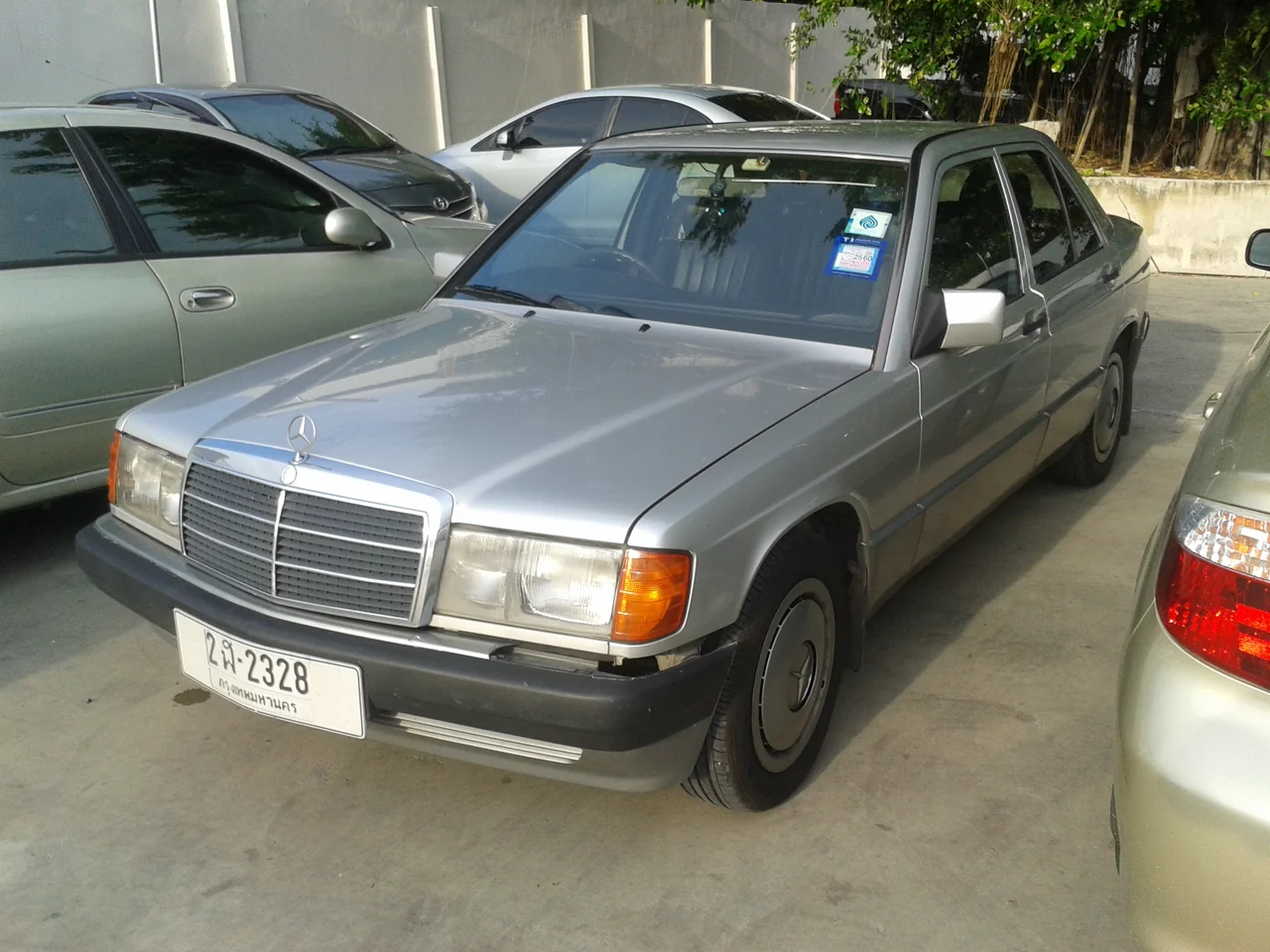
A compact Mercedes with several identities
The ordinary 190 E and the 16-valve cars appeal for different reasons. The standard saloon offers a compact expression of Mercedes' traditional design language, while the more specialised versions bring a stronger performance identity and additional systems to understand. It is a mistake to judge every four-cylinder 190 E only by how closely it resembles a 2.3-16 or 2.5-16.
We find the less elaborate cars interesting in their own right. Their proportions, glass area and restrained detailing can be appreciated without a body kit or a rare badge. A largely original example also gives a buyer a clearer starting point for checking equipment, trim and maintenance. Originality is useful evidence when documented; it is not a certificate of present condition.
A six-cylinder 2.6 adds another legitimate branch rather than serving as a universal upgrade recommendation. Accommodation, intended use, transmission preference and the condition of the specific car still decide the purchase. A buyer who wants a straightforward classic saloon may reasonably choose differently from one building a collection around homologation-era performance cars.
The best candidate is the one whose identity and needs can be explained plainly. Before paying extra for Sportline, AMG or a 16-valve description, establish what was actually built and what has subsequently changed. A convincing standard car can be a better starting point than an uncertain special-model claim.
The W201 family includes petrol 190 and 190 E models and separately badged 190 D diesels. This guide concentrates on the petrol 190 E, whose engines and equipment still vary substantially. Establish the exact car before comparing specifications or service needs.12
Mercedes-Benz introduced the 190 and 190 E in December 1982 and ended W201 production in 1993. Its archive splits the series into 1982–1988 and facelifted 1988–1993 phases.12
Early or facelifted?
The 1988 facelift brought body and interior changes, including revised bumpers and side protection strips with sill trims.2 These cues help orient a buyer, but they are not proof of build identity. Panels, bumpers and trim can be changed. Confirm the VIN, type and build data.
| Question | Useful evidence | Limit |
|---|---|---|
| Is it pre- or post-facelift? | Build record supported by physical details | Styling alone can be altered |
| Which engine is fitted? | Type, engine number and manufacturer data | Boot badge is not enough |
| Is it Australian-delivered? | Compliance and registration history | Overseas specifications may differ |
| Is a special-variant claim genuine? | Build identifiers, engine, trim, options and invoices | Appearance and seller description are not proof |
The original 190 E used Bosch KE-Jetronic mechanically and electronically controlled petrol injection, according to Mercedes-Benz’s history.1 Poor starting, uneven running or hesitation can have several causes. Do not convert a symptom into a universal diagnosis or a one-part shopping list.
Three useful variant branches
The archive records below show why exact type matters. They are global manufacturer examples, not a complete list of Australian deliveries.
| Variant record | Type and engine | Inspection emphasis |
|---|---|---|
| 190 E 1.8 | Type 201.018, M 102.910 | Verify market equipment; archive lists ABS as optional, standard from October 19923 |
| 190 E 2.6 | Type 201.029, M 103.942 inline-six | Confirm transmission and six-cylinder-specific maintenance history4 |
| 190 E 2.5-16 | Type 201.035, M 102.990 | Verify identity and inspect model-specific rear hydropneumatic level control5 |
The 2.6 archive lists both manual and automatic transmissions.4 The 2.5-16 is not simply an ordinary four-cylinder 190 E with cosmetic changes. Its identity, condition and rear suspension need specialist attention.5 Sportline, AMG or 16-valve claims should be tested against build data and physical evidence rather than accepted from badges or body-kit parts.
Inspection before the road test
Arrange to see the engine cold. Check the VIN and engine number against registration and records before spending time on cosmetics.
- Examine the body and underside for corrosion, water entry and previous repair.
- Ask a specialist to inspect structural areas, suspension mounting points and repair quality.
- Check tyres, brakes, steering, suspension and driveline.
- Confirm which warning lamps should be present for the build.
- Watch the ABS, SRS and other lamps perform their bulb check where fitted.
- Look for leaks and unsafe fuel-system work.
- Test fitted climate, window, lock, sunroof and lighting functions.
Fuel-pressure and ignition diagnosis involves fire and electrical hazards. Hydropneumatic systems and springs store energy. Those jobs belong with a specialist using the correct procedure.
Cold, hot and road-test checks
A road test should follow a basic safety inspection. Start cold, continue to normal operating temperature, then check hot restart.
Record whether the engine starts, idles and accelerates cleanly. Note smoke, abnormal noise, warning lights or temperature instability. Assess transmission selection and shifting, steering response, brake feel and suspension behaviour. These observations tell the specialist where to investigate; they do not establish a failed component.
| Observation | Buyer response |
|---|---|
| Clean behaviour with coherent service evidence | Continue to independent inspection |
| Poor cold or hot running | Obtain fuel/ignition diagnosis before negotiating |
| Warning lamp absent during bulb check or remaining on | Diagnose the exact system; do not call it minor |
| Rear ride-height concern on a 2.5-16 | Stop guessing and use a hydropneumatic-system specialist |
| Modified engine, suspension or body | Ask for parts, tuning and approval records |
Paper trail, with Australian checks
Line up invoices by date and odometer. Look for specific parts, products and work, especially where the engine, fuel system, transmission or special suspension has been repaired. A general stamp cannot explain a major conversion or support an authenticity claim.
Run a current PPSR/NEVDIS search using the vehicle’s VIN. The Australian Government service can identify registered security interests and provide stolen and written-off information.6 Match the result to the car and retain the certificate.
Australian-delivered equipment may differ from German archive specifications, while private imports add another branch to the research. No rarity or value premium can be safely inferred here. Live market evidence and verified authenticity would be needed for that.
An exotic badge should not outrank a sound shell, understood mechanical condition and coherent history. Keep the written specialist report with the purchase file; it records what was actually checked rather than relying on the model's reputation.
Sources and further reading
References supporting the reporting and practical context on this page.